Future or present value of regular payments — for savings plans, pensions and loans.
Results are estimates for planning purposes and are not financial, medical, or professional advice.
How to Use the Annuity Calculator
An annuity is a series of equal payments at regular intervals — behind retirement savings and pensions. This calculator shows what regular payments grow into, and what a payment stream is worth today.
- Enter the payment you make or receive each period.
- Enter the annual rate, such as 7 for 7 percent.
- Enter the number of payments — 360 for monthly payments over 30 years.
- Choose end or beginning of period, then press Calculate to see both values plus total paid in.
Annuity Calculator Formula
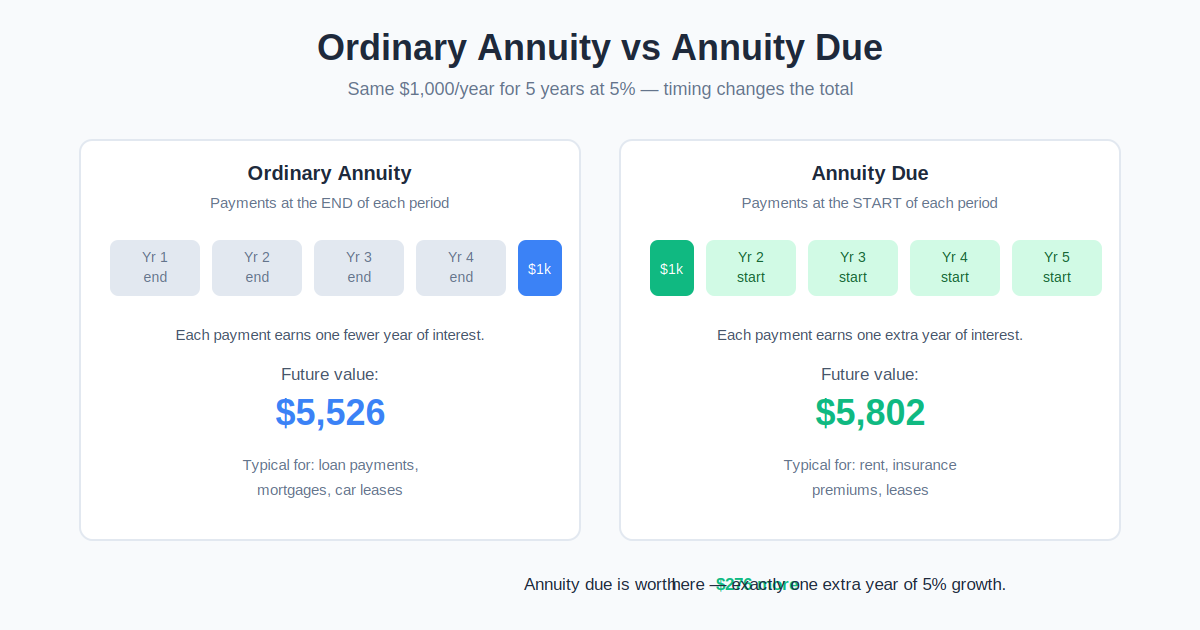
The calculator uses a monthly rate: r is the annual rate divided by 12, and n is the number of payments. The future value of an ordinary annuity is FV = PMT × ((1 + r)^n − 1) ÷ r, and the present value is PV = PMT × (1 − (1 + r)^−n) ÷ r, where PMT is the payment per period. For an annuity due, with payments at the start of each period, both results are multiplied by (1 + r), giving each payment one extra period of interest.
Example Calculation
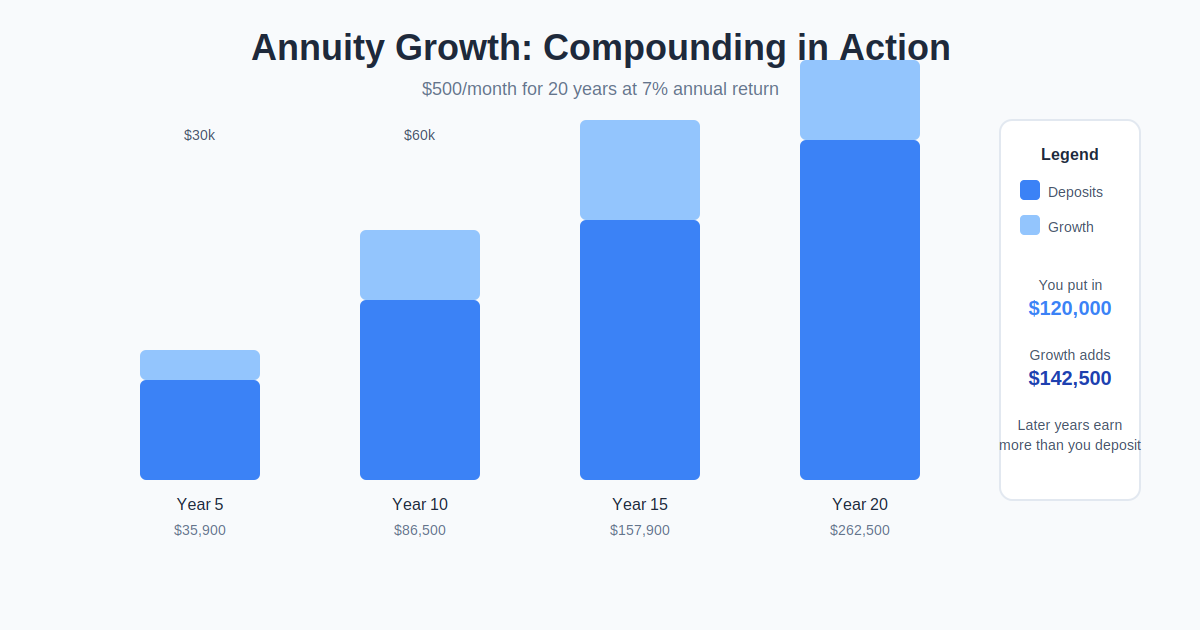
Invest 500 dollars monthly for 30 years at 7 percent: the monthly rate is 0.07 ÷ 12 ≈ 0.005833, so with 360 payments FV = 500 × ((1.005833)^360 − 1) ÷ 0.005833 = 609,985.50 dollars. Your 180,000 dollars of payments grew by 429,986 dollars.
In reverse, 500 dollars monthly for 20 years at 6 percent is worth PV = 500 × (1 − (1.005)^−240) ÷ 0.005 = 69,790.39 dollars today — the math behind pension lump-sum offers.
Types of Annuities
Annuities are immediate (paying soon after purchase) or deferred (building value), and fixed (set rate), variable (market-based) or indexed (index-linked). This calculator models the fixed case.
Payout From a Lump Sum
Rearranging the present value formula gives the payment: PMT = PV × r ÷ (1 − (1 + r)^−n). At 6 percent over 240 payments, a 100,000 dollar lump sum supports 716.43 dollars a month — test payouts by adjusting the payment until the present value matches your lump sum.
Frequently Asked Questions
What is the difference between an ordinary annuity and an annuity due?
In an ordinary annuity, payments fall at the end of each period, like a typical loan payment. In an annuity due they fall at the beginning, like rent, earning one extra period of growth.
How does an annuity calculator help with retirement planning?
It turns a savings habit into a projected nest egg. Test different amounts, rates and time spans to find the contribution your target needs.
What interest rate should I assume?
A conservative long-term estimate: 6 to 7 percent for stock-heavy portfolios, 3 to 4 percent for bond-heavy ones, adjusted for inflation.
Can an annuity calculator handle growing payments?
An annuity assumes fixed payments. For rising contributions, run the calculation in yearly segments or use a growing-annuity formula.
Is the future value guaranteed?
No — it assumes a constant rate of return, while real investments fluctuate. Treat it as a planning estimate, not a promise.
What are the main types of annuities?
Fixed, variable and indexed, each sold as immediate or deferred. Fixed pays a set rate; the others follow investments or a market index.
How do I find the monthly payout from a lump sum?
Rearrange the present value formula: PMT = PV × r ÷ (1 − (1 + r)^−n). At 6 percent over 20 years, 100,000 dollars pays 716.43 dollars a month.
Related Calculators
Try our Compound Interest Calculator and Present Value Calculator for more financial planning tools.