Convert between nine area units — square inches, square feet, square yards, square meters, square centimeters, square kilometers, acres, hectares and square miles — using exact conversion factors. The converter is built around the question land buyers and homeowners ask most, how to convert square feet to acres, but every pair of units works in both directions. The table below the result shows your amount in all nine units at once, so you never have to run a second conversion to compare a listing written in hectares with a deed written in square feet.
Your amount in every unit
| Unit | Value |
|---|
All conversions run through square meters using exact defined factors, for example 1 acre = 4,046.8564224 square meters and 1 square foot = 0.09290304 square meters. Results are rounded to at most four decimal places.
How to Use This Area Converter
- Enter the amount you already have. It can come from a deed, a listing, a floor plan or your own length times width calculation. The converter starts at 1 acre so you can see the headline conversion straight away.
- Choose the From and To units. There are nine units covering everything from a tile measured in square centimeters to a ranch measured in square miles. Results update live as you type or change a unit; there is no Convert button.
- Use Swap to reverse the direction. The Swap button exchanges the two units, which is the quickest way to check a conversion both ways, for example acres to square feet after square feet to acres.
- Read the all-units table. Under the main result, the same amount is shown in every unit at once. That is the fastest way to compare documents that use different units, such as a listing in acres, a survey in square feet and a tax record in hectares.
Square Feet, Acres and Hectares: What Each Unit Really Means
The square foot is the working unit of homes and small lots in the United States: one square foot is the area of a square one foot on each side, and rooms, houses and building plots are quoted in it. It is a comfortable size for a house, but it becomes unwieldy for land. A modest farm written in square feet runs to seven figures, which is exactly why larger units exist.
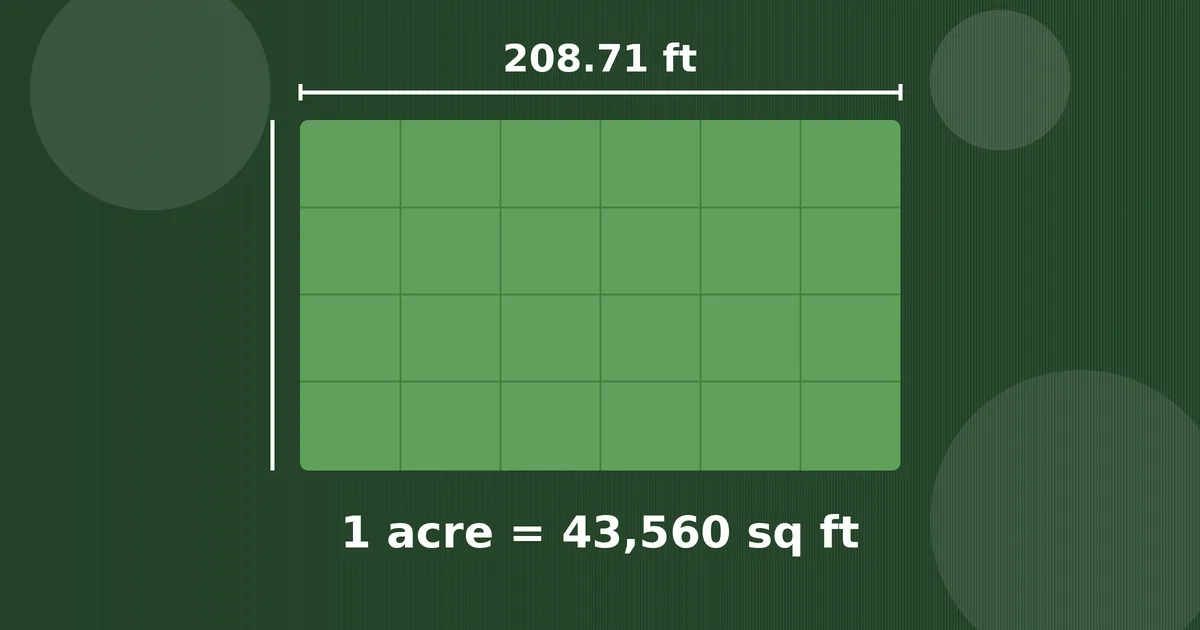
The acre is the traditional land unit, defined today as exactly 43,560 square feet. Its shape comes from old field strips: one chain wide (66 feet) by one furlong long (660 feet), and 66 multiplied by 660 gives the 43,560 figure. An acre does not have to be that shape, or any particular shape; if it were a perfect square it would measure about 208.71 feet on each side. A useful picture is an American football field: an acre is about 91 percent of the field measured from goal line to goal line, without the end zones. Most suburban lots are fractions of an acre, commonly between an eighth and a half.
The hectare is the metric answer to the same problem. It is a square 100 meters on each side, so exactly 10,000 square meters, and it is the standard land unit across most of the world for farms, forests and development sites. One hectare equals 2.4711 acres, so the two units are similar in scale but far from interchangeable. Above both sit the square kilometer and the square mile, used for towns, ranches, parks and wildfire reports; one square mile is exactly 640 acres, a relationship built into the United States survey system, where a square mile forms a section that divides into quarter sections of 160 acres.
The Formula Behind Area Conversion
Every conversion in this tool passes through square meters, the shared reference unit. Each unit has an exact factor stating how many square meters it contains, and converting is one multiplication followed by one division:
Result = amount × factor of the From unit ÷ factor of the To unit
Acres = square feet ÷ 43,560
Square feet = acres × 43,560
Acres = hectares × 2.4711 (exactly 10,000 ÷ 4,046.8564224)
The square feet and acres pair is the one to memorize, because it covers most deeds and listings: divide by 43,560 going up to acres, multiply by 43,560 coming back down. If you are starting from measurements rather than a finished area, multiply length by width first to get square feet, then convert. A plot 50 feet wide by 100 feet deep is 50 × 100 = 5,000 square feet before any conversion happens. One warning hides in the math: area factors are squares of length factors. A meter is 3.28084 feet, but a square meter is 3.28084 squared, which is 10.7639 square feet, and using the smaller number is one of the most common conversion errors there is.
Fractions of an Acre in Square Feet
Listings love fractions — a quarter-acre lot, half an acre, three quarters — while deeds and surveys speak in square feet. This table connects the two, with square meters for metric documents.
| Acres | Square feet | Square meters |
|---|---|---|
| 0.1 acre | 4,356 | 404.69 |
| 0.25 acre (quarter acre) | 10,890 | 1,011.71 |
| 0.5 acre (half acre) | 21,780 | 2,023.43 |
| 0.75 acre | 32,670 | 3,035.14 |
| 1 acre | 43,560 | 4,046.86 |
| 2 acres | 87,120 | 8,093.71 |
| 5 acres | 217,800 | 20,234.28 |
| 10 acres | 435,600 | 40,468.56 |
Worked Examples
A 5,000 square foot lot, in acres. Divide by 43,560: 5,000 ÷ 43,560 = 0.1148 acres. That is a compact suburban lot, a little under an eighth of an acre, and it shows why listings round so aggressively: 0.1148 acres and a claimed quarter acre are very different amounts of land.
2.5 acres, in square feet. Multiply by 43,560: 2.5 × 43,560 = 108,900 square feet. This is the direction surveyors and fencing or sod suppliers need, because materials are ordered against square footage, not acreage.
3 hectares, in acres and square meters. A hectare is 10,000 square meters by definition, so 3 hectares is 30,000 square meters. In acres, 3 × 2.4711 = 7.4132 acres. A European farm listing of 3 hectares is therefore a property of well over 7 acres, not the 3 acres a quick glance might suggest.
A 100 square meter apartment, in square feet. Using the factor method, 100 × 1 ÷ 0.09290304 = 1,076.39 square feet. International listings quote apartments in square meters, and this conversion is the one that lets a buyer compare them with local listings honestly.
1.5 square miles of ranch land, in acres. One square mile is 640 acres, so 1.5 × 640 = 960 acres. At this scale, square feet stop being useful altogether: the same ranch is 41,817,600 square feet, a number nobody can picture.
Common Mistakes to Avoid
- Confusing feet with square feet. Feet measure a line; square feet measure a surface. A lot described as 200 feet wide has no area until you also know its depth, and no conversion can rescue a missing dimension.
- Using a length factor for an area. Converting square meters to square feet with 3.28084 instead of 10.7639 understates the area by more than two thirds. Area factors are always the length factor squared.
- Treating acres and hectares as the same unit. A hectare is about 2.47 times an acre. Reading a hectare figure as acres shrinks a property on paper by nearly 60 percent, an expensive mistake in a purchase or a lease.
- Rounding 43,560 in serious paperwork. Dividing by 44,000 is fine for a rough guess, but on a 100,000 square foot parcel it misstates the land by about a full percent. Use the exact figure for prices, taxes and legal documents.
- Assuming the lot is a neat rectangle. Real parcels have angled boundaries, easements, setbacks and road frontage. The deed area is the legal figure; the usable area can be smaller, and a survey beats a tape measure for anything irregular.
- Comparing price per acre across different units. A cheaper-looking price per hectare is usually just the bigger unit at work. Convert every offer to the same unit before judging which land is actually cheaper.
More Tools on This Site
If you still need the square footage itself, the Square Footage Calculator multiplies length and width for rooms and plots, after which this converter can express the result in acres or hectares. The Surface Area Calculator does a different job: it finds the outside surface of three-dimensional shapes such as boxes, cylinders and spheres, rather than converting land units. For the measurements themselves, the Length Converter moves between feet, meters, yards and miles. Once an area is settled, the Carpet Calculator, Flooring Calculator and Sod Calculator turn it into the materials a project actually needs.
Frequently Asked Questions
How many square feet are in an acre?
Exactly 43,560. An acre was defined as a strip 66 feet wide by 660 feet long, and 66 multiplied by 660 is 43,560. The shape does not matter: any plot whose length multiplied by its width totals 43,560 square feet is one acre.
How do I convert square feet to acres?
Divide the square feet by 43,560. For example, 10,000 square feet divided by 43,560 is 0.2296 acres. To go the other way, multiply acres by 43,560: 2.5 acres is 108,900 square feet. The converter above does both directions and shows every other unit at the same time.
How big is an acre in real life?
Picture a square about 208.71 feet on each side, or about 91 percent of an American football field measured from goal line to goal line, end zones excluded. A typical suburban house lot of 5,000 to 10,000 square feet is roughly an eighth to a quarter of an acre.
Which is bigger, an acre or a hectare?
A hectare is bigger. One hectare is 10,000 square meters, which is 2.4711 acres, while one acre is 0.4047 hectares. Mixing the two up understates or overstates land by almost two and a half times, so always check which unit a listing or document is using.
How many acres are in a square mile?
Exactly 640. The square mile is the surveyor section in the United States land system, and it divides neatly into 640 acres, then into quarter sections of 160 acres. In metric terms one square mile is about 2.59 square kilometers or 259 hectares.
How do I work out the area of an irregularly shaped lot?
Split the shape on paper into rectangles and triangles you can measure. Work out each part in square feet (length times width for rectangles, half of base times height for triangles), add the parts together, then divide the total by 43,560 for acres. For curved or many-sided boundaries, a county GIS map or a licensed surveyor will be more reliable.