How big should your safety net be? Set your target and see how close you are.
Results are estimates for planning purposes and are not financial, medical, or professional advice.
How to Use the Emergency Fund Calculator
An emergency fund is cash set aside for surprises like job loss, car repairs, or medical bills. This calculator shows your target fund size based on your monthly spending, how far your current savings go, and how much to save each month to close the gap.
- Enter your total monthly expenses, including rent, food, transport, insurance, and minimum debt payments.
- Choose how many months of coverage you want. Three months is the minimum, six months is the classic target.
- Enter what you have already saved in an emergency fund.
- Pick a timeline, such as 12 months, and the calculator shows the monthly savings needed to reach your goal.
Emergency Fund Calculator Formula
The target is your monthly expenses multiplied by the number of months you want covered. The gap is that target minus your current savings. Divide the gap by your timeline in months to get the monthly savings amount that gets you there on schedule.
Target fund = monthly expenses x months of coverage. Savings gap = target fund minus current savings. Monthly savings needed = savings gap divided by months in your timeline.
Example Calculation
Say your monthly expenses total 3,500 dollars and you want six months of coverage. Your target fund is 3,500 x 6 = 21,000 dollars. If you already have 8,000 dollars saved, your gap is 13,000 dollars.
To close that gap in 12 months, you need to save 13,000 divided by 12 = 1,083 dollars per month. Stretch the timeline to 18 months and it drops to about 722 dollars per month, which may fit your budget more comfortably.

Frequently Asked Questions
How many months of expenses should my emergency fund cover?
Three to six months is the standard advice. Choose three if you have stable income and low risk, six if you are self-employed or the sole earner, and nine to twelve if your income is highly variable.
Where should I keep my emergency fund?
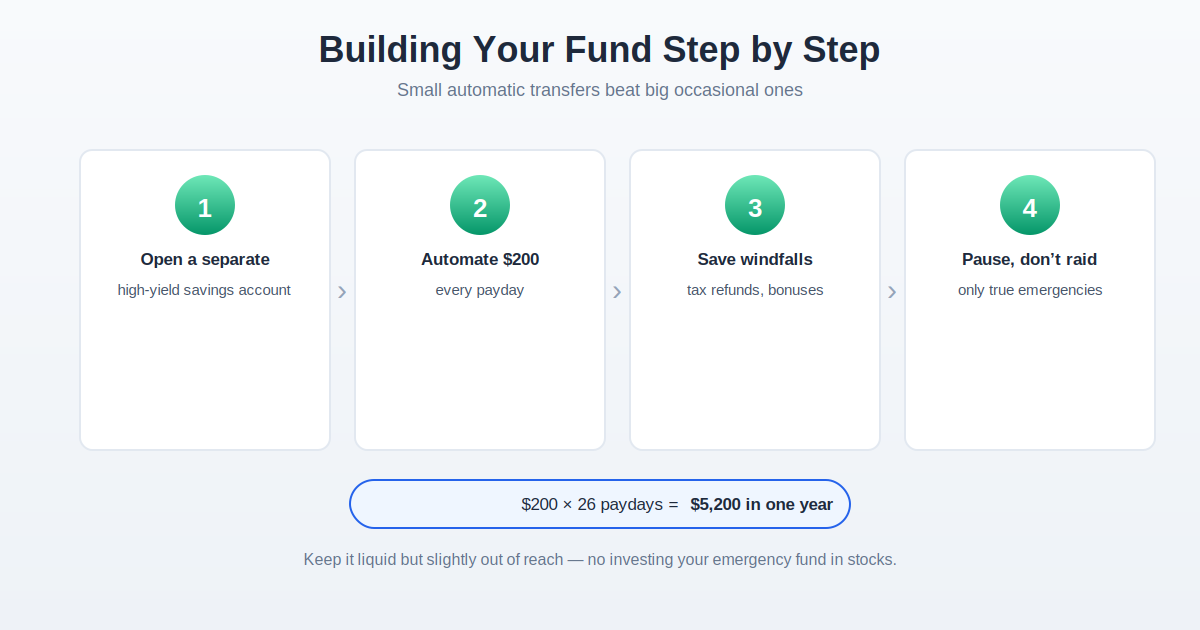
Use a high-yield savings account that is separate from your checking account. It stays liquid for true emergencies, earns some interest, and the separation keeps you from spending it on non-emergencies.
What counts as a real emergency?
Job loss, urgent car repairs, medical bills, and essential home repairs count. Vacations, holiday shopping, and sale items do not. If you have to ask whether it is an emergency, it probably is not one.
Should I build an emergency fund or pay off debt first?
Do both in stages. Save a starter fund of about 1,000 dollars first, then attack high-interest debt, then grow the fund to three to six months of expenses. This keeps one surprise from forcing you back into debt.
Can my emergency fund be too big?
Yes. Cash beyond twelve months of expenses loses purchasing power to inflation. Once your fund is full, direct extra savings toward retirement accounts or other investments where the money can grow faster.
Should I include loan payments and EMIs in my monthly expenses?
Yes. Loan payments are the least flexible expense you have — a mortgage or car loan does not pause when your income does. Including your minimum debt payments keeps the target honest; leaving them out makes the fund look sufficient while it quietly drains months faster than planned.
Related Calculators
Keep building your financial safety net with our Compound Interest Calculator to see your savings grow, and our Net Worth Calculator to track your overall financial picture.