Enter any 3 known sides/angles and get the rest — plus area and perimeter.
Results are estimates for planning purposes and are not financial, medical, or professional advice.
How to Use the Triangle Calculator
Give this calculator any three pieces of a triangle and it solves for the rest: the remaining sides, all three angles, area, and perimeter.
- Enter the values you know – three side lengths is the most common case.
- Respect the triangle inequality: the sum of any two sides must exceed the third.
- Click Calculate.
- Review missing sides, angles, area, and perimeter.
Triangle Calculator Formula
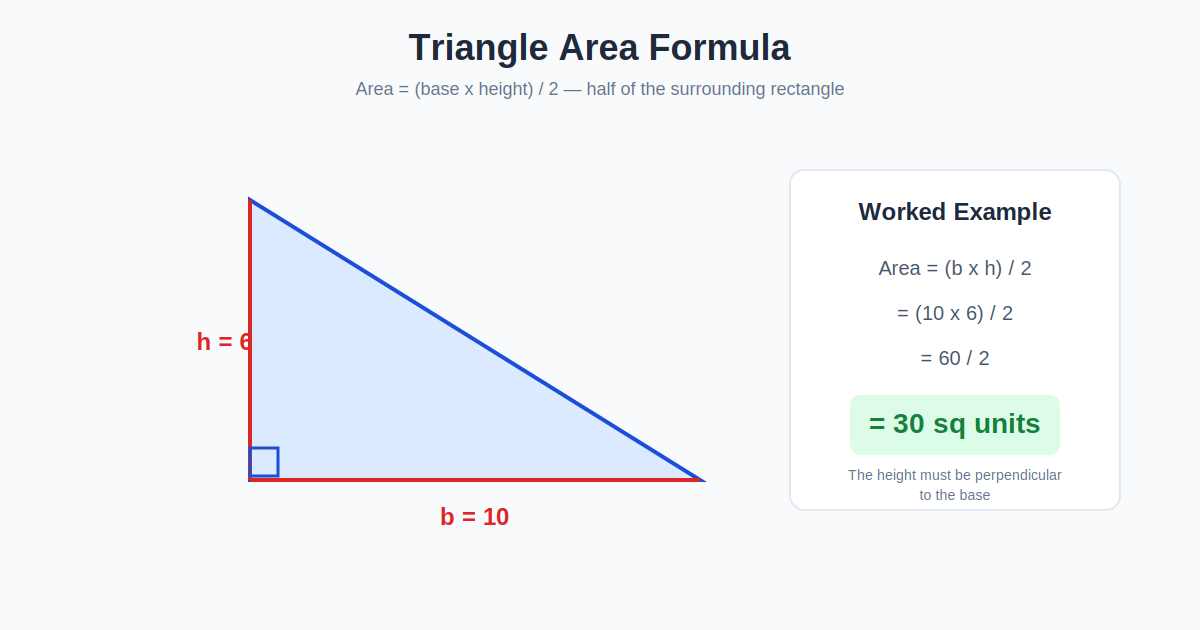
Several formulas work together. Perimeter is a plus b plus c, and area is one-half times base times height when the height is known. With three sides, it uses Heron’s formula: with the semiperimeter s equal to (a plus b plus c) divided by 2, area is the square root of (s times (s minus a) times (s minus b) times (s minus c)). Unknowns come from the law of cosines – c squared equals a squared plus b squared minus 2ab times cos(C) – and from the law of sines, a divided by sin(A) equals b divided by sin(B) equals c divided by sin(C).
Which Combination Solves Your Triangle?
Your three inputs decide the method. With three sides (SSS), the law of cosines recovers every angle; with two sides and the included angle (SAS), it finds the third side first. With two angles and any side (ASA or AAS), the third angle follows from the 180 degree sum, and the law of sines sets the size. Two cases need care: two sides with a non-included angle (SSA) can describe two different triangles, and three angles alone (AAA) fix only the shape, never the size – at least one side is always required.
Example Calculation
Take a triangle with sides 5, 6, and 7. The semiperimeter is 9, so Heron’s formula gives the square root of (9 times 4 times 3 times 2) – the square root of 216, about 14.70 square units. The law of cosines adds the angles: about 44.42, 57.12, and 78.46 degrees. Enter the three sides to confirm everything at once.

Frequently Asked Questions
What do SSS, SAS, and ASA mean?
They describe which three measurements fix a triangle: three sides, two sides and the included angle, or two angles and the included side.
When should I use Heron’s formula?
When you know all three sides but not the height – it is the only area formula that needs no angle or altitude.
What is the triangle inequality rule?
Any two sides must sum to more than the third. If not, the shape cannot close, and the calculator flags the inputs.
How are triangles classified?
By sides: equilateral, isosceles, or scalene. By angles: acute, right, or obtuse – a triangle can be both, like an isosceles right triangle.
Can this calculator solve right triangles too?
Yes. Enter the two legs, or the hypotenuse plus one leg, and it returns the rest. For pure right triangles, the Pythagorean theorem calculator is quicker.
Why are two sides and a non-included angle (SSA) a problem?
Because it is ambiguous: the same two sides and non-included angle can describe two different triangles. Enter the included angle between the two sides instead.
How can I tell if a triangle is a right triangle from its sides?
Check the longest side: if its square equals the sum of the other two squares, the opposite angle is 90 degrees. The 3-4-5 triangle passes, since 9 plus 16 equals 25.
Related Calculators
Try our Pythagorean Theorem Calculator, Right Triangle Calculator and Square Footage Calculator for geometry tools.