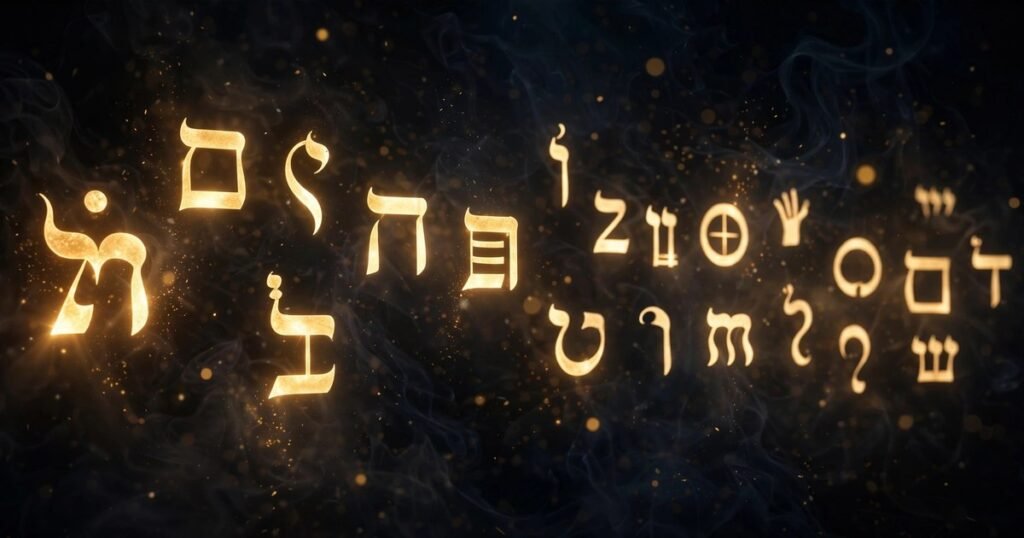
What If Words Had Hidden Totals?
Gematria is the old practice of giving every letter a number and adding them up — turning a word into a total you can compare, ponder, and play with. Type “light” into the calculator below and you’ll get four different totals at once: 56 in English Ordinal, 29 in Full Reduction, 79 in Reverse Ordinal, and 57 in Hebrew. Same word, four lenses.
The idea goes back a long way: Hebrew scribes noticed that words sharing a value seemed connected — the famous example is chai (חי, “life”), which totals 18, the reason gifts are so often given in multiples of 18. This free gematria calculator does the arithmetic for you in four classic ciphers, with a letter-by-letter breakdown so you can see exactly where every number comes from.
English ordinal · Full reduction · Reverse ordinal · Hebrew
Please enter at least one letter to calculate.
Gematria values
for “”
Letter-by-letter breakdown
| Letter | Ordinal | Reduction | Reverse | Hebrew |
|---|
Hebrew transliteration: sh=300, ch=8, th=400, tz=90, kh=20, ph=80 — vowels a=1, e=5, i/y=10, o/u/w=6. Transliteration is approximate; Hebrew script gives exact values.
For curiosity and entertainment — matching totals don’t prove a hidden connection between words. Spelling changes the value, so double-check your letters.
How to Use This Calculator
- Type any word or phrase into the text field — names, words, or whole sentences all work.
- Using Hebrew? Type or paste Hebrew letters directly (א to ת, final forms included), or use transliteration: sh=300, ch=8, th=400, tz=90, kh=20, ph=80.
- Click Calculate Gematria — you’ll get all four cipher values at once, each with its digital root.
- Check the breakdown table to see each letter’s contribution per cipher, plus the totals.
What Is Gematria?
Gematria is an alphanumeric code: each letter of an alphabet carries a fixed number, so every word has a total. The practice grew up in the Hebrew scribal tradition — the word “gematria” itself likely comes from the Greek geometria — and it runs through rabbinic literature and Kabbalah, where two words with the same value were read as meaningfully linked.
The Hebrews weren’t alone. The Greeks had isopsephy (same idea, Greek letters), Arabic developed the abjad numeral system, and English picked up its own ciphers much later. Today gematria survives as a tool for textual study, wordplay, puzzles, and plain curiosity — which is exactly what this calculator is for.
The Four Ciphers Explained
| Cipher | How it works | Best for |
|---|---|---|
| English Ordinal | A=1, B=2 … Z=26, then summed | The standard English starting point |
| Full Reduction | Each letter reduced to one digit: A=1…I=9, J=1…R=9, S=1…Z=8 | Compact totals, numerology-style |
| Reverse Ordinal | The mirror alphabet: Z=1 … A=26 | A second English lens on the same word |
| Hebrew · Mispar Hechrechi | The standard count: א=1…י=10, כ=20…ק=100, ר=200, ש=300, ת=400 | Authentic Hebrew values, incl. transliteration |
Worked example: “light”
Full Reduction: 3 + 9 + 7 + 8 + 2 = 29
Reverse Ordinal: 15 + 18 + 20 + 19 + 7 = 79
Hebrew (transliterated): l(30) + i(10) + g(3) + h(5) + t(9) = 57
Notice how the reduction cipher shrinks each letter to a single digit first (L=12 becomes 3, t=20 becomes 2), while the reverse cipher flips the alphabet entirely. Same five letters, three very different English totals — plus the Hebrew reading on top.
Famous Values and Matched Pairs
Gematria becomes interesting the moment two words share a total — the whole tradition treats a matching value as a possible connection. A few of the classics that commentaries cite again and again:
- אהבה (ahavah, “love”) = 13 — 1 + 5 + 2 + 5. And אחד (echad, “one”) = 13 — 1 + 8 + 4. “Love” and “one” sharing a number is one of the most-quoted pairings in the tradition.
- יהוה (the Divine Name) = 26 — 10 + 5 + 6 + 5, one of the first values any student of Hebrew gematria memorizes.
- משיח (mashiach, “messiah”) = 358 — 40 + 300 + 10 + 8 — and נחש (nachash, “serpent”) = 358 — 50 + 8 + 300. The identical totals of these two words are among the most famous gematria observations in rabbinic literature.
- “Jesus” in English Ordinal = 74 — 10 + 5 + 19 + 21 + 19, the best-known English-gematria touchstone.
One reason these totals are fun to test in the calculator above: switch ciphers and the pairings vanish. Love and one only match in Hebrew — run the English words through Ordinal and you get different numbers entirely, because each cipher defines its own letter values. Matches are meaningful only inside a single method, which is also why some other calculators give different totals for the same Hebrew word: many Hebrew tools use Mispar Gadol, where final letter forms continue the alphabet at 500–900 (so a final mem ם counts 600). This page uses the standard Mispar Hechrechi, where final forms keep their base values (final mem = 40) — the most widely cited convention.
Who This Calculator Is For
- Students of religion and history checking the gematria values cited in commentaries and texts.
- Writers and puzzle-makers hiding numerical patterns in names, titles, and riddles.
- Name enthusiasts comparing the values of names across the four ciphers.
- The simply curious — type any word and see what the numbers say.
A note on transliteration
Hebrew written in Latin letters is always a little approximate, because several Hebrew letters share one Latin letter. The calculator uses a common scheme (shown under the results) and flags it as approximate. For exact, authoritative values, type or paste the actual Hebrew letters — the tool reads Unicode Hebrew including all five final forms (ךםןףץ).
Frequently Asked Questions
What is gematria?
Gematria is a system that assigns a fixed number to each letter of an alphabet, so every word or phrase has a numerical total. It originated in the Hebrew scribal tradition and appears in rabbinic literature and Kabbalah, where words sharing a value were read as connected in meaning.
How does this gematria calculator work?
Type a word or phrase and click Calculate. The tool assigns each letter its value in four ciphers — English Ordinal, Full Reduction, Reverse Ordinal, and Hebrew Mispar Hechrechi — and sums them. A breakdown table shows every letter’s contribution so you can verify the math yourself.
What are the four ciphers?
English Ordinal (A=1…Z=26), Full Reduction (every letter collapsed to a single digit, 1–9), Reverse Ordinal (Z=1…A=26, the mirror alphabet), and Hebrew Mispar Hechrechi (the standard Hebrew count, א=1 through ת=400).
What is Mispar Hechrechi?
It’s the standard Hebrew gematria: א through י are 1–10, כ through ק go by tens (20–100), and ר, ש, ת are 200, 300, 400. Final letter forms (ךםןףץ) carry the same values as their non-final versions. Unless a source says otherwise, “gematria” means this count.
Can I type Hebrew letters directly?
Yes. The calculator accepts Unicode Hebrew (א to ת, including final forms) and transliterated Hebrew typed in Latin letters. Transliteration follows a documented scheme (sh=300, ch=8, th=400, tz=90, kh=20, ph=80) and is approximate — Hebrew script gives exact values.
Is gematria the same as numerology?
They’re cousins, not twins. Numerology usually reduces everything to single digits and interprets them as personality or destiny readings. Gematria is older and text-focused: it’s about comparing the totals of words, especially in Hebrew scripture and commentary, rather than profiling people.
Do matching gematria values prove a hidden connection?
No — and that’s worth saying plainly. A shared total is a curiosity, a starting point for study or a neat piece of wordplay, not evidence of a secret meaning. Spelling alone changes the value, so small variations produce different totals. Enjoy the patterns; don’t build beliefs on them.
Why do different gematria calculators give different totals for the same word?
Because they use different methods. English calculators vary by cipher (Ordinal vs Sumerian vs Jewish), and Hebrew calculators differ on how they treat final letter forms: Mispar Hechrechi keeps their base values, while Mispar Gadol counts them as 500–900. Totals are only comparable within one method, so always check which cipher a calculator is running.
Do spaces, numbers, and punctuation count in gematria?
No — this calculator only totals the letters A–Z and Hebrew א–ת. Spaces, digits, punctuation, and other scripts contribute nothing; repeated letters count every time. Accented Latin letters are treated as their base letter.
Final Thoughts
Gematria won’t reveal your destiny — but it’s a wonderful lens for playing with language. Type a favorite word, a name, or a line you love, and watch four different numbering traditions weigh it. Compare totals, argue with the spellings, and check the breakdown when a number surprises you. That’s the whole game, and it’s been entertaining curious minds for centuries.
Playing With Numbers?
Explore number patterns with our Fibonacci calculator and roll random values with our random number generator.