A right triangle calculator is the fastest way to solve a right triangle when you know only part of it. A right triangle has one 90-degree angle, and that single fact unlocks the entire shape: give the calculator any two known values — two sides, or one side plus one acute angle — and it returns everything else. All three sides, both acute angles, the area, and the perimeter appear instantly, with no manual trigonometry required.
This tool is built for students checking geometry homework, builders laying out a square corner, and anyone who needs a quick hypotenuse calculator without reaching for formulas. It uses standard triangle notation throughout: the right angle sits at vertex C, the hypotenuse is side c, side a sits opposite angle A, and side b sits opposite angle B. Enter your two known values, press solve, and the full triangle is laid out in front of you.
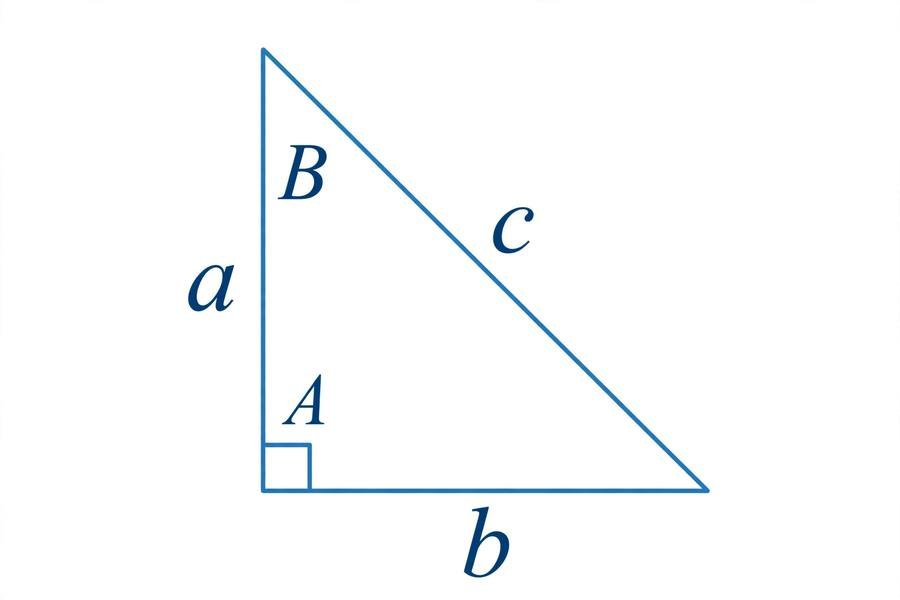
How to Use the Right Triangle Calculator
Solving a triangle takes four short steps:
- Pick the pair you know. Open the dropdown and choose the two values you have, for example “Sides a and b (the two legs)” or “Hypotenuse c and angle A”. There are nine combinations, covering every solvable case.
- Enter the numbers. Type the two values into the labeled boxes. Angles go in as degrees — there is no need to convert to radians yourself.
- Press “Solve Triangle”. The calculator applies the Pythagorean theorem and the sine, cosine, and tangent ratios in the background.
- Read the full solution. The results table shows side a, side b, hypotenuse c, angles A and B, the area, and the perimeter, each rounded sensibly.
Two rules keep results meaningful. Every input must be greater than zero, and any angle you enter must be strictly between 0 and 90 degrees — a right triangle has exactly one right angle, so the other two must be acute. If you enter a hypotenuse that is shorter than a leg, the calculator flags the error instead of producing nonsense, because the hypotenuse is always the longest side.
The Formulas Behind the Calculator
Every result comes from two classical ideas: the Pythagorean theorem and the trigonometric ratios. Understanding them helps you trust the answers and spot mistakes in your own inputs.
Pythagorean theorem
For any right triangle, the square of the hypotenuse equals the sum of the squares of the legs:
a² + b² = c²
This single equation finds a missing side whenever two sides are known. Rearranged, it gives c = √(a² + b²) when you know both legs, or a = √(c² − b²) when you know the hypotenuse and one leg. It is the same formula that powers any dedicated Pythagorean theorem calculator.
Sine, cosine, and tangent
When an angle is involved, the calculator uses SOH-CAH-TOA relative to an acute angle:
- sin(A) = opposite / hypotenuse = a / c
- cos(A) = adjacent / hypotenuse = b / c
- tan(A) = opposite / adjacent = a / b
Given one side and one acute angle, these ratios pin down every remaining side. The second acute angle follows immediately because the two acute angles of a right triangle always add to 90 degrees: B = 90° − A. The calculator converts your degrees to radians internally, since JavaScript math functions expect radians, then converts back for display.
Area and perimeter
Area = (a × b) / 2 — the legs act as base and height, and the triangle is exactly half of the rectangle they form. Perimeter = a + b + c, the simple sum of the three sides.
Worked Examples
Example 1: the classic 3-4-5 triangle
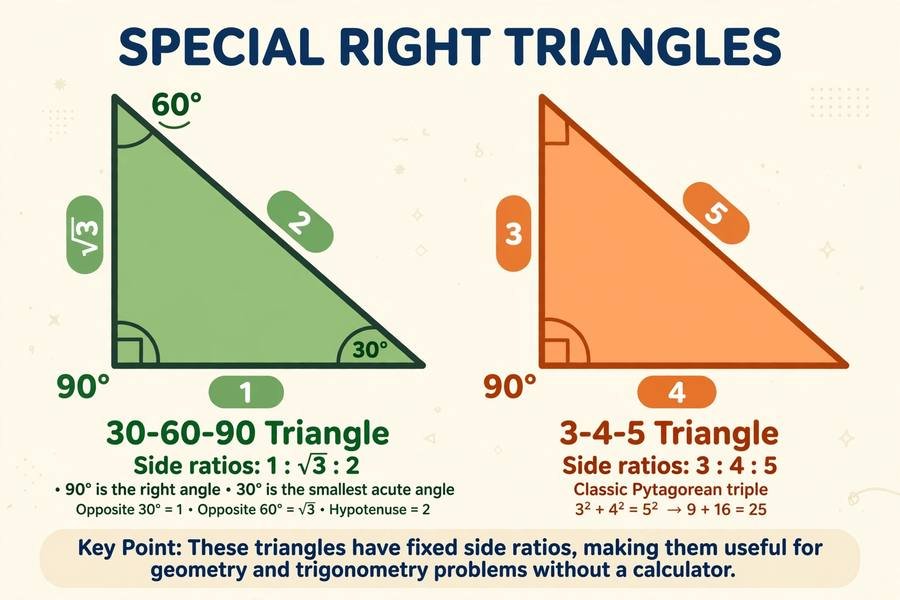
Suppose the legs are a = 3 and b = 4. Select “Sides a and b” and enter the values. The hypotenuse is c = √(3² + 4²) = √25 = 5. Angle A = arctan(3/4) ≈ 36.87°, and angle B = 90 − 36.87 ≈ 53.13°. The area is (3 × 4)/2 = 6, and the perimeter is 3 + 4 + 5 = 12. The 3-4-5 triangle is the most famous Pythagorean triple, and builders have used multiples of it for centuries to check that corners are square.
Example 2: hypotenuse and one angle
Suppose the hypotenuse c = 10 and angle A = 30°. Select “Hypotenuse c and angle A”. The other acute angle is B = 90 − 30 = 60°. Side a = c × sin(30°) = 10 × 0.5 = 5, and side b = c × cos(30°) = 10 × 0.8660 ≈ 8.66. Area = (5 × 8.66)/2 ≈ 21.65, perimeter ≈ 23.66. This is the well-known 30-60-90 triangle, whose sides always sit in the ratio 1 : √3 : 2.
Example 3: one leg and the opposite-side angle
Suppose side a = 7 and angle B = 45°. Select “Side a and angle B”. Then angle A = 90 − 45 = 45°, which makes this an isosceles right triangle. Side b = a × tan(45°) = 7 × 1 = 7, and hypotenuse c = a / cos(45°) = 7 / 0.7071 ≈ 9.90. Area = (7 × 7)/2 = 24.5, perimeter ≈ 23.90.
Special Right Triangles: 30-60-90 and 45-45-90
Two right triangles appear so often that their ratios are worth memorizing — spot one, and every side follows without the trig ratios.
A 30-60-90 triangle is half of an equilateral triangle. Its sides stand in the ratio 1 : √3 : 2: the short leg is half the hypotenuse; the long leg is the short leg times √3. Example 2 is one — hypotenuse 10, legs 5 and 5√3 ≈ 8.66.
A 45-45-90 triangle is half a square cut along its diagonal, so its legs are equal — ratio 1 : 1 : √2, hypotenuse = leg × √2. Example 3 is one: legs 7, hypotenuse 7√2 ≈ 9.90.
The converse of the Pythagorean theorem runs the formula backward: if a² + b² = c², the triangle is right-angled — 5, 12, 13 pass since 25 + 144 = 169 = 13². A larger sum means acute; smaller, obtuse.
The Altitude to the Hypotenuse
The altitude to the hypotenuse is not a calculator output — it follows from its results: h = (a × b) ÷ c. For Example 1’s 3-4-5 triangle, h = (3 × 4) ÷ 5 = 2.4. It splits the hypotenuse into segments of 1.8 and 3.2 and is their geometric mean: h² = 1.8 × 3.2 = 5.76.
Practical Uses
Right triangles hide in plain sight across real work:
- Construction and carpentry. Checking that a foundation corner is square, cutting rafters at the correct pitch, or figuring the diagonal of a rectangular room all reduce to right-triangle math.
- Surveying and navigation. A measured baseline plus one sighted angle gives the distance to an unreachable point — the same one-side-plus-angle case the calculator solves.
- Engineering and design. Ramps, staircases, trusses, and brackets are dimensioned from right triangles, where rise, run, and slope length must agree.
- DIY projects. Hanging a TV at the right viewing angle, sizing a ladder against a wall, or centering a picture frame diagonally all use the same relationships.
For triangles without a right angle, use our general triangle calculator instead — the formulas on this page only apply when one angle is exactly 90 degrees.
Tips and Limitations
- Keep units consistent. If side a is in centimeters, side b must be too; mixing inches and feet silently produces wrong answers.
- Two values are enough — and required. A single side or a single angle cannot determine a unique triangle, because similar triangles share the same angles at any size.
- Watch floating-point rounding. Results are rounded for display; intermediate values keep full precision, but extremely long or tiny triangles can accumulate small rounding error in the last digit.
- This is a Euclidean-geometry tool. It assumes a flat plane. For distances on the curved surface of the Earth, spherical trigonometry is needed instead.
- Special triangles are a free sanity check. If your triangle is close to 30-60-90 or 45-45-90, compare against the exact ratios (1 : √3 : 2 and 1 : 1 : √2) to catch input mistakes.
Frequently Asked Questions
What is a right triangle calculator?
A right triangle calculator solves a right triangle from partial information. Enter any two known values — two sides, or one side plus one acute angle — and it computes the remaining sides, both acute angles, the area, and the perimeter using the Pythagorean theorem and trigonometric ratios.
What is the Pythagorean theorem?
The Pythagorean theorem states that in a right triangle, the square of the hypotenuse equals the sum of the squares of the two legs: a² + b² = c². It lets you find any missing side when the other two are known, and it is the foundation of every hypotenuse calculator.
How do you find the hypotenuse of a right triangle?
Square both legs, add them, and take the square root: c = √(a² + b²). For legs of 3 and 4, c = √(9 + 16) = √25 = 5. If you know one leg and the hypotenuse instead, rearrange the formula: a = √(c² − b²).
What is a 30-60-90 triangle?
A 30-60-90 triangle is a special right triangle whose angles are 30°, 60°, and 90°. Its sides always follow the exact ratio 1 : √3 : 2 — the side opposite 30° is half the hypotenuse, and the side opposite 60° is the shorter leg times √3. Try entering hypotenuse 10 and angle 30° in the calculator above to see it.
Can I solve a right triangle with only one side and one angle?
Yes, as long as the angle is one of the two acute angles. One side plus one acute angle fully determines the triangle through the sine, cosine, and tangent ratios. What does not work is a single side alone, or two angles alone — those leave the size of the triangle undefined.
How is this different from a general triangle calculator?
A right triangle calculator exploits the guaranteed 90° angle, so two known values are enough. A general triangle calculator must handle oblique triangles with no right angle, using the law of sines and the law of cosines instead. Use the right triangle version whenever you know one angle is exactly 90 degrees — it is simpler and less error-prone.
What is a 45-45-90 triangle?
An isosceles right triangle: the legs are equal, and the hypotenuse is one leg times √2 (about 1.414). Legs of 7 give 7 × √2 ≈ 9.90 — the triangle in Example 3. Halving a square along its diagonal makes two of them.
How can I check whether a triangle is a right triangle?
Use the converse of the Pythagorean theorem: if the two smaller squares sum to the largest, the angle opposite the longest side is exactly 90° — 5, 12, 13 pass since 25 + 144 = 169.