Stride estimate: walking stride is about 0.413 times your height, running stride about 0.65 times your height. For best accuracy, measure your own stride.
If you have ever finished a long walk, glanced at your fitness tracker, and wondered how far you actually went, you are not alone. Step counters are everywhere today, from smartwatches to phones, but most people think in miles and kilometers, not in step counts. The Steps to Miles Calculator bridges that gap. Enter your step count and it converts steps into miles and kilometers instantly. It also works in reverse: enter a distance and find out roughly how many steps it will take to cover it.
Whether you are chasing the famous 10,000-steps-a-day goal, training for a walking challenge, or simply curious about the distance behind your daily activity, understanding the relationship between steps and miles helps you set realistic targets and measure progress with confidence.
How the Steps to Miles Calculation Works
The math behind converting steps to miles is straightforward once you know one personal measurement: your stride length. A stride is the distance covered by a single step, measured from the heel strike of one foot to the heel strike of the other foot.
The formula is:
Miles = (Steps x Stride Length in inches) / 63,360
The number 63,360 is simply the number of inches in a mile (5,280 feet x 12 inches). To get kilometers, multiply the mile result by 1.609344.
For example, if you take 10,000 steps with an average stride of 30 inches: 10,000 x 30 / 63,360 = 4.73 miles, which is about 7.62 kilometers. The reverse calculation is just as simple: divide the total inches in your target distance by your stride length to estimate the steps required.
The calculator above handles all of this automatically. If you know your stride length, enter it directly for the most accurate result. If you do not, enter your height and select walking or running, and the tool will estimate your stride using well-established anthropometric ratios.
Average Stride Length by Height
Stride length varies from person to person, but it correlates strongly with height. Taller people generally take longer steps. Researchers commonly estimate walking stride length as roughly 0.413 times a person’s height, and running stride length as roughly 0.65 times height. The table below shows typical values.
| Height | Walking Stride | Running Stride |
|---|---|---|
| 5 ft 0 in (152 cm) | 24.8 in (63 cm) | 39.0 in (99 cm) |
| 5 ft 4 in (163 cm) | 26.5 in (67 cm) | 41.6 in (106 cm) |
| 5 ft 8 in (173 cm) | 28.1 in (71 cm) | 44.2 in (112 cm) |
| 6 ft 0 in (183 cm) | 29.7 in (76 cm) | 46.8 in (119 cm) |
| 6 ft 4 in (193 cm) | 31.4 in (80 cm) | 49.4 in (125 cm) |
These are averages, and individual variation is normal. Factors such as leg length proportions, walking speed, footwear, terrain, and even fatigue can shift your real stride by several inches. That is why the calculator lets you override the estimate with a measured stride length whenever accuracy matters.
How Many Steps Are in a Mile?
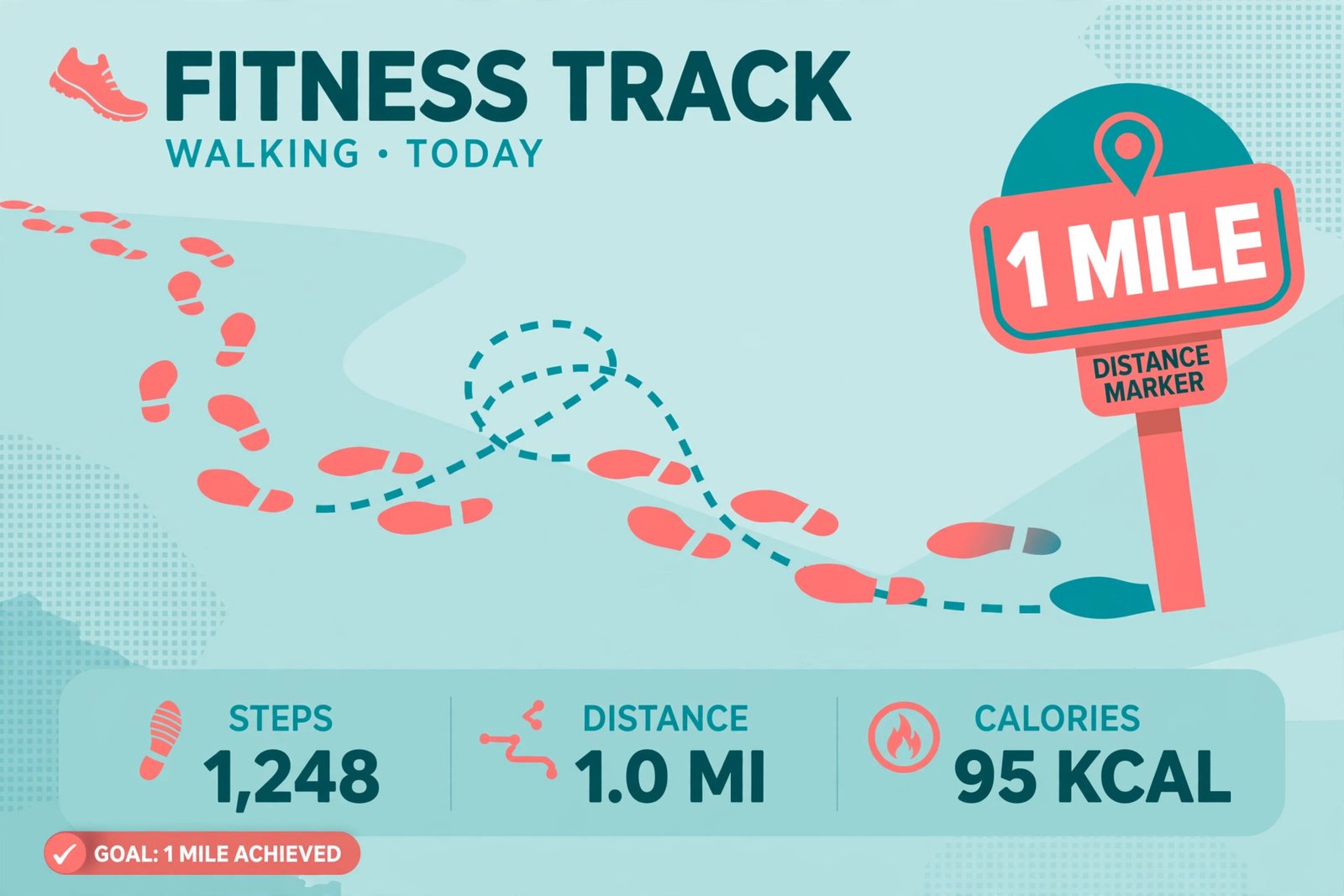
This is one of the most searched fitness questions, and the honest answer is that it depends on your stride. Still, using average stride lengths gives useful benchmarks. For an average adult walking at a moderate pace, a mile takes roughly 2,000 to 2,500 steps. Runners, with their longer strides, cover a mile in roughly 1,400 to 1,700 steps.
| Steps | Walking Distance (approx.) | Running Distance (approx.) |
|---|---|---|
| 1,000 | 0.47 miles (0.76 km) | 0.69 miles (1.12 km) |
| 2,000 | 0.95 miles (1.52 km) | 1.39 miles (2.24 km) |
| 5,000 | 2.37 miles (3.81 km) | 3.47 miles (5.59 km) |
| 10,000 | 4.73 miles (7.62 km) | 6.94 miles (11.18 km) |
| 15,000 | 7.10 miles (11.43 km) | 10.42 miles (16.76 km) |
| 20,000 | 9.47 miles (15.24 km) | 13.89 miles (22.35 km) |
These figures assume a 30-inch walking stride and a 44-inch running stride. Your numbers will differ slightly, which is exactly what the calculator is for.
Another useful view is steps per mile: divide 63,360 by your stride length in inches. At a 30-inch stride, one mile takes 2,112 steps; at a 26-inch stride it takes 2,437. This single number makes the reverse calculation easy — multiply it by your target distance to get your step goal, which is exactly what the Distance to Steps tab does for you.
Walking vs Running: Why Stride Matters
Walking and running are biomechanically different. When you walk, one foot is always on the ground, and your stride stays relatively compact. When you run, there is a flight phase where both feet leave the ground, which stretches each stride considerably. This is why the calculator asks for your activity type when estimating stride from height.
Speed also changes stride within the same activity. A leisurely stroll produces shorter steps than a brisk power walk. If you are converting step counts from a varied day, the walking estimate is the right default, since most daily steps come from ordinary walking rather than exercise sessions.
For runners tracking training mileage, measuring your actual running stride at your typical training pace gives far better conversions than any estimate. Treadmill runners can count steps over a known distance to calibrate precisely.
How to Measure Your Stride Accurately
Getting your true stride length takes less than five minutes. Walk normally for about 30 feet on a flat surface, count your steps, and divide the total distance by the number of steps. For example, if you cover 360 inches in 12 steps, your stride is 30 inches. Repeat the test three times and average the results to smooth out natural variation.
Measure at your normal walking pace, wearing the shoes you usually walk in. If you want a running stride, do the same test at your typical jogging pace over a longer distance, such as 100 feet. Write the number down or save it in your phone, then enter it into the calculator whenever you want precise conversions.
Practical Uses for Step-to-Distance Conversion
Beyond curiosity, converting steps to miles has several practical applications. Walkers training for charity walks or hiking trips can translate fundraising step goals into real distances. Travelers exploring a new city on foot can estimate how far they wandered from their step count. People following a doctor’s recommendation to walk a certain distance daily can check whether their step goal actually covers it.
The reverse conversion is equally handy. If your training plan calls for a five-mile walk but your tracker only counts steps, the Distance to Steps mode tells you the step target to aim for. Runners planning routes can estimate how many steps a given course will demand, which helps with pacing and energy planning.
Limitations to Keep in Mind
No step-to-distance conversion is exact. Stride length changes with pace, slope, surface, and fatigue, so a single average cannot capture a full day of varied movement. Fitness trackers themselves miscount steps, especially during activities with arm movement but little walking, such as cooking or folding laundry.
Treat the results as good estimates rather than survey-grade measurements. For casual fitness tracking and goal setting, the accuracy is more than sufficient. For race planning or scientific purposes, measure your stride carefully and consider using GPS as a cross-check.
Frequently Asked Questions
How many steps are in a mile?
For an average adult, a walking mile takes about 2,000 to 2,500 steps, while a running mile takes about 1,400 to 1,700 steps. The exact number depends on your stride length, which is why taller people generally need fewer steps per mile. Use the calculator above with your own stride for a personalized answer.
How many miles is 10,000 steps?
For most adults, 10,000 steps equals roughly 4.2 to 5 miles (6.8 to 8 km) of walking. With an average 30-inch stride, 10,000 steps works out to 4.73 miles or 7.62 kilometers. Runners cover more distance per step, so 10,000 running steps can exceed 6 miles.
How do I find my stride length?
Walk normally over a measured distance, such as 30 feet, count your steps, and divide the distance by the step count. Repeat three times and take the average. Alternatively, enter your height into the calculator and it will estimate your stride automatically.
Is the 10,000 steps a day goal based on distance?
The 10,000-step guideline originated as a marketing concept in 1960s Japan rather than from clinical research, but it stuck because it translates to roughly 4 to 5 miles of walking, which is a genuinely healthy amount of daily activity. Health organizations generally recommend at least 7,000 to 8,000 steps for meaningful benefits.
Does stride length change when I walk faster?
Yes. As walking speed increases, stride length grows while cadence (steps per minute) also rises. A relaxed stroll might use a 26-inch stride while a brisk walk stretches to 32 inches or more. For the most accurate conversions, measure your stride at the pace you most often walk.
Can I convert kilometers to steps with this calculator?
Yes. Switch to the Distance to Steps tab, enter your distance, and select kilometers as the unit. The calculator converts to miles internally and then estimates your step count from your stride length.
Why does my fitness tracker or phone show a different distance?
Trackers estimate distance with their own stride models, GPS, and motion sensors, and every brand calibrates differently. GPS can drift indoors, around tall buildings, or on winding trails, and wrist devices can miss steps when your arm is still or count extras during activities like driving. Small differences from this calculator are normal — for the closest match, measure your own stride and enter it directly.
How many steps do I need to walk 5 miles?
It depends on your stride. With a 30-inch stride, one mile takes 2,112 steps, so 5 miles takes about 10,560 steps. A shorter 26-inch stride needs roughly 12,185 steps for the same distance. Use the Distance to Steps mode above with your own stride length for a personal target.