Convert speed between seven units — kilometers per hour, miles per hour, meters per second, kilometers per second, feet per second, knots and Mach — using exact conversion factors. The converter is built around the question drivers ask most, how to convert km into mph, but every pair works in both directions. The table under the result shows your amount in all seven units at once, so a road speed, a wind speed in knots and a physics answer in meters per second never need three separate calculations.
Your amount in every unit
| Unit | Value |
|---|
All conversions run through kilometers per hour using the exact factors in the formula section below. Mach is the one exception to exactness: its factor here, 1,225.08 km/h for Mach 1, assumes sea-level standard (ISA) conditions, because the true speed of sound changes with altitude and temperature. The speed of light is not a widget unit; it appears in the real-world table for scale.
How to Use This Speed Converter
- Enter the amount you already have. It can come from a speed limit sign, a dashboard, a weather forecast, or a physics problem. The converter opens at 100 km/h so the headline answer is on screen straight away.
- Choose the From and To units. Seven units cover road travel, science, engineering, sailing, aviation and very fast objects. The result, formula line and all-units table update live as you type, and the Convert button runs the same calculation on demand.
- Use Swap to reverse the direction. Swap exchanges the two units, which is the quickest way to check a conversion both ways, for example mph back to km/h after km/h to mph.
- Read the all-units table and the formula line. The table shows the same speed in every unit at once, and the line under the result shows the exact multiplication and division used, so you can reproduce the answer on paper.
The km/h and mph Formulas, With Worked Examples
Every conversion in this tool passes through kilometers per hour, the shared reference unit. Each unit has a factor stating how many kilometers per hour one unit equals, and converting is one multiplication followed by one division: multiply by the factor of the From unit, then divide by the factor of the To unit. For the most common pair, the factors give two formulas worth remembering.
mph = km/h ÷ 1.609344, which is the same as km/h × 0.6213711922
km/h = mph × 1.609344
Result = amount × factor of the From unit ÷ factor of the To unit
Factors to km/h: km/h 1, mph 1.609344, m/s 3.6, km/s 3,600, ft/s 1.09728, knots 1.852, Mach 1,225.08 at sea level
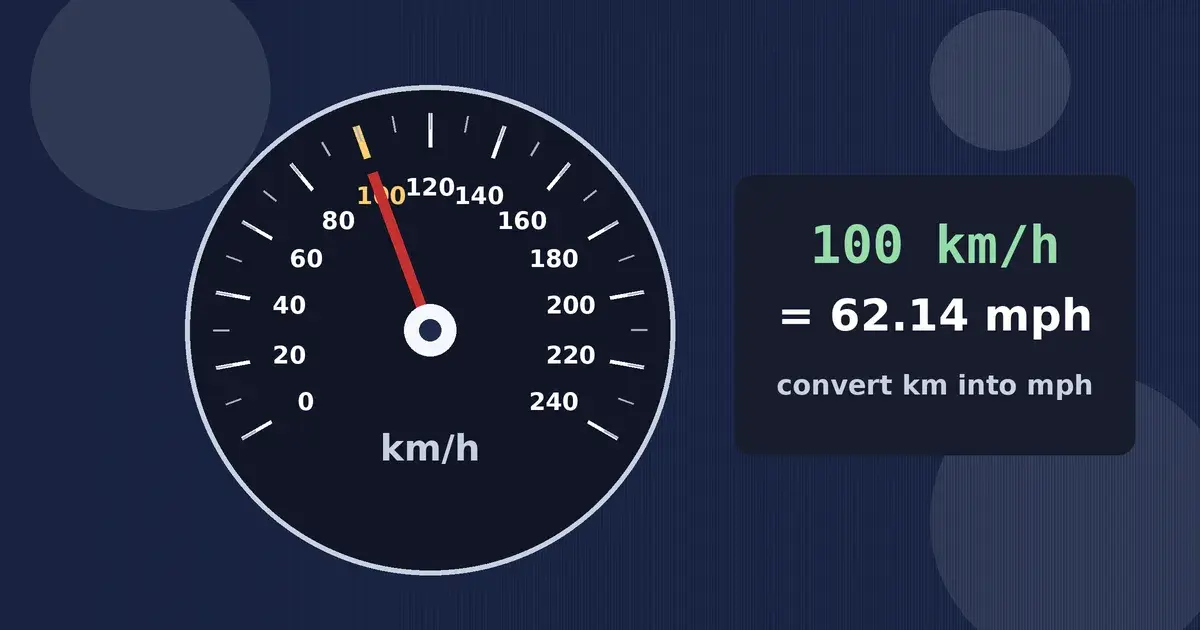
Worked example one: 100 km/h in mph. Divide by 1.609344: 100 ÷ 1.609344 = 62.1371 mph, usually rounded to 62.14 mph. This is the standard highway figure across most of the metric world, so international drivers use it most.
Worked example two: 60 mph in km/h. Multiply by 1.609344: 60 × 1.609344 = 96.5606 km/h, usually rounded to 96.56 km/h. A 100 km/h sign is therefore a slightly higher limit than a 60 mph sign, not the same one.
Two more quick checks. Ten meters per second is 10 × 3.6 = 36 km/h exactly, a useful anchor because so many physics answers land near it. One knot is 1.852 km/h exactly, by the definition of the nautical mile, so 20 knots is 37.04 km/h with no rounding in the factor at all.
Every Speed Unit Explained
Kilometers per hour (km/h). The road-speed unit for most of the world, used on signs, dashboards and public weather reports in metric countries. It answers an easy question directly: at this speed, how many kilometers will pass in one hour?
Miles per hour (mph). The road-speed unit of the United States and the United Kingdom, built on the statute mile of exactly 1,609.344 meters. Because a mile is longer than a kilometer, the mph number for a given speed is always smaller than the km/h number, by a factor of about 0.62.
Meters per second (m/s). The scientific unit, and the one physics, engineering and meteorology calculate in, because it connects directly to meters, seconds, newtons and joules without extra constants. Everyday speeds look small in m/s: a brisk walk is about 1.4 m/s and a highway car about 28 m/s. Multiply m/s by 3.6 to get km/h; divide by 3.6 to go back.
Kilometers per second (km/s). A unit for objects far faster than anything on a road: rockets, satellites and planets. The International Space Station orbits at about 7.66 km/s, and Earth travels around the Sun at about 29.8 km/s. It keeps very large speeds readable instead of running to millions of km/h.
Feet per second (ft/s). An imperial unit still common in United States engineering, ballistics and machinery specifications. Sixty mph is exactly 88 ft/s, a neat anchor worth remembering. One foot per second is 1.09728 km/h, so ft/s figures are always a little larger than the same speed in km/h.
Knots (kn). One knot is one nautical mile per hour, and a nautical mile is exactly 1,852 meters, defined from the geometry of the Earth as one minute of latitude. That is why sailors and aviators use knots: chart distances are measured in nautical miles, so a speed in knots divides straight into a chart distance to give hours of travel, with no conversion step. Ships, aircraft and marine weather reports all speak in knots worldwide.
Mach. Mach is not a fixed speed but a ratio: Mach 1 is the local speed of sound, Mach 2 is twice it, and so on. Because sound travels slower in colder air, the km/h value of Mach 1 falls with altitude. This tool uses the sea-level standard (ISA) value, Mach 1 = 1,225.08 km/h (340.3 m/s), and labels it that way everywhere. Treat Mach results as sea-level estimates unless a converter states a different altitude or temperature.
Real-World Speeds in Every Unit
This table places everyday and famous speeds side by side; the speed of light is included for scale, even though it is not a converter unit.
| Speed | km/h | mph | m/s |
|---|---|---|---|
| Walking | 5 | 3.1069 | 1.3889 |
| Leisure cycling | 20 | 12.4274 | 5.5556 |
| City speed limit | 50 | 31.0686 | 13.8889 |
| Highway speed limit | 100 | 62.1371 | 27.7778 |
| Fast motorway limit | 120 | 74.5645 | 33.3333 |
| Cheetah, top speed (about) | 104 | 64.6226 | 28.8889 |
| Airliner cruise (about) | 900 | 559.2341 | 250 |
| Speed of sound, sea level | 1,225.08 | 761.2294 | 340.3 |
| Speed of light in vacuum | 1,079,252,848.8 | 670,616,629.38 | 299,792,458 |
Quick Mental-Math Rules for km/h and mph
km/h to mph: multiply by 5, then divide by 8. Five eighths is 0.625, very close to the exact 0.621371. For 100 km/h it gives 62.5 mph against an exact 62.14, and for 80 km/h it gives 50 mph against an exact 49.71. That is close enough to read a speed limit safely, and the small error is on the cautious side going this direction.
mph to km/h: multiply by 8, then divide by 5. Eight fifths is 1.6, close to the exact 1.609344. For 60 mph it gives 96 km/h against an exact 96.56, and for 70 mph it gives 112 km/h against an exact 112.65. A rougher version also works: take six tenths of a km/h figure for a quick mph estimate, accepting that 100 km/h becomes about 60 mph rather than 62.14. Use the exact converter, not a mental rule, for anything written down, priced or graded.
Common Mistakes to Avoid
- Converting in the wrong direction. Km/h to mph divides by 1.609344 and makes the number smaller; mph to km/h multiplies and makes it bigger. If a km/h speed comes out larger in mph, the operation is backwards.
- Treating a knot as a mile per hour. A knot is based on the longer nautical mile, so 30 knots is 55.56 km/h or about 34.52 mph, not 30 mph — a gap of about 15 percent.
- Treating Mach as a fixed speed. Mach 1 is about 1,225.08 km/h at sea level under standard conditions, but roughly 1,062 km/h in the cold air at cruise altitude. Always ask which conditions a Mach figure assumes.
- Confusing speed with pace. Pace is time per distance, such as minutes per kilometer, and it runs backwards: a smaller pace number is a faster run. Convert pace to speed first, by dividing 60 by the minutes per kilometer, before using this tool.
- Mixing up per hour and per second. One meter per second is 3.6 km/h, and one kilometer per second is 3,600 km/h. Dropping that factor of 3.6, or of 1,000, is the most common homework error.
- Rounding a speed limit up. Mental rules are estimates. A 100 km/h limit is 62.14 mph, so driving at 65 mph on the strength of a rough guess is over the limit, not under it.
More Tools on This Site
Speed sits between distance and time, and the neighboring tools cover both sides. The Length Converter moves between kilometers, miles, meters and feet when the distance itself needs converting. Runners who think in minutes per mile rather than speed should use the Running Pace Calculator, and walkers can turn a step count into distance with the Steps to Miles Calculator. For changing speed rather than steady speed, the Acceleration Calculator is the right tool, and drivers can pair this converter with the Batch 15 Tire Size Converter, because a different tire diameter changes what a speedometer shows.
Frequently Asked Questions
How do I convert km into mph for speed?
Divide the km/h figure by 1.609344, or multiply it by 0.6213711922. For example, 100 km/h divided by 1.609344 is 62.1371 mph. To go the other way, multiply mph by 1.609344: 60 mph is 96.5606 km/h.
What is 100 km/h in mph?
100 km/h is 62.1371 mph, usually rounded to 62.14 mph. It is the standard highway limit across most of the metric world and the most useful anchor to memorize: a little above the 60 mph limit common on United States highways.
What is 60 mph in km/h?
60 mph is 96.5606 km/h, usually rounded to 96.56 km/h. Multiply any mph figure by 1.609344 to get km/h. That is why a 100 km/h sign allows slightly more speed than a 60 mph sign, even though the two numbers look very different.
What is a knot, and why do sailors and pilots use it?
A knot is one nautical mile per hour, exactly 1.852 km/h. Sailors and aviators use it because the nautical mile is defined from the Earth itself, as one minute of latitude, so chart distances are measured in nautical miles. A speed in knots then divides straight into a chart distance to give travel time in hours.
What is Mach 1 in km/h?
At sea level under standard (ISA) conditions, Mach 1 is 1,225.08 km/h, which is 340.3 meters per second or about 761.23 mph. Mach is a ratio to the local speed of sound rather than a fixed speed, so the same Mach 1 is only about 1,062 km/h in the cold air at typical airliner cruise altitude.
Is speed the same thing as pace?
No. Speed is distance per time, such as 12 km/h, while pace is time per distance, such as 5 minutes per kilometer. They are reciprocals: divide 60 by a pace in minutes per kilometer to get speed in km/h, so a 5 minute per kilometer pace is 12 km/h, or 7.4565 mph.