Build a CD ladder strategy with staggered maturities for liquidity and yield.
How to Use the CD Ladder Calculator
A CD ladder splits your savings across certificates of deposit with staggered maturities, so you earn higher long-term rates while a rung matures every year. This calculator designs the ladder and projects total interest.
- Enter the total amount you want to invest across the ladder.
- Choose the number of rungs (typically 3–5) and the longest term.
- Enter the APY for each term length — longer terms usually pay more.
- See each rung’s amount at maturity in the table, the ladder’s blended (weighted average) APY, and the total interest across all rungs.
CD Ladder Formula
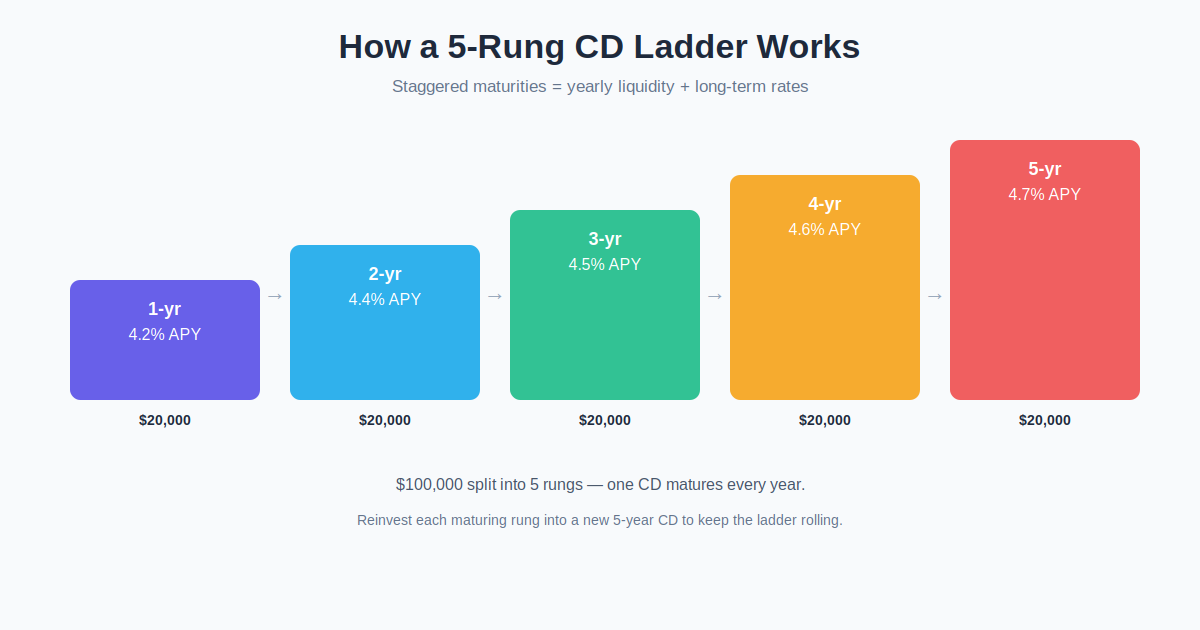
A ladder divides your principal into equal rungs, each in a CD of a different term. With $50,000 and a 5-rung ladder, you buy 1-year, 2-year, 3-year, 4-year, and 5-year CDs of $10,000 each. Every year one rung matures; you reinvest it into a new 5-year CD at the then-current rate. After the initial build phase, you hold five 5-year CDs maturing one year apart — earning long-term rates with annual liquidity.
Each rung compounds independently: future value equals principal × (1 + APY)^years. Total ladder value is the sum of all rungs’ future values. The blended yield — total interest divided by total principal divided by years — typically beats a single short-term CD while keeping yearly access to a slice of cash. The main risk is opportunity cost: if rates rise sharply, money locked in older rungs earns below-market rates until those rungs mature and roll over.
Example Calculation
Emma invests $60,000 in a 5-rung ladder: $12,000 each in 1-year (4.0%), 2-year (4.3%), 3-year (4.5%), 4-year (4.6%), and 5-year (4.8%) CDs. After year one, the 1-year rung matures at $12,480 and rolls into a new 5-year CD. Total interest earned across all rungs in year one is roughly $2,664 — a blended yield of 4.44%, well above the 4.0% a single 1-year CD would pay, while still freeing $12,000+ every twelve months. If rates jump to 6% in year two, only the matured rung captures it immediately; the rest follow as they mature.
Blended APY: Your Ladder’s Headline Number
With five different rates in play, one number summarizes the ladder: the blended APY, a weighted average of the rung rates where each rate is weighted by the money in that rung. Because this calculator splits your deposit evenly, the blend is simply the average of the rung APYs. With the default $50,000 ladder — $10,000 each at 4.5, 4.3, 4.1, 4.0, and 3.9 percent — the blended APY is 4.16 percent, and first-year interest is $2,080: each rung earns its own rate on $10,000 ($450 + $430 + $410 + $400 + $390). The calculator reports this weighted APY so you can compare a ladder against a single CD or a high-yield savings account at a glance.
CD Ladder vs a Single CD
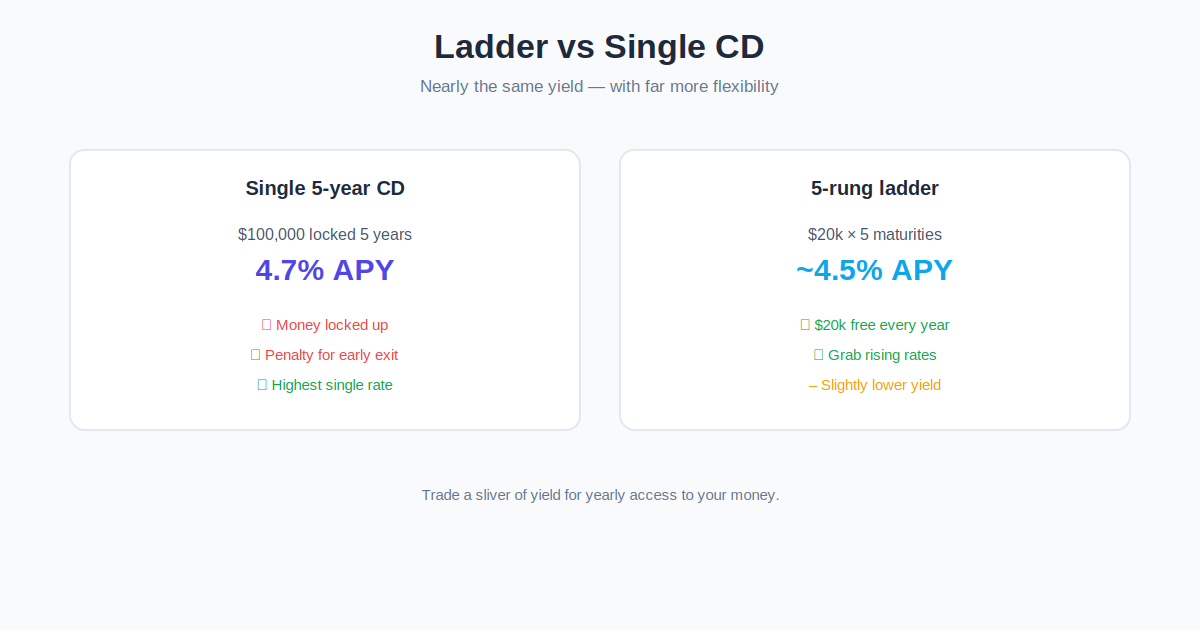
Using those same default rates on $50,000 shows the trade-off honestly. Everything in one 5-year CD at 3.9 percent earns $1,950 in year one — less than the ladder’s $2,080 — and the entire $50,000 is locked away for five years, with an early-withdrawal penalty if life intervenes. Everything in one 1-year CD at 4.5 percent earns $2,250 in year one, beating the ladder, but after twelve months the whole amount reprices at whatever rates then exist. The ladder sits deliberately in between: at maturity the rungs are worth $10,450, $10,878, $11,281, $11,699, and $12,108 respectively, one fifth of your money frees up every year, and only that fifth is exposed to new rates at a time. You give up a little peak yield to buy flexibility and rate insurance in both directions.
Frequently Asked Questions
What is a CD ladder?
A strategy that splits savings across CDs with staggered maturity dates — for example, 1- through 5-year terms. One rung matures each year, giving you regular access to cash while earning higher long-term rates.
How many rungs should my ladder have?
Five rungs is the classic setup, balancing yield and simplicity. Three rungs work for smaller amounts or shorter horizons. More than five adds complexity without much extra benefit for most savers.
What happens when a CD matures?
You get a grace period (usually 7–10 days) to withdraw or move the money. Do nothing and most banks auto-renew into the same term at the current rate — in a ladder, you instead roll it into the longest rung.
Are CDs FDIC insured?
Yes, up to $250,000 per depositor per bank, including principal and earned interest. Splitting a large ladder across multiple banks keeps everything insured.
Should I build a ladder when rates are falling?
Ladders shine when rates are flat or rising, since maturing rungs capture new higher rates. When rates are clearly falling, locking everything into the longest term immediately usually wins — though nobody times this perfectly.
What is the blended APY of a CD ladder?
It is the weighted average of all your rung APYs, weighted by how much money sits in each rung. With equal rungs it is simply the average of the rates — APYs of 4.5, 4.3, 4.1, 4.0, and 3.9 percent blend to 4.16 percent. The calculator shows it so you can compare your ladder with a single CD or a savings account in one number.
What happens if I need my money before a rung matures?
You can usually withdraw early, but the bank keeps an early-withdrawal penalty — commonly 3 to 12 months of interest depending on the term — and on a young CD the penalty can eat into your principal. This is exactly the problem a ladder softens: with a rung maturing every year, you rarely need to break a CD at all.
Related Calculators
Try our CD Calculator and Compound Interest Calculator for more calculations.