Total/HDL and LDL/HDL ratios predict heart risk better than total alone.
How to Use the Cholesterol Ratio Calculator
Total cholesterol alone can mislead — two people with the same total can face very different heart risk depending on their HDL. Ratios put the numbers in context, and cardiologists often trust them more than any single value.
- Enter total cholesterol. Use mg/dL (US standard) from your lipid panel. If your results are in mmol/L, convert them first using the guide below — the ratios themselves come out identical in either unit, as long as both numbers use the same one.
- Enter HDL cholesterol. HDL is the protective kind; higher is better, and it forms the denominator of both ratios.
- Enter LDL cholesterol. LDL is the primary artery-clogging particle and the main treatment target.
- Read your ratios. You get total-to-HDL and LDL-to-HDL with color-coded zones showing ideal, borderline, and elevated ranges.
Cholesterol Ratio Calculator Formula
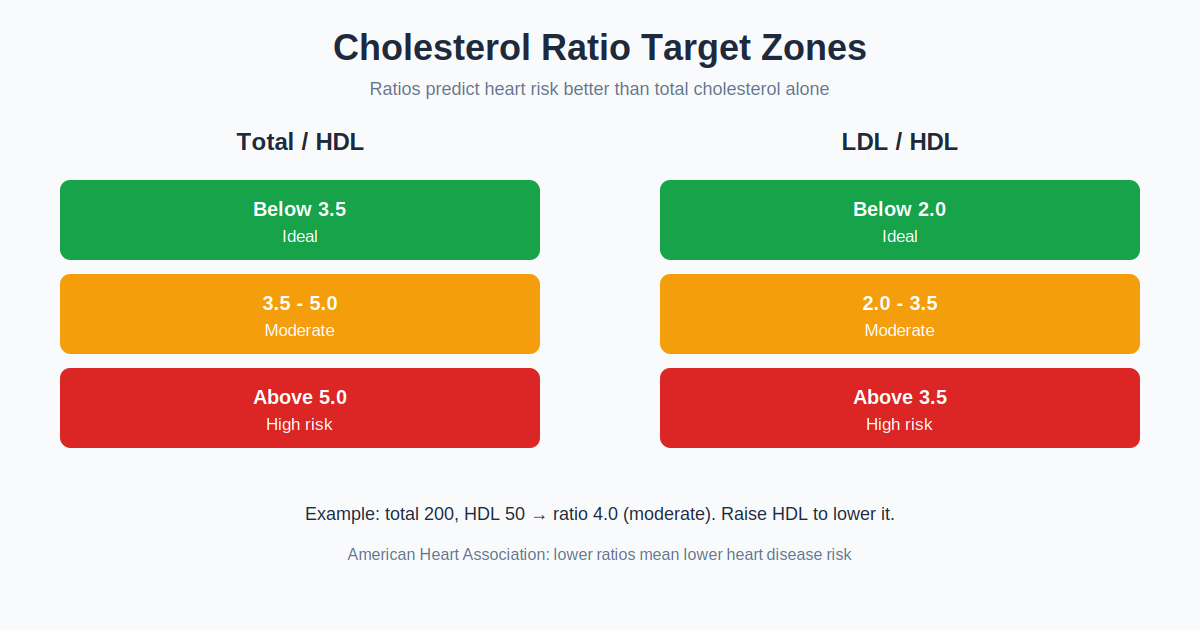
The total-to-HDL ratio is simply total cholesterol divided by HDL cholesterol. The American Heart Association considers below 5.0 acceptable and below 3.5 ideal. The LDL-to-HDL ratio is LDL divided by HDL, with below 3.5 considered good and below 2.5 ideal. Both formulas work identically in mg/dL or mmol/L because the units cancel out in division.
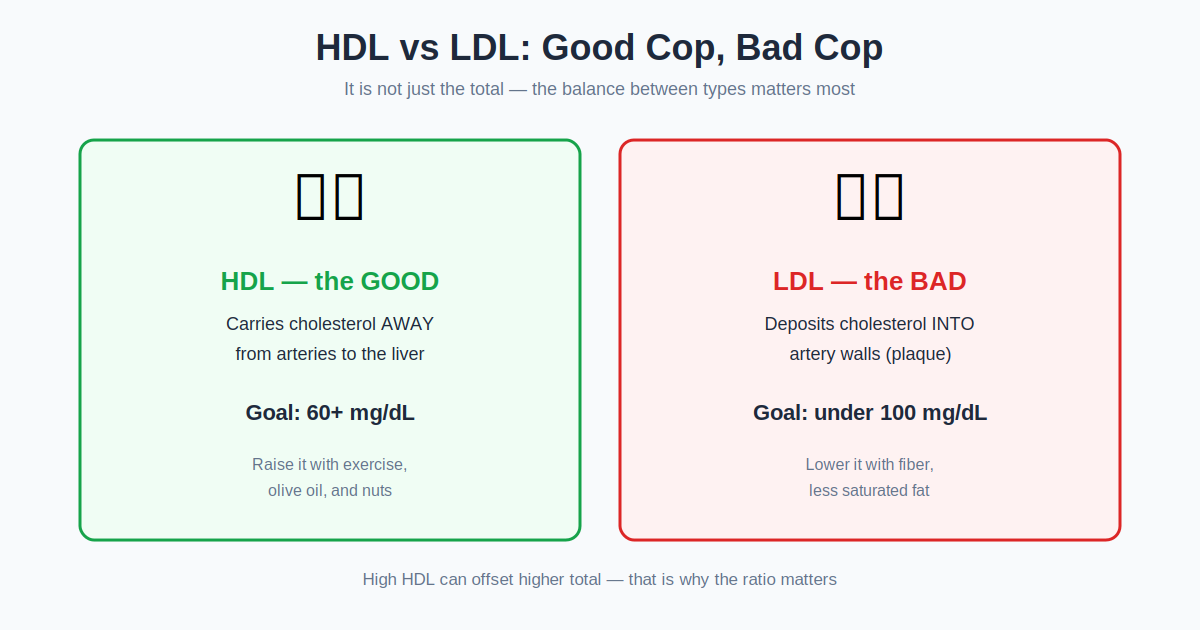
Why do ratios outperform single numbers? HDL runs reverse cholesterol transport, hauling cholesterol away from artery walls back to the liver. A total of 220 with HDL of 70 gives a ratio of 3.1 — excellent. The same total of 220 with HDL of 35 gives 6.3 — concerning. The total never changed; the context did. That is the insight ratios deliver.
A related number worth knowing is non-HDL cholesterol — total minus HDL — which captures all the atherogenic particles (LDL, VLDL, IDL) in one figure. Many guidelines now set non-HDL targets about 30 mg/dL above the LDL target. If your ratios are elevated, the fix is usually two-sided: lower LDL through diet, exercise, and if needed medication, while raising HDL through aerobic exercise, healthy fats, and avoiding smoking.
Example Calculation
Suppose your lipid panel shows total cholesterol 220, HDL 38, and LDL 150 mg/dL. Total-to-HDL equals 220 divided by 38, or about 5.8 — above the 5.0 threshold, in the elevated zone. LDL-to-HDL equals 150 divided by 38, about 3.9 — also above the 3.5 mark.
Notice the story: a total of 220 is only borderline-high on its own and might not raise alarms, but the low HDL of 38 drags both ratios into concerning territory. This person would benefit most from HDL-raising strategies — regular aerobic exercise, replacing refined carbs with unsaturated fats, and quitting smoking if applicable — alongside standard LDL-lowering steps. Retesting after three months of changes shows whether the ratios are moving.
Cholesterol Ratio Ranges at a Glance
Once you have your two ratios, this table shows where they land. The bands below are the ones most commonly used alongside American Heart Association guidance — treat them as context for a conversation with your doctor, not as a diagnosis, because your LDL level, blood pressure, blood sugar, and smoking status all shape your real risk.
| Ratio | Ideal | Acceptable | Elevated |
|---|---|---|---|
| Total cholesterol / HDL | Below 3.5 | 3.5 to 5.0 | Above 5.0 |
| LDL / HDL | Below 2.5 | 2.5 to 3.5 | Above 3.5 |
Notice what the table rewards: you can improve a ratio from either side. Dropping LDL with diet or medication pulls the LDL-to-HDL ratio down, and raising HDL through aerobic exercise pulls both ratios down at once. That is why the worked example above improves fastest when a low HDL is treated as part of the problem.
If Your Results Are in mmol/L
Many countries outside the US report cholesterol in mmol/L instead of mg/dL. There is good news: a ratio is unit-free. Total divided by HDL gives exactly the same number in mmol/L as in mg/dL, provided both values come from the same panel. To use this calculator with an mmol/L panel, convert each value first by multiplying by 38.67 — for example, a total cholesterol of 5.2 mmol/L × 38.67 ≈ 201 mg/dL. (Triglycerides use a different factor: multiply mmol/L by 88.57.)
For quick reference: 200 mg/dL = 5.17 mmol/L, HDL of 50 mg/dL = 1.29 mmol/L, LDL of 100 mg/dL = 2.59 mmol/L, and a non-HDL value of 130 mg/dL = 3.36 mmol/L. Whichever unit your lab uses, compare your ratios against the same bands in the table above.
Frequently Asked Questions
Which cholesterol ratio matters most?
The total-to-HDL ratio is the most widely used and validated; the American Heart Association highlights keeping it below 5.0. The LDL-to-HDL ratio is a close second and some cardiologists prefer it since LDL is the main treatment target. Check both — they usually agree, and when they disagree the worse one deserves attention.
What is a good total cholesterol to HDL ratio?
Below 3.5 is considered ideal, 3.5 to 5.0 is acceptable, and above 5.0 is elevated. For context, a ratio of 6 means you have six times as much total cholesterol as protective HDL — a pattern strongly linked with higher cardiovascular risk in population studies.
Can my total cholesterol be normal but my ratios bad?
Absolutely, and this is exactly why ratios exist. A total of 200 looks fine, but with HDL of 32 the ratio is 6.3 — poor. Conversely, a total of 230 with HDL of 75 gives 3.1 — fine. Never judge a lipid panel by the total alone.
How can I improve my cholesterol ratios?
Raise HDL with regular aerobic exercise, monounsaturated fats like olive oil, and quitting smoking. Lower LDL by cutting saturated fat and trans fat, adding soluble fiber like oats, and maintaining healthy weight. When lifestyle is not enough, statins and other medications effectively lower LDL — discuss options with your doctor.
How often should cholesterol be tested?
Adults should have a fasting lipid panel every 4 to 6 years starting at age 20, and more often with risk factors like diabetes, smoking, or family history of early heart disease. After starting treatment or major lifestyle changes, retesting in 3 months shows whether your plan is working.
What is a good LDL to HDL ratio?
Below 2.5 is considered ideal, 2.5 to 3.5 is generally good, and above 3.5 is elevated. Because LDL is the main treatment target, many clinicians watch this ratio alongside the total-to-HDL ratio — if either one is elevated, it deserves attention.
How do I convert cholesterol from mmol/L to mg/dL?
Multiply any cholesterol value (total, HDL, LDL or non-HDL) in mmol/L by 38.67 to get mg/dL. For triglycerides, multiply by 88.57 instead. Ratios do not need converting — a ratio calculated in mmol/L equals the same ratio in mg/dL.
Related Calculators
Try our BMI Calculator and Calorie Calculator for more calculations.