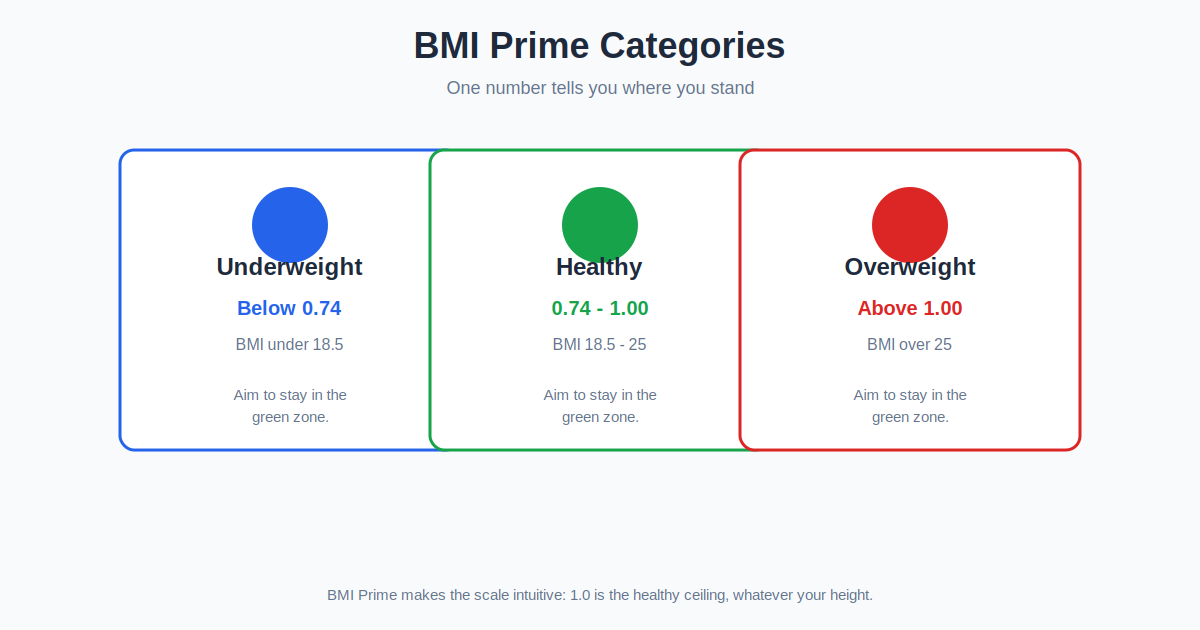
BMI Prime expresses your BMI as a simple ratio to the healthy upper limit of 25. A value under 1.0 means a healthy BMI; over 1.0 means above it.
Enter your height and weight to get your BMI and BMI Prime.
How to Use the BMI Prime Calculator
- Enter your height in centimeters, measured without shoes standing straight.
- Enter your weight in kilograms, ideally weighed in the morning before eating.
- Click Calculate to see your BMI, your BMI Prime ratio, and your weight category.
- Read the interpretation note. A BMI Prime under 1.0 is the key number to remember.
- Recheck monthly rather than daily. Weight fluctuates with water, food, and hormones.
BMI Prime Formula
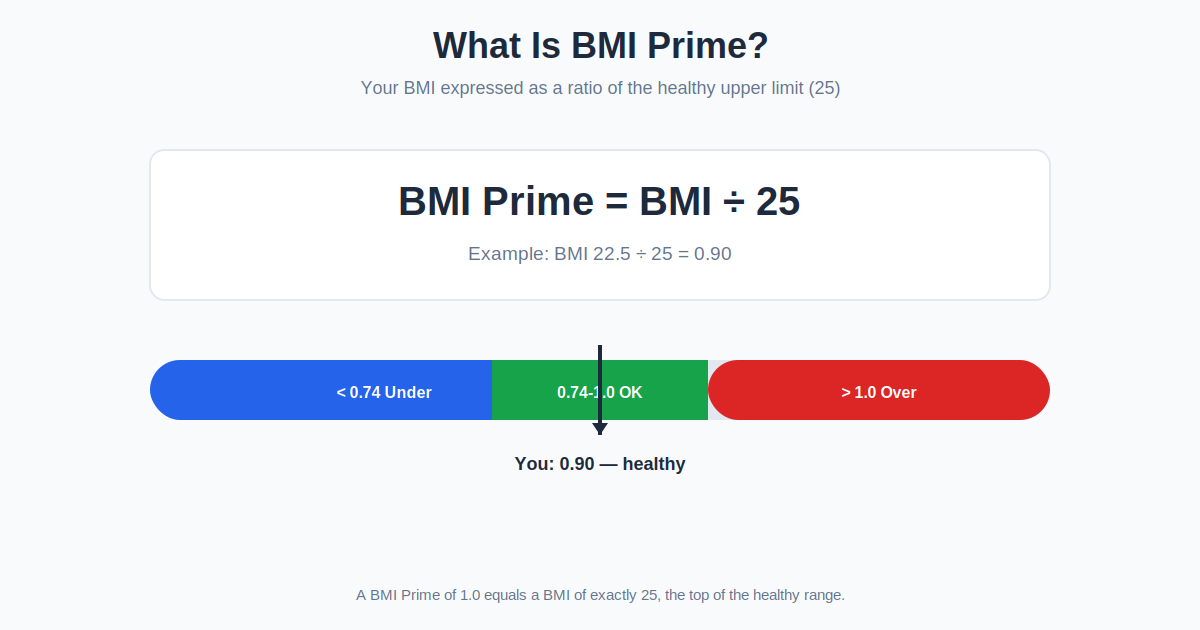
BMI Prime is delightfully simple: it is your Body Mass Index divided by 25, the upper limit of the healthy BMI range. BMI itself is weight in kilograms divided by height in meters squared. So BMI Prime equals weight divided by (height squared times 25). The genius of the ratio is psychological and practical. Instead of remembering category cutoffs like 18.5, 25, and 30, you only need one number: 1.0. Below 1.0 means your BMI is within the healthy range; above 1.0 means it exceeds the healthy upper limit. A BMI Prime of 0.85, for example, tells you instantly that you are at 85 percent of the overweight threshold. It was proposed as a clearer way to communicate BMI results, especially across populations where the raw number means little to patients. The categories map neatly: under 0.74 is underweight (BMI under 18.5), 0.74 to 1.0 is healthy, 1.0 to 1.2 is overweight, and 1.2 or above is obese. Like BMI itself, BMI Prime does not distinguish muscle from fat, so muscular athletes can score above 1.0 while being perfectly healthy. It inherits all of BMI’s limitations along with its simplicity.
Worked Example
A person 175 centimeters tall weighing 70 kilograms: height in meters is 1.75, squared is 3.0625, and 70 divided by 3.0625 gives a BMI of 22.9. BMI Prime is 22.9 divided by 25, which is 0.91, comfortably in the healthy range. This person is at 91 percent of the overweight threshold. If the same person gains weight to 85 kilograms, BMI becomes 85 divided by 3.0625, or 27.8, and BMI Prime becomes 1.11, in the overweight range. The ratio makes the change easy to grasp: they went from 0.92 to 1.11, crossing the meaningful 1.0 line. To return to a Prime of 1.0, they need a BMI of exactly 25, which at 1.75 meters means 25 times 3.0625, or 76.6 kilograms. Framing the goal as getting BMI Prime back under 1.0 is often more motivating than targeting an abstract BMI number, because the ratio reads like a score where 1.0 is the line you want to stay beneath. (Their original Prime of 0.91 meant they were at 91 percent of the overweight threshold.)
What a BMI Prime of 1.00 Really Means
The key landmark on this scale is 1.00. A BMI Prime of exactly 1.00 means your BMI is exactly 25 — the boundary where the WHO’s overweight category begins. This surprises some people, who assume 1.00 marks the middle of “healthy.” It doesn’t: the healthy BMI range of 18.5 to 24.9 maps to a Prime range of 0.74 to 1.00, so 1.00 is the top edge of healthy, not its centre. Reading Prime this way is genuinely useful: 1.16 means your BMI is 16% above the overweight threshold, and 0.80 means it is 20% below it. The number is a distance measurement, which is the whole point of the rescaling proposed by Gadzik in 2006.
Converting Between BMI and BMI Prime
Going back and forth is one multiplication or division by 25. BMI = Prime × 25, and Prime = BMI ÷ 25. A short table makes the correspondence obvious:
| BMI Prime | BMI | Meaning |
|---|---|---|
| 0.74 | 18.5 | Healthy range begins |
| 0.80 | 20.0 | Healthy |
| 0.92 | 23.0 | Healthy |
| 1.00 | 25.0 | Overweight begins |
| 1.20 | 30.0 | Obesity begins |
Your Healthy Weight Range in Kilograms
Because the Prime categories are just BMI categories divided by 25, you can turn them into a weight range for your own height. The healthy band for height h meters runs from 18.5 × h² to 25 × h² kilograms. At 1.75 m (h² = 3.0625), that is 18.5 × 3.0625 ≈ 56.7 kg up to 25 × 3.0625 ≈ 76.6 kg — the top of this range is exactly the weight where your BMI Prime reaches 1.00. It is also worth being honest about limits: BMI Prime contains no information that BMI doesn’t, it still cannot separate muscle from fat or bone, and its fixed thresholds are adult screening values — children and teenagers are assessed against age- and sex-specific percentile charts instead. Treat it as a fast screening number, not a diagnosis.
Frequently Asked Questions
What is BMI Prime exactly?
BMI Prime is your BMI divided by 25, the top of the healthy BMI range. It turns BMI into a simple ratio where 1.0 is the line between healthy and overweight.
Why use BMI Prime instead of BMI?
It is easier to interpret. You do not need to memorize cutoffs; anything under 1.0 is fine and anything over needs attention. Clinicians like it for quick patient communication.
Is BMI Prime more accurate than BMI?
No, it carries exactly the same information as BMI, just rescaled. It shares BMI’s main weakness: it cannot tell muscle apart from fat.
What BMI Prime should athletes aim for?
Athletes with high muscle mass may exceed 1.0 while being healthy. For them, body fat percentage or waist measurements are better guides than any BMI-derived number.
Can BMI Prime be below 0.74?
Yes, that corresponds to a BMI under 18.5, the underweight range. If your Prime is very low without trying, consider checking in with a healthcare professional.
How do I convert BMI Prime back to BMI?
Multiply by 25. A Prime of 0.92 means BMI 23.0, and 1.16 means BMI 29. The calculator shows both numbers, so you never have to do the conversion yourself.
What is the Ponderal Index and how is it different?
The Ponderal Index divides weight by height cubed (kg/m³) instead of squared, which suits very tall or very short people slightly better. It has no widely used category cutoffs, so it is compared only against your own earlier readings.
Does BMI Prime work for children?
No. Children’s BMI is interpreted against age- and sex-specific percentile charts, not the adult threshold of 25 that Prime is built on. BMI Prime is an adult screening measure.
Related Calculators
See the standard version with our BMI Calculator and check abdominal fat distribution with our Waist to Height Ratio Calculator.