Compare snowball vs avalanche payoff plans for up to 3 debts and find your debt-free date.
Results are estimates for planning purposes and are not financial, medical, or professional advice.
How to Use the Debt Payoff Calculator
Carrying multiple debts with different rates makes it hard to see the fastest way out. Our debt payoff calculator compares the avalanche and snowball strategies, showing your debt-free date and total interest under each plan.
- List each debt with its current balance, annual interest rate, and minimum monthly payment.
- Enter the extra amount you can pay each month beyond the minimums.
- Choose the avalanche method (highest rate first) or the snowball method (smallest balance first).
- Calculate to see the payoff order, the month you become debt-free, and total interest for each strategy.
Debt Payoff Calculator Formula
The calculator simulates month-by-month amortization across all debts at once. Each month, every balance accrues interest equal to balance times (annual rate divided by 12), minimums are paid on all debts, and the extra payment goes to the target debt per your chosen strategy. When a debt hits zero, its minimum payment rolls into the extra amount for the next target. This payment snowballing is what accelerates the payoff far beyond making minimums alone.
Example Calculation
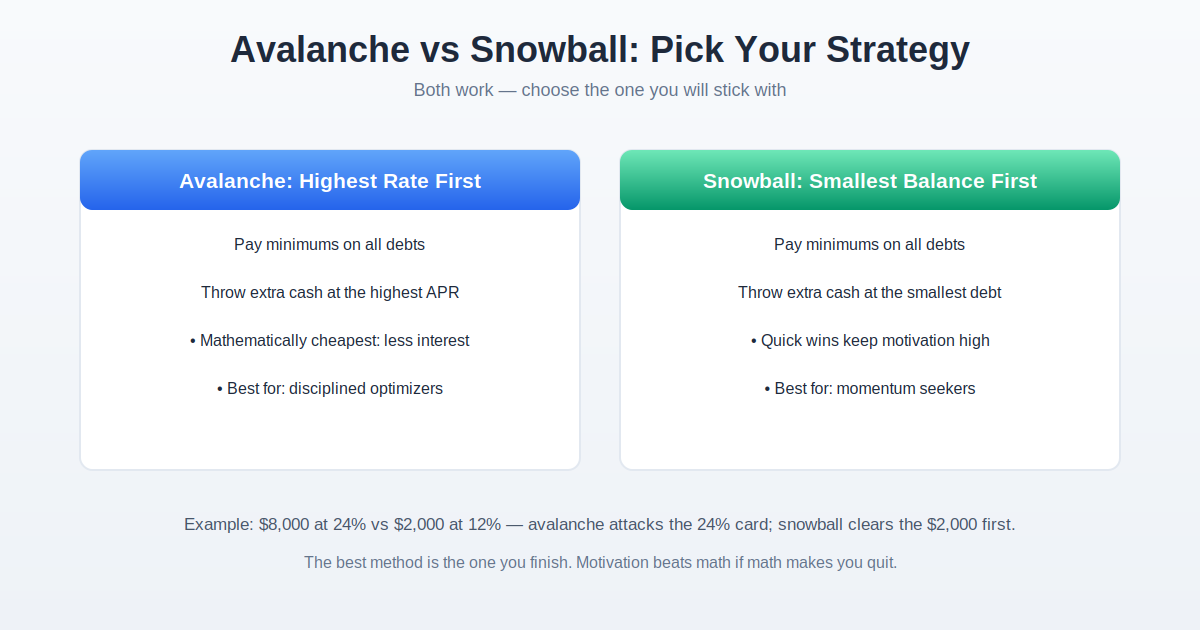
Suppose you owe 8,000 dollars on a card at 22 percent (minimum 160 dollars), 5,000 dollars on a card at 18 percent (minimum 100 dollars), and 2,000 dollars on a store card at 12 percent (minimum 40 dollars), with 300 dollars extra per month. Under the avalanche method, you attack the 22 percent card first (cleared in month 22), then the 18 percent card (month 30), and become debt-free in about 32 months, paying roughly 4,050 dollars in interest. The snowball method clears the 2,000 dollar store card in month 7 for a quick win, but finishes in 34 months and pays about 4,800 dollars in interest. Paying only the minimums would take 137 months — over 11 years — and cost nearly 19,000 dollars in interest.

Frequently Asked Questions
Which is better, avalanche or snowball?
Avalanche always costs less in interest because it targets the most expensive debt first. Snowball wins on psychology: quick victories keep people motivated. Pick the one you will actually stick with.
How much extra should I pay each month?
Pay as much as your budget allows after covering essentials and a small emergency buffer. Even 100 dollars extra per month can cut years off a payoff plan.
Should I save or pay debt first?
Keep a small emergency fund of 1,000 dollars or one month of expenses, then attack high-interest debt. Once expensive debt is gone, redirect those payments into savings.
Does the calculator handle different payment frequencies?
It models monthly payments, which matches how most credit cards and loans bill. If you get paid biweekly, consider making half-payments every two weeks to squeeze in an extra full payment each year.
What about consolidating my debts first?
A lower-rate consolidation loan can reduce total interest, but only if you stop adding new debt. Run the numbers here first to see whether consolidation actually beats your current payoff plan.
Related Calculators
Try our Debt-to-Income Ratio Calculator and Loan Calculator for more financial planning tools.