How many boxes of flooring you need for a room, including cutting waste.
Results are estimates for planning purposes and are not financial, medical, or professional advice.
How to Use the Flooring Calculator
Flooring is sold by the box or by square footage, and running short mid-project is every renovator’s nightmare. Enter your room dimensions and flooring type, and the calculator tells you exactly how much material to order, waste included.
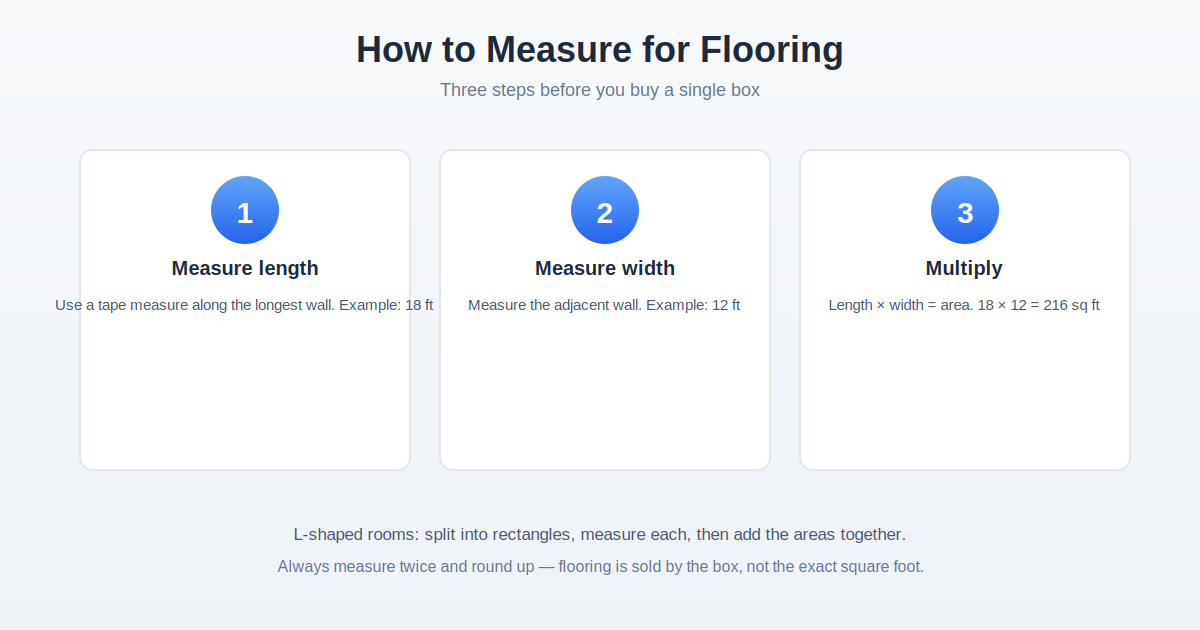
- Measure the length and width of the room in feet. For L-shaped rooms, split the space into rectangles and add the areas.
- Select your flooring material, such as hardwood, laminate, vinyl plank, or tile.
- Enter the coverage per box if you know it, or use the standard coverage for your material.
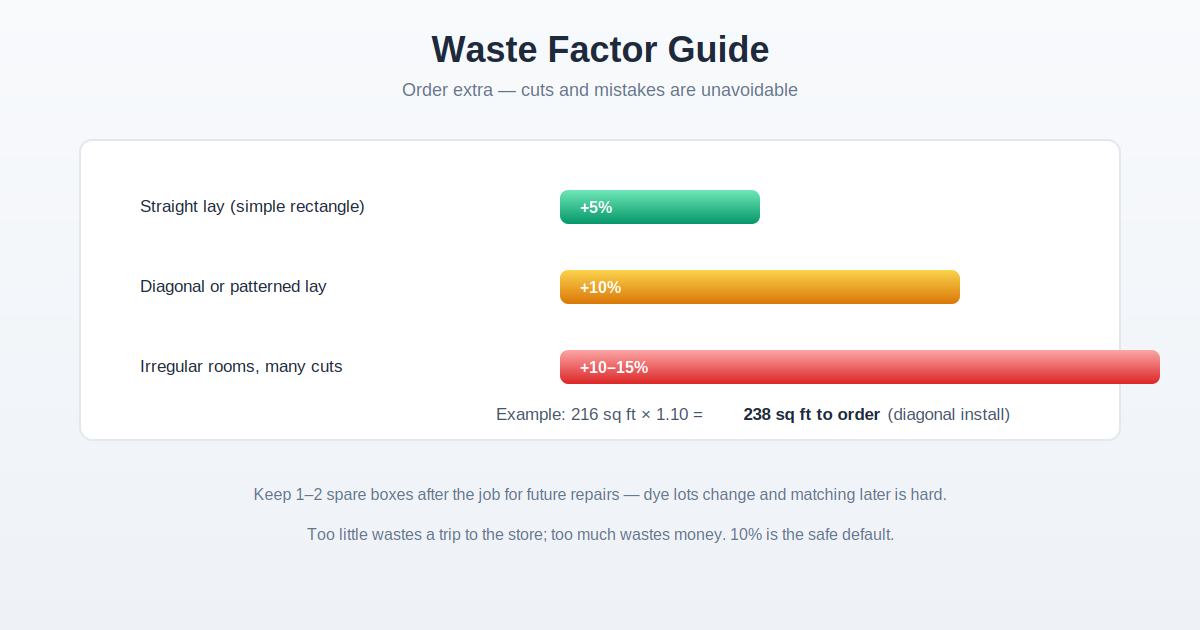
- Set a waste factor. Ten percent works for simple rooms, fifteen percent for diagonal layouts or rooms with many angles.
Flooring Calculator Formula
Room area comes from length times width. The calculator multiplies that area by one plus your waste percentage to get the total material needed. If your flooring comes in boxes, it divides the total by the coverage per box and rounds up to whole boxes.
Room area = length x width. Material needed = room area x (1 + waste percentage). Boxes needed = material needed divided by coverage per box, rounded up.
Example Calculation
Take a living room that is 15 feet by 12 feet. The area is 180 square feet. With a 10 percent waste factor, you need 180 x 1.10 = 198 square feet of flooring.
If your laminate comes in boxes covering 20 square feet each, divide 198 by 20 to get 9.9, which rounds up to 10 boxes. Ordering 10 boxes gives you 200 square feet, enough for the room plus cuts and spares.
Typical Box Coverage by Flooring Type
Most laminate and luxury vinyl plank products cover 18 to 24 square feet per box, so a 180 square foot room needs roughly 8 to 10 boxes before waste. Engineered hardwood usually covers 25 to 35 square feet per carton. Tile is often sold by the square foot or in cases that vary widely by tile size. Always read the coverage printed on your product’s box and enter that exact number in the calculator above — the box label beats any generic average.
Frequently Asked Questions
How much extra flooring should I order for waste?
Order 10 percent extra for straightforward rectangular rooms. Go to 15 percent for diagonal installations, herringbone patterns, or rooms with lots of corners and doorways.
How do I measure an L-shaped room for flooring?
Divide the L into two rectangles, measure each one separately, and add the two areas together. This is more accurate than trying to measure the shape as one piece.
Do I need to include closets in my flooring measurement?
Yes, if the closet will get the same flooring. Measure each closet as its own rectangle and add it to the total. Small closets are easy to forget and annoying to run short on.
What is the difference between square feet and square yards?
One square yard equals 9 square feet. Carpet is often sold by the square yard, so divide your square footage by 9. A 180 square foot room needs 20 square yards of carpet before waste.
Should I remove baseboards before installing new flooring?
Removing baseboards gives the cleanest result, since the flooring can run underneath and the baseboard hides the expansion gap. If you skip this, you will need quarter-round trim to cover the edges.
Related Calculators
Measure first with our Square Footage Calculator, and if you are tiling a bathroom or kitchen, check our Tile Calculator for grout and tile counts.