Log of x in any base, plus natural and common logs.
Results are estimates for planning purposes and are not financial, medical, or professional advice.
How to Use the Logarithm Calculator
Logarithms reverse exponentiation: they tell you what power you need to raise a base to in order to get a number. Enter the number and pick a base, and the calculator returns the logarithm instantly.
- Enter the number you want the logarithm of. It must be greater than zero.
- Choose a base. Common choices are 10, the natural base e, and 2.
- For any other base, select the custom option and type your base value.
- Read the result, which is the exponent that turns your base into your number.
Logarithm Calculator Formula
A logarithm answers the question: to what power must the base be raised to equal x? If log base b of x equals y, then b raised to the power y equals x. To compute a logarithm in an unfamiliar base, divide the natural log of the number by the natural log of the base.
log base b of x = y means b to the power y = x. Change of base: log base b of x = ln(x) divided by ln(b).
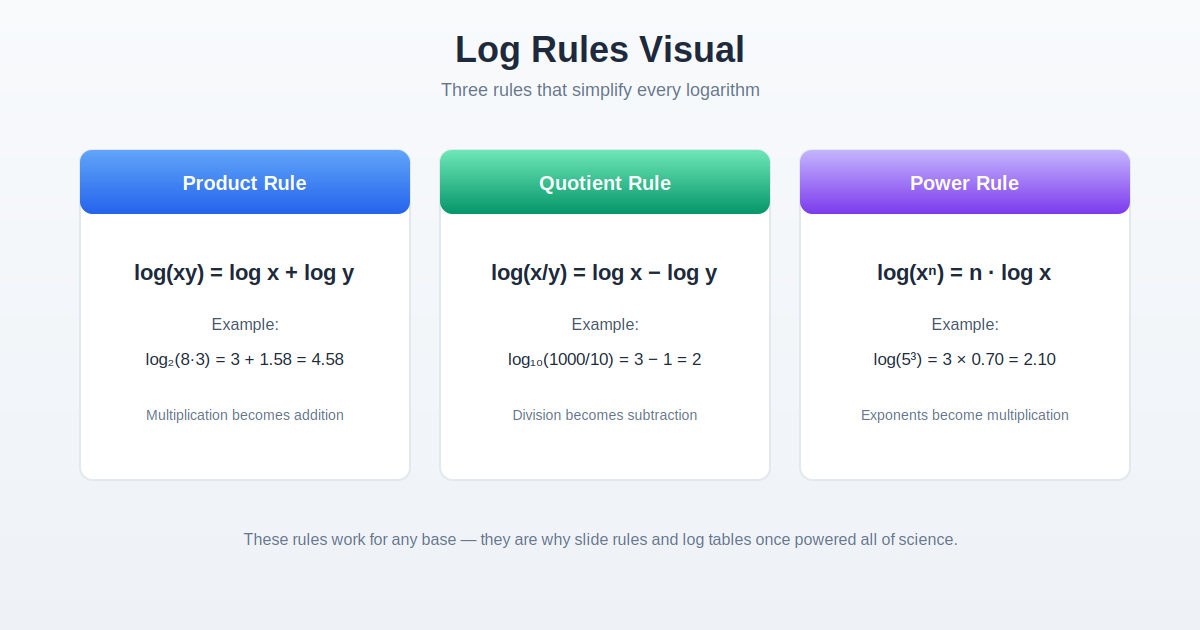
Three properties make logarithms easy to work with. The log of a product equals the sum of the logs; the log of a quotient equals the difference of the logs; and the log of a power brings the exponent down in front. In symbols: log base b of (x times y) = log base b of x + log base b of y; log base b of (x divided by y) = log base b of x minus log base b of y; and log base b of (x to the power p) = p times log base b of x.
Example Calculation
What is log base 10 of 1000? You are asking what power of 10 gives 1000. Since 10 to the power 3 = 1000, the answer is 3.
What about log base 2 of 32? Powers of 2 go 2, 4, 8, 16, 32, so 2 to the power 5 = 32 and the answer is 5. For a trickier one like log base 10 of 500, the change of base formula gives ln(500) divided by ln(10) = 6.215 divided by 2.303 = 2.699.

Frequently Asked Questions
What is a logarithm in simple terms?
A logarithm is the opposite of an exponent. While 10 to the power 3 = 1000 goes from exponent to result, log base 10 of 1000 = 3 goes from result back to the exponent.
What is the difference between log and ln?
Log usually means base 10, the common logarithm used in science and engineering scales. Ln means base e (about 2.718), the natural logarithm used in calculus, growth models, and finance.
Why is there no logarithm of zero or negative numbers?
No power of a positive base can produce zero or a negative number, so the logarithm is undefined there. In the real number system, logarithms only exist for positive values.
What are logarithms actually used for?
The Richter scale for earthquakes, decibels for sound, pH for acidity, and compound interest formulas all use logarithms. They turn huge ranges of numbers into manageable scales.
How do you find a logarithm without a calculator?
Memorize a few anchor points: log base 10 of 10 = 1, log base 10 of 100 = 2, log base 10 of 1000 = 3. For values in between, estimate between the anchors, or use the change of base formula with known natural logs.
How do you calculate log with a different base?
Use the change-of-base formula: log base b of x = ln(x) divided by ln(b). For example, log base 2 of 100 = ln(100) divided by ln(2) = 4.605 divided by 0.693, which is about 6.64. This calculator accepts any base directly, so you never need the conversion by hand.
Related Calculators
Explore growth math with our Exponential Growth Calculator, and crunch everyday numbers with our Percentage Calculator.