Assets minus liabilities — the single number that tracks your financial progress.
Results are estimates for planning purposes and are not financial, medical, or professional advice.
How to Use the Net Worth Calculator
Net worth is the clearest single snapshot of your financial health: everything you own minus everything you owe. List your assets and debts below, and the calculator does the subtraction for you.
- Enter your assets: cash, savings, investments, retirement accounts, home value, and vehicle values.
- Enter your liabilities: mortgage balance, car loans, student loans, and credit card balances.
- Use realistic current values. Check recent statements and look up your home and car values rather than guessing.
- Review your net worth total and the breakdown, then repeat every few months to track your progress.
Net Worth Calculator Formula
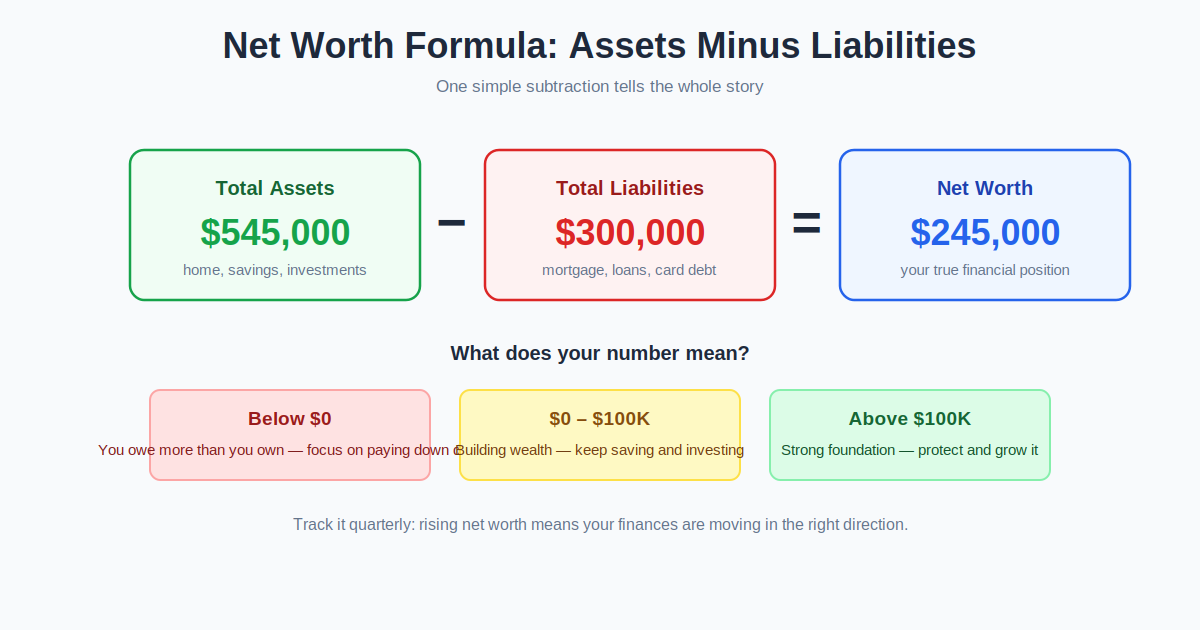
The formula has just one step. Add up the current market value of everything you own to get total assets. Add up every balance you owe to get total liabilities. Subtract liabilities from assets. A positive number means you own more than you owe.
Net worth = total assets minus total liabilities.
Example Calculation
Consider someone with these assets: a home worth 300,000 dollars, retirement accounts at 50,000, savings of 20,000, and a car worth 15,000. Total assets = 385,000 dollars.
Their liabilities: mortgage balance 220,000, car loan 10,000, student loans 10,000, and credit cards 5,000. Total liabilities = 245,000 dollars. Net worth = 385,000 minus 245,000 = 140,000 dollars.

How to Value Your Assets Honestly
Use today’s market values, not what you originally paid. Check recent bank and investment statements for balances, look up your home’s current market value, and value your car at resale prices rather than its purchase price. Leave out future income, everyday household goods you would never sell, and sentimental items. Conservative values beat optimistic ones: net worth should describe what you would actually have if you settled every account today.
Frequently Asked Questions
What is a good net worth for my age?
A common benchmark is having one times your annual income saved by 30, three times by 40, and six times by 50. These are rough guides, not rules, since housing markets and career paths vary widely.
Should I include my home in net worth?
Yes, include your home’s current market value as an asset and the remaining mortgage as a liability. Just remember that home equity is hard to spend, so many people also track net worth without the house.
Are retirement accounts counted in net worth?
Yes. Include 401k, IRA, and pension values at their current balances. They are your assets even though taxes and penalties apply if you withdraw early.
Can net worth be negative?
Absolutely, and it is common for young graduates with student loans. A negative net worth simply means debts exceed assets. The goal is to watch the number climb as you pay down debt and build savings.
How often should I calculate my net worth?
Quarterly is ideal for most people. Monthly works if you are aggressively paying debt, while once a year is enough once your finances are on autopilot. The trend matters more than any single number.
Related Calculators
Grow the asset side with our Compound Interest Calculator, and shrink the liability side by planning payments with our Mortgage Calculator.
Related Guides
Learn more in our detailed guide: How to Calculate Net Worth Step by Step.