Your pace per km/mile plus predicted race times using the Riegel formula.
Results are estimates for planning purposes and are not financial, medical, or professional advice.
How to Use the Running Pace Calculator
Running pace tells you how long it takes to cover one mile or one kilometer, and it is the number most training plans are built around. Enter any race or workout you have completed and this calculator converts it into pace per kilometer, pace per mile, plus predicted finish times for 5K, 10K, half marathon, and marathon.
- Enter the distance you ran, in miles or kilometers.
- Enter your finish time in hours, minutes, and seconds.
- Click Calculate to see your pace per kilometer, pace per mile, and predicted times for 5K, 10K, half marathon, and marathon.
- Use the result to set target paces for easy runs, tempo runs, and race day.
Running Pace Calculator Formula
Pace is simply total time divided by total distance. If you ran 10 kilometers in 52 minutes and 30 seconds, convert the time to minutes (52.5), divide by the distance in your preferred unit, and format the result as minutes and seconds. Average speed is the inverse: distance divided by time, usually shown in miles per hour or kilometers per hour. To convert a per-kilometer pace to a per-mile pace, multiply by 1.609, since there are 1.609 kilometers in a mile.
Example Calculation
Say you finished a 10K race in 52 minutes and 30 seconds. First convert the time to decimal minutes: 52.5. Divide by 10 kilometers to get 5.25 minutes per kilometer, which is 5 minutes and 15 seconds per kilometer. Multiply by 1.609 to get 8.45 minutes per mile, or about 8 minutes and 27 seconds per mile. Your average speed is 10 divided by 0.875 hours, which is roughly 11.4 kilometers per hour. Enter 10K and 52:30 in the calculator to verify the pace figures.
Predicting Race Times with the Riegel Formula
The calculator predicts race times with the Riegel formula, T2 = T1 × (D2/D1)^1.06, where T1 is your time over D1 and T2 the prediction for D2. The 1.06 exponent builds in the slowdown of longer distances. A 10K run in 50:00, for example, predicts 23:59 for 5K, 1:50:19 for a half marathon, and 3:50:01 for a marathon. Predictions assume you have trained for the distance; without the long runs, expect to finish slower.
Pace Needed for Common Race Goals
The pace each popular finish-time goal requires:
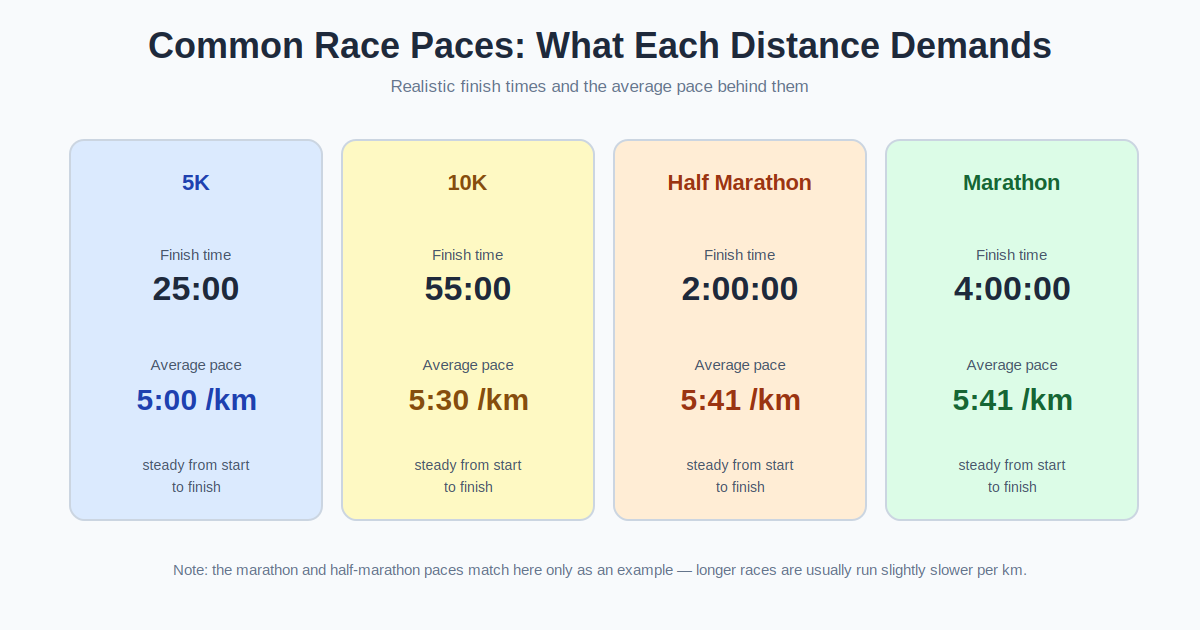
- 5K under 25:00: 5:00 per km (8:03 per mile)
- 10K under 50:00: 5:00 per km (8:03 per mile)
- Half marathon under 2:00: 5:41 per km (9:09 per mile)
- Marathon under 4:00: 5:41 per km (9:09 per mile)
- Marathon under 3:00: 4:16 per km (6:52 per mile)
Frequently Asked Questions
What is the difference between pace and speed?
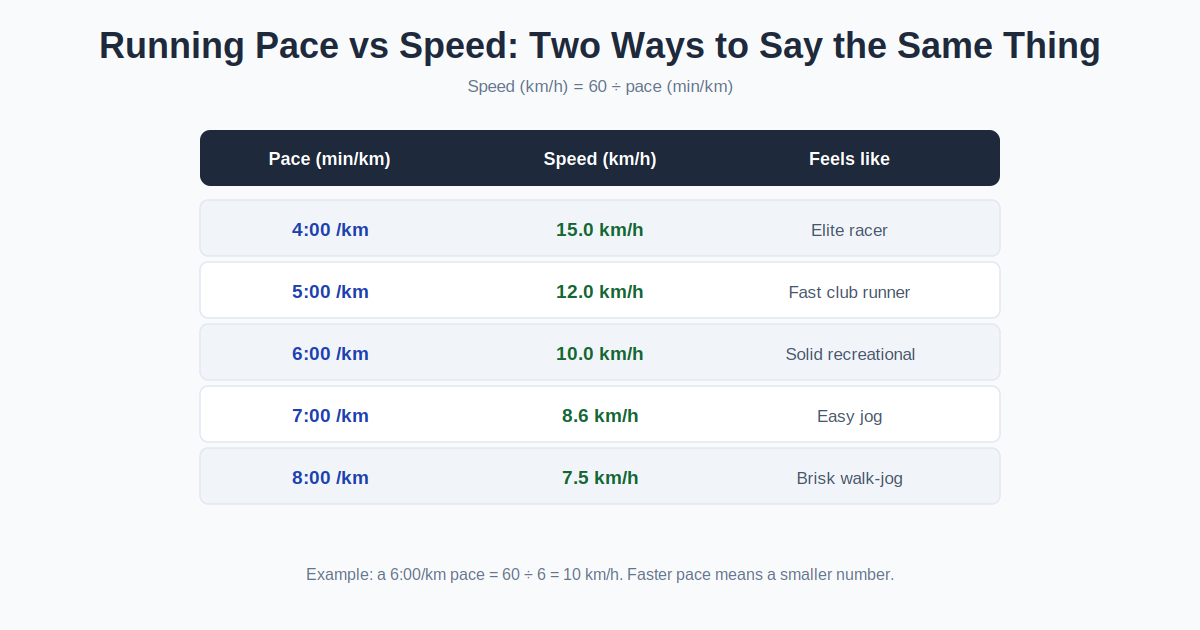
Pace is time per unit of distance, like 9 minutes per mile, while speed is distance per unit of time, like 6.7 miles per hour. Runners usually talk in pace because it maps directly onto training plans.
What is a good running pace for a beginner?
Most new runners land between 10 and 12 minutes per mile for easy runs. Consistency matters far more than speed in the first few months.
How do I convert minutes per kilometer to minutes per mile?
Multiply the per-kilometer pace by 1.609. A 6:00 per kilometer pace becomes about 9:39 per mile.
Can this calculator predict my marathon time?
Yes — the calculator predicts 5K, 10K, half marathon, and marathon finish times from your result using the Riegel formula, which allows for longer-distance slowdown. Predictions assume you have trained for the distance; step up without the long runs and you will probably finish slower.
How can I improve my running pace?
Mix one interval or tempo session per week into mostly easy running, add a weekly long run, and be patient. Most gains come from consistent aerobic mileage.
How do I turn my pace into a treadmill speed?
Divide 60 by your minutes-per-kilometer pace. So 6:00 per km equals 10 km/h (about 6.2 mph), and 5:00 per km equals 12 km/h (about 7.5 mph).
Related Calculators
Try our Calorie Calculator, BMI Calculator, and Steps to Miles Calculator for more fitness tools.