Estimate your VO2 max from a 12-minute Cooper run test.
Results are estimates for planning purposes and are not financial, medical, or professional advice.
How to Use the VO2 Max Calculator
VO2 max is the maximum rate your body can use oxygen during intense exercise, in milliliters per kilogram per minute, and it is the standard measure of cardiovascular fitness. This calculator estimates yours from the Cooper 12-minute run test, on any flat, measured course.
- Warm up for 10 minutes with easy jogging and a few short, faster strides.
- Run as far as you can in exactly 12 minutes, pacing evenly.
- Measure the distance covered in meters. On a 400-meter track, count laps and add the final partial lap.
- Enter the distance and click Calculate.
VO2 Max Calculator Formula
This calculator uses the Cooper test formula: VO2 max = (distance in meters – 504.9) / 44.73. Dr. Kenneth Cooper introduced the 12-minute run in 1968 to assess large groups without laboratory equipment, and the estimate correlated strongly with lab-measured VO2 max in the original research. Pacing decides how honest the result is: starting too fast and fading, or finishing with something in reserve, both skew it. Each extra 100 meters adds about 2.2 ml/kg/min.
Example Calculation
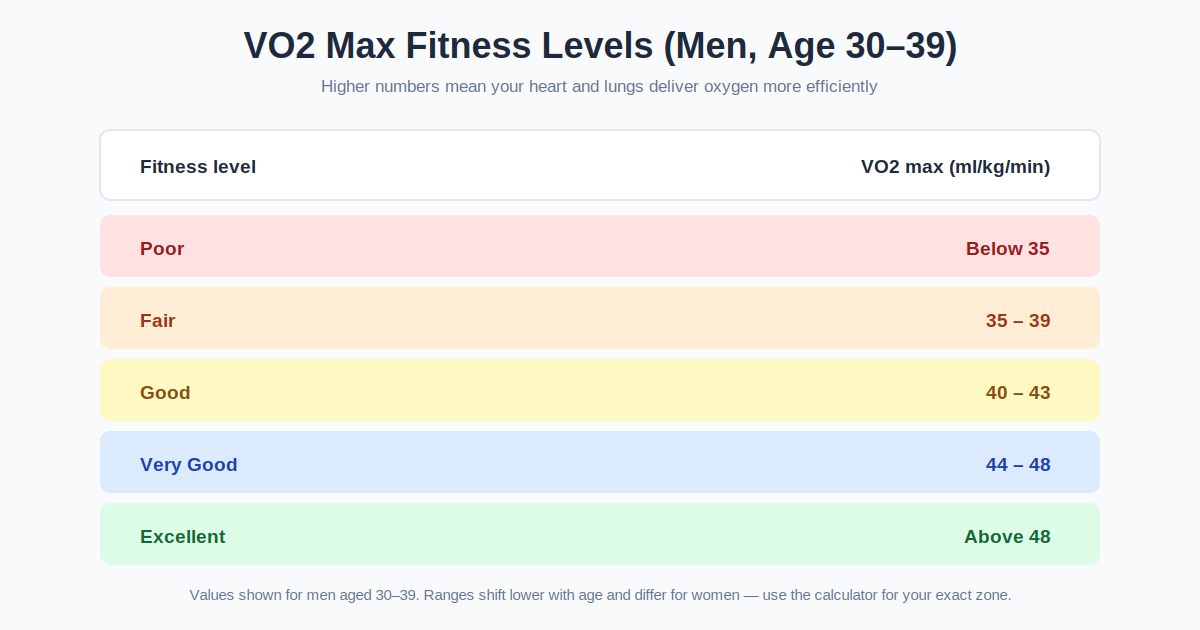
Suppose you cover 2,400 meters in 12 minutes, the default value above. Subtract 504.9 to get 1,895.1, then divide by 44.73 to get about 42.37 ml/kg/min, which the calculator rates as Good on its general scale. Against age-adjusted norms the same score reads differently: it sits near the top of the Good band for a woman aged 30 to 39, while a man the same age would need roughly 44 to reach Good. Enter 2400 above to reproduce this result.
What Your Result Means
The rating in the result panel uses one general scale: under 30 is Poor, 30 to 38 Fair, 38 to 46 Good, 46 to 54 Excellent, and 54 or above Superior. Age and sex shift what is typical, though. On widely used Cooper Institute norms, a man aged 20 to 29 needs about 45 to 51 to be Good, while a woman the same age needs about 40 to 44. Values fall with age, roughly 10 percent per decade after the mid-20s in inactive adults, and women’s values average 10 to 15 percent lower than men’s. Elite endurance athletes commonly reach the 60s and 70s.
Accuracy, Safety, and Improving Your Score
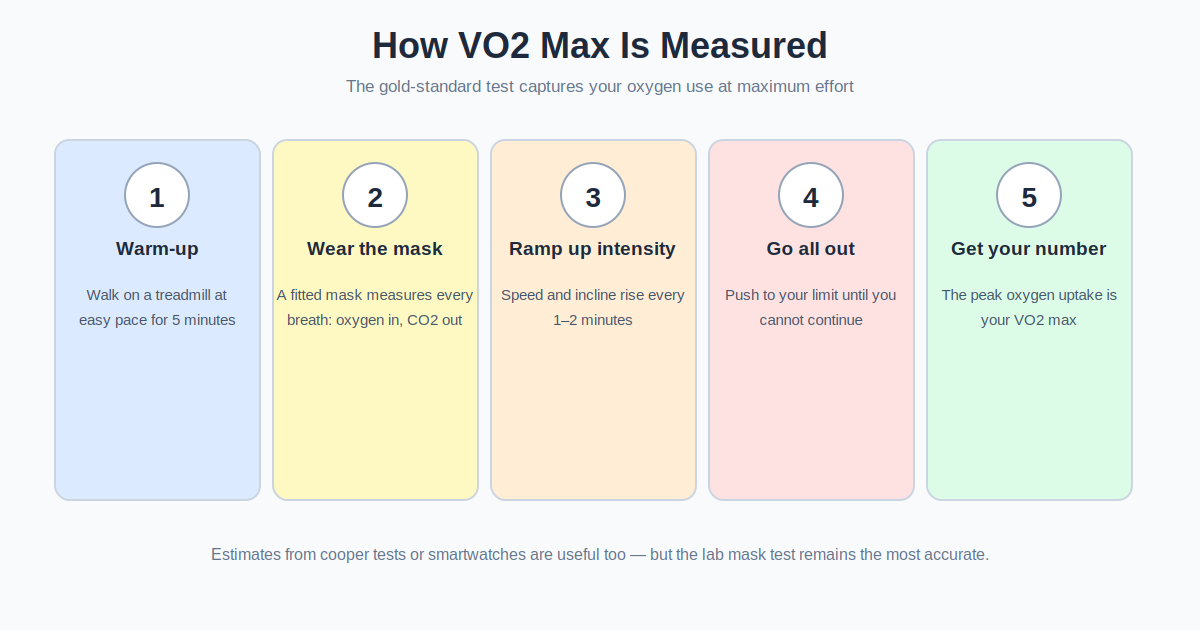
A field test is an estimate, not a lab measurement. Expect it to land within several ml/kg/min of a lab test with breath analysis, worse if the course is mis-measured or the effort is not truly maximal. The test asks for a near-maximal effort, so if you have a heart or lung condition, chest pain, or have been inactive for a long time, check with a doctor first and stop if you feel unwell. To improve, combine plenty of easy aerobic volume with one or two weekly interval sessions, such as 4 rounds of 4 minutes hard with 3 minutes easy. Beginners often improve 10 to 20 percent over a few months. Retest every 6 to 12 weeks under the same conditions and judge the trend, not a single result.
Frequently Asked Questions
What is VO2 max?
VO2 max is the maximum rate at which your body can consume oxygen during intense exercise. It is measured in milliliters of oxygen per kilogram of body weight per minute (ml/kg/min) and is considered one of the best indicators of cardiovascular fitness.
What is a good VO2 max score?
A good VO2 max depends on age and sex. For men aged 20 to 29, above about 51 ml/kg/min is excellent on Cooper Institute norms; for women the same age, above about 44 is excellent. Average scores decline with age, so compare your result against age-adjusted tables.
How is VO2 max calculated from the Cooper test?
Run as far as you can in exactly 12 minutes and measure the distance in meters. The calculator applies VO2 max = (distance in meters minus 504.9) divided by 44.73. Covering 2,400 meters gives about 42.37 ml/kg/min.
How can I improve my VO2 max?
High-intensity interval training (HIIT) is the most effective way to raise VO2 max. Aim for 1 to 2 interval sessions per week, such as 4 rounds of 4 minutes hard with 3 minutes easy, alongside regular aerobic base training, and retest after 6 to 12 weeks.
How accurate is an online VO2 max calculator?
A field-test estimate like this one can sit several ml/kg/min away from a lab measurement with gas analysis. Use the same test, on the same course and under similar conditions each time, and track the change over time rather than chasing a single number.
Does VO2 max decline with age?
Yes. VO2 max typically falls by about 10 percent per decade after the mid-20s in inactive adults, and more slowly in people who keep training. That is why ratings compare you with people of your own age and sex.
Related Calculators
Try our Running Pace Calculator and Calorie Calculator for more fitness tools.