Roth IRA calculator: project your tax-free retirement savings. Enter yearly contributions, your age, retirement age, and expected return to see future balance.
Projection assumes each annual contribution is made at the end of the year. 2026 IRS limits: $7,500 under age 50; $8,600 at age 50 or older.
Results are estimates for planning purposes and are not financial, medical, or professional advice.
How to Use the Roth IRA Calculator
A Roth IRA lets your money grow tax-free, and qualified withdrawals in retirement are also tax-free. This calculator projects what your account could be worth based on steady annual contributions and compound growth.
- Enter how much you plan to contribute each year, up to the IRS annual limit (this calculator accepts up to 8,000 dollars).
- Enter your current age and the age you plan to retire.
- Enter the expected average annual return, such as 7 percent for a stock-heavy portfolio.
- Review your projected tax-free balance, total contributions, and investment growth.
Roth IRA Growth Formula
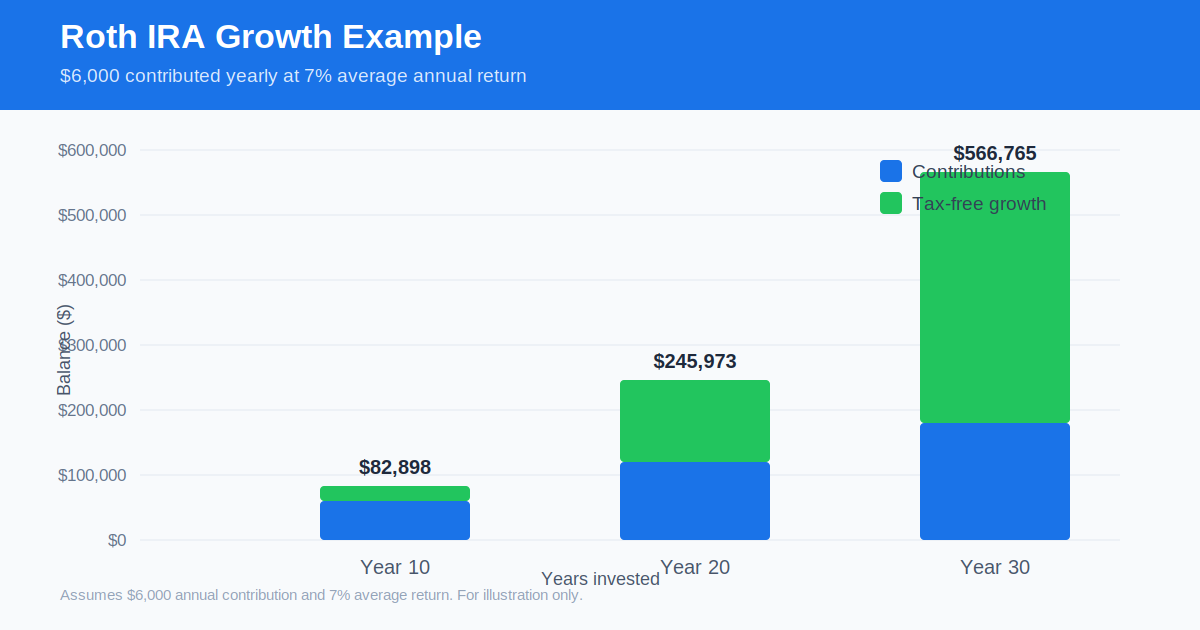
The calculator uses the future value of an annuity formula, which models equal contributions made at the end of each year: FV = PMT x (((1 + r)^n – 1) / r), where PMT is the annual contribution, r is the annual return as a decimal, and n is the number of years. For example, contributing 6,000 dollars per year for 35 years at 7 percent gives 6,000 x (((1.07)^35 – 1) / 0.07), which equals about 829,421 dollars. Because Roth contributions are made with after-tax dollars, the entire projected balance is available tax-free in retirement if IRS rules are followed.
Example
Sara is 30 and plans to retire at 65. She contributes 6,000 dollars every year and expects a 7 percent average annual return. Over 35 years she contributes 210,000 dollars out of pocket, and compound growth turns that into about 829,421 dollars — roughly 619,421 dollars of tax-free investment growth. Waiting until 40 to start would leave her with only about 379,494 dollars — a lost decade of compounding worth roughly 449,927 dollars.
2026 Contribution Limits and Income Rules
Direct Roth contributions phase out at higher incomes: for 2026, between 153,000 and 168,000 dollars of modified adjusted gross income for single filers, and between 242,000 and 252,000 dollars for married couples filing jointly. Above the range, higher earners commonly use a backdoor Roth — contributing to a traditional IRA and converting it. There is no age limit with earned income, and contributions for a tax year can be made until the filing deadline, usually April 15 of the following year. (Limits current as of 2026.)
Withdrawal Rules and the 5-Year Rule
Your own contributions can be withdrawn at any time, at any age, with no tax and no penalty, because that money was already taxed. Earnings are stricter: they come out tax-free and penalty-free only in a qualified withdrawal, generally meaning you are at least 59 and a half and your first Roth contribution was at least five tax years earlier. The five-year clock starts on January 1 of the tax year of that first contribution, so opening an account early starts the clock. Early earnings withdrawals usually mean income tax plus a 10 percent penalty, with limited exceptions.
Frequently Asked Questions
How much can I contribute to a Roth IRA?
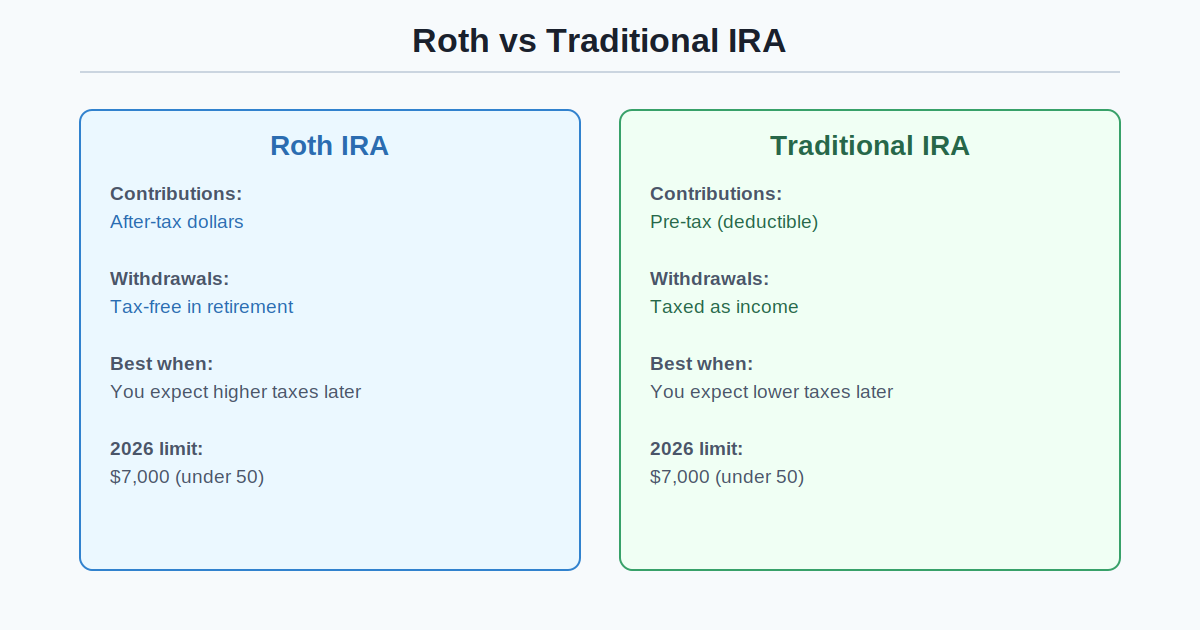
For 2026 the IRS limit is 7,500 dollars under 50, or 8,600 dollars at 50 or older. The limit is shared across all your traditional and Roth IRAs and cannot exceed your taxable compensation. This calculator accepts up to 8,000 dollars.
Is a Roth IRA better than a traditional IRA?
It depends on your tax situation. Roth contributions are after-tax but withdrawals are tax-free, favoring younger savers and anyone expecting higher taxes in retirement. Traditional IRAs give a deduction now but withdrawals are taxed later.
What return should I assume?
A diversified stock portfolio has returned about 7 percent a year after inflation over long periods. Conservative investors might use 5 percent; aggressive ones might use 8 percent.
Do I pay taxes when I withdraw?
Qualified withdrawals — generally after age 59 and a half with the account open at least five years — are completely tax-free, including all growth.
What if I skip contributions some years?
The projection assumes steady annual contributions. Missing years reduces compounding significantly, especially early ones. Try a lower annual amount to model inconsistent saving.
Do Roth IRAs have required minimum distributions?
No. Unlike traditional IRAs and 401(k)s, a Roth IRA has no required minimum distributions during the owner’s lifetime.
Related Calculators
Compare retirement strategies with our 401(k) Calculator and see the power of compounding with the Compound Interest Calculator.