Credit card minimum payment calculator: see how long payoff takes paying only minimums. Enter balance, APR, and minimum percent to reveal total interest.
Results are estimates for planning purposes and are not financial, medical, or professional advice.
How to Use the Credit Card Minimum Payment Calculator
Paying only the minimum feels manageable, but it stretches payoff over years and piles on interest. This calculator simulates month-by-month minimum payments so you can see the true cost.
- Enter your current credit card balance.
- Enter the card APR.
- Enter the minimum payment as a percent of the balance, often 1 to 3 percent.
- Review months to payoff, total interest, and the total you will pay.
Minimum Payment Math
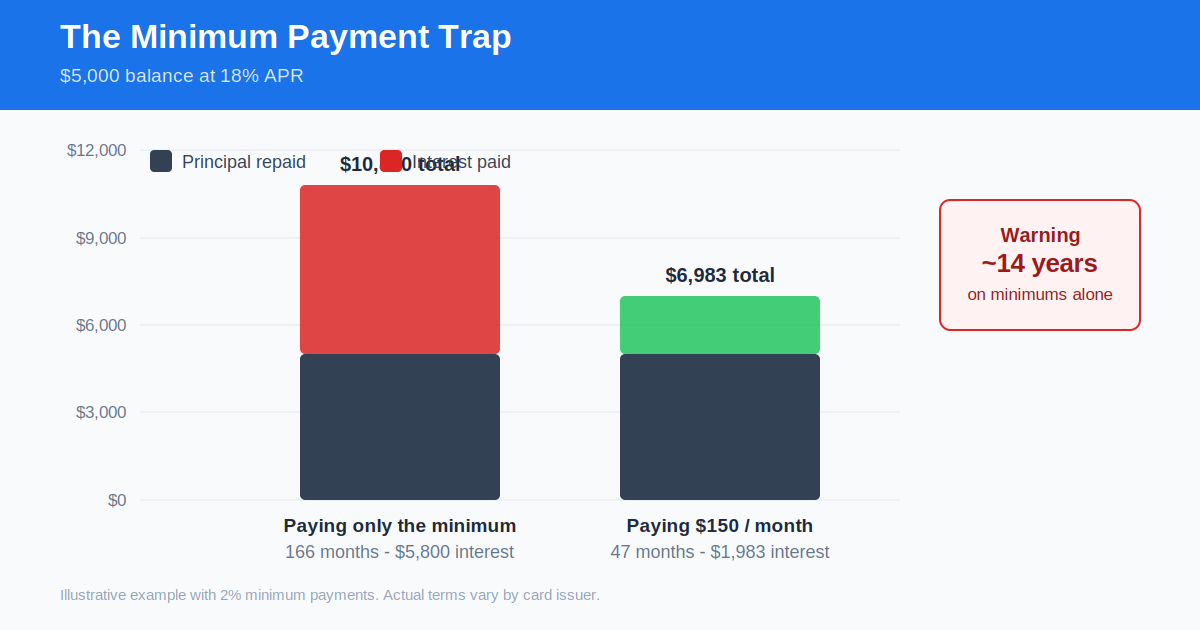
Each month, interest of Balance x (APR / 1200) is added, then you pay the greater of the percent-based minimum and a 25 dollar floor. Because the payment shrinks as the balance shrinks, payoff follows a long tail. A 5,000 dollar balance at 18 percent APR with a 3 percent minimum takes 166 months, costs about 4,497.19 dollars in interest, and totals about 9,497.19 dollars paid. If the minimum does not exceed the monthly interest charge, the balance never decreases, and the calculator will warn you.
Example
Lena owes 5,000 dollars at 18 percent APR and pays only the 3 percent minimum. Her first payment is 150 dollars. She needs 166 months to become debt-free, pays about 4,497.19 dollars in interest, and 9,497.19 dollars in total. Paying a fixed 200 dollars monthly instead would clear the debt far sooner.
Minimum-Only vs a Fixed Payment
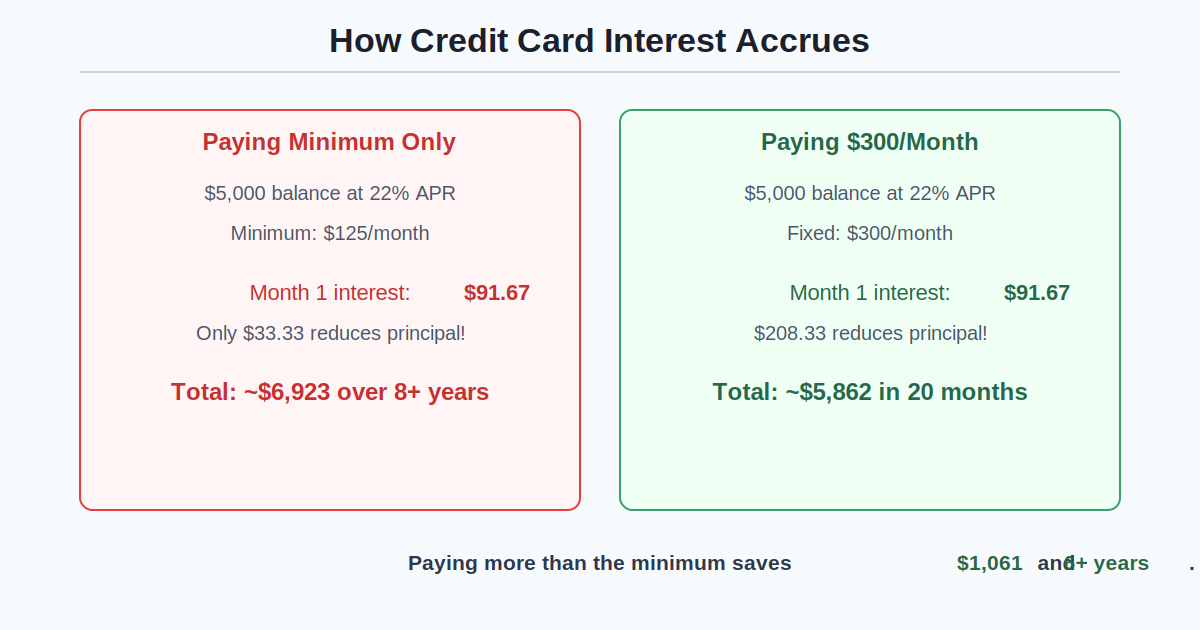
Numbers make the trap concrete. On a 5,000 dollar balance at 18 percent APR, minimum-only payments take about 166 months and cost about 4,497 dollars in interest. Paying a fixed 200 dollars a month instead clears the same balance in about 32 months with about 1,314 dollars in interest, saving about 3,183 dollars. A Credit Card Payoff Calculator can model your own fixed-payment plan in detail.
Frequently Asked Questions
Why does the minimum keep me in debt so long?
Minimums are designed so most of the payment covers interest first. As the balance falls, the percent-based payment falls too, which drags out the final years. A fixed payment above the minimum escapes this trap.
What is a typical minimum payment?
Most issuers require the greater of 1 to 3 percent of the balance or 25 dollars, plus any fees and past-due amounts. Check your cardholder agreement for the exact formula.
Does paying the minimum hurt my credit?
Paying on time protects your score, but high balances raise your utilization ratio, which can lower it. Paying more than the minimum improves utilization faster.
How much faster is a fixed payment?
Dramatically. Doubling the minimum often cuts payoff time by more than half because extra dollars attack principal directly instead of shrinking with the balance.
Should I use savings to pay the card?
If your card charges 18 to 25 percent and savings earn 4 to 5 percent, paying the card is usually the better mathematical move, while keeping a small emergency buffer.
What happens if my minimum payment does not cover the interest?
The balance stops shrinking and can even grow. At 18 percent APR, a 5,000 dollar balance accrues about 75 dollars of interest a month; if your minimum is less than that, you are not paying down debt at all. The calculator warns you when this happens, and a fixed higher payment is the way out.
Related Calculators
Attack balances strategically with the Debt Payoff Calculator and understand borrowing costs with the Loan Calculator.