Pregnancy weight gain calculator: check healthy gain ranges by pre-pregnancy BMI. Enter your BMI category and week to see recommended total and on-track target.
Results are estimates for planning purposes and are not financial, medical, or professional advice.
How to Use the Pregnancy Weight Gain Calculator
Healthy pregnancy weight gain depends on your pre-pregnancy BMI. This calculator uses Institute of Medicine guidelines to show your recommended total range and whether your progress is on track. If you are not sure which category fits you, use our BMI Calculator first.
- Select your pre-pregnancy BMI category.
- Enter your current week of pregnancy, from 1 to 40.
- Review your recommended total gain range.
- Compare the on-track target for your week against your actual gain.
Weight Gain Guidelines
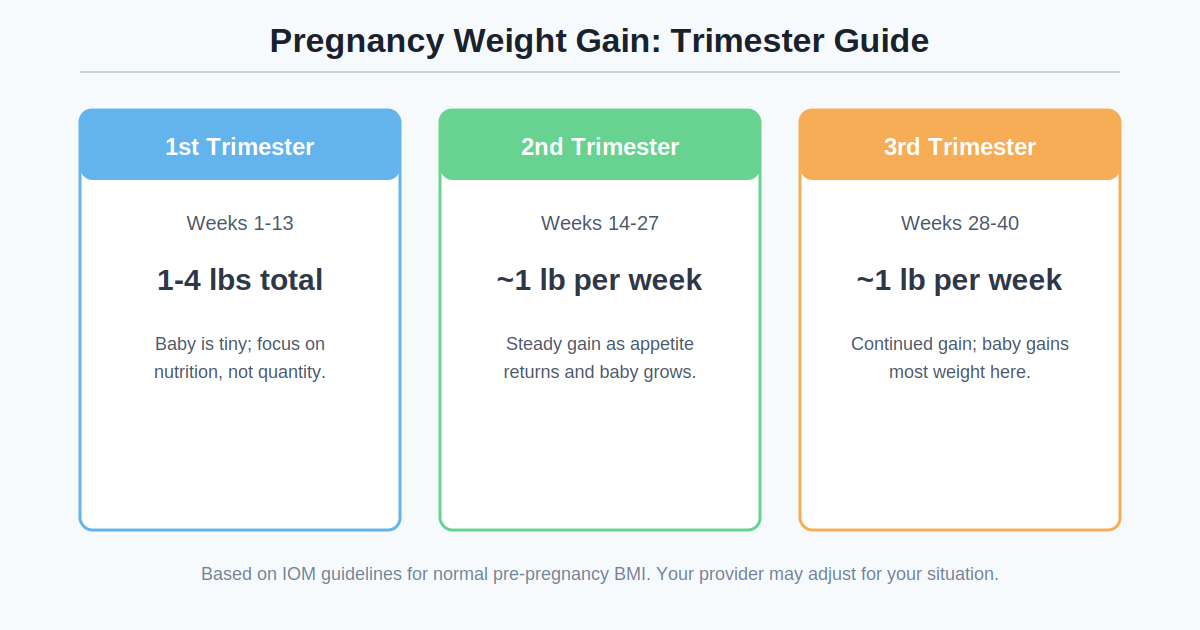
The Institute of Medicine recommends total gains of 28 to 40 lbs for underweight, 25 to 35 lbs for normal weight, 15 to 25 lbs for overweight, and 11 to 20 lbs for obese pregnancies. Gain is not linear: roughly 3 lbs are expected in the first trimester, then steady weekly rates apply, about 0.8 to 1.0 lb per week for normal-weight pregnancies. At week 20, a normal-weight pregnancy is on track at about 3 + 7 x 0.9 = 9.3 lbs gained so far.
Example
Emma started at a normal BMI and is at week 20. Her recommended total gain is 25 to 35 lbs. Her on-track target so far is about 9.3 lbs. If she has gained 9 to 10 lbs, she is right on pace. Her expected weekly rate for the rest of pregnancy is 0.8 to 1.0 lb per week.

Where the Gained Weight Goes
The baby itself is only part of the story. At term, roughly 6 to 8 pounds is the baby, about 1.5 pounds is the placenta, and another 5 to 7 pounds goes to amniotic fluid and increased blood volume. The uterus, breasts, and maternal fat stores make up the rest. Knowing the breakdown explains why a healthy total looks so much bigger than the birth weight alone.
Frequently Asked Questions
Do I need to eat for two?
No. Most pregnancies need no extra calories in the first trimester, about 340 extra per day in the second, and about 450 extra in the third. Quality matters more than quantity.
What if I gain more than recommended?
Talk to your provider rather than dieting, which is not safe in pregnancy. They may adjust nutrition and activity guidance. One high week does not define the trend.
What if I am not gaining enough?
Consistently low gain can also warrant a check-in. Your provider may review nutrition, nausea, or other factors. Never try to lose weight while pregnant unless medically supervised.
Are twins different?
Yes. Twin pregnancies have higher ranges, for example 37 to 54 lbs for normal-weight mothers. This calculator covers singleton pregnancies only.
Does starting BMI really change the target?
Yes. People starting at higher BMIs need less gain because reserves already exist, while those starting underweight need more to support healthy fetal growth. That is why the ranges differ.
How much weight should I gain in the first trimester?
Only about 1 to 4 pounds. The calculator models roughly 3 pounds in the first trimester, with most gain arriving in the second and third trimesters at a steady weekly rate.
How much weight should I have gained by week 20?
On-track targets by week 20 are about 11.05 pounds for underweight, 9.30 for normal weight, 7.20 for overweight, and 6.50 for obese pre-pregnancy BMI, computed from this calculator’s own weekly rates.
Related Calculators
Plan conception timing with the Ovulation Calculator and track nutrition with the Calorie Calculator.