Free standard form calculator: convert any number into scientific notation and engineering notation with a clear step-by-step normalization process shown.
Results are estimates for planning purposes and are not financial, medical, or professional advice.
How to Use the Standard Form Calculator
Enter any number to see it written in scientific notation and engineering notation, the two standard compact forms used across science and engineering. Type the number once; both results appear instantly with the normalization worked out for you.
- Type your number, large or small, positive or negative. Zero is not accepted because zero has no useful standard form.
- Press calculate.
- Read the scientific notation result: one digit before the decimal point, a power of 10 that fixes the scale.
- Read the engineering notation result below it: the exponent is a multiple of 3, so it reads directly in kilo, mega, milli, and the other metric prefixes.
Standard Form Explained
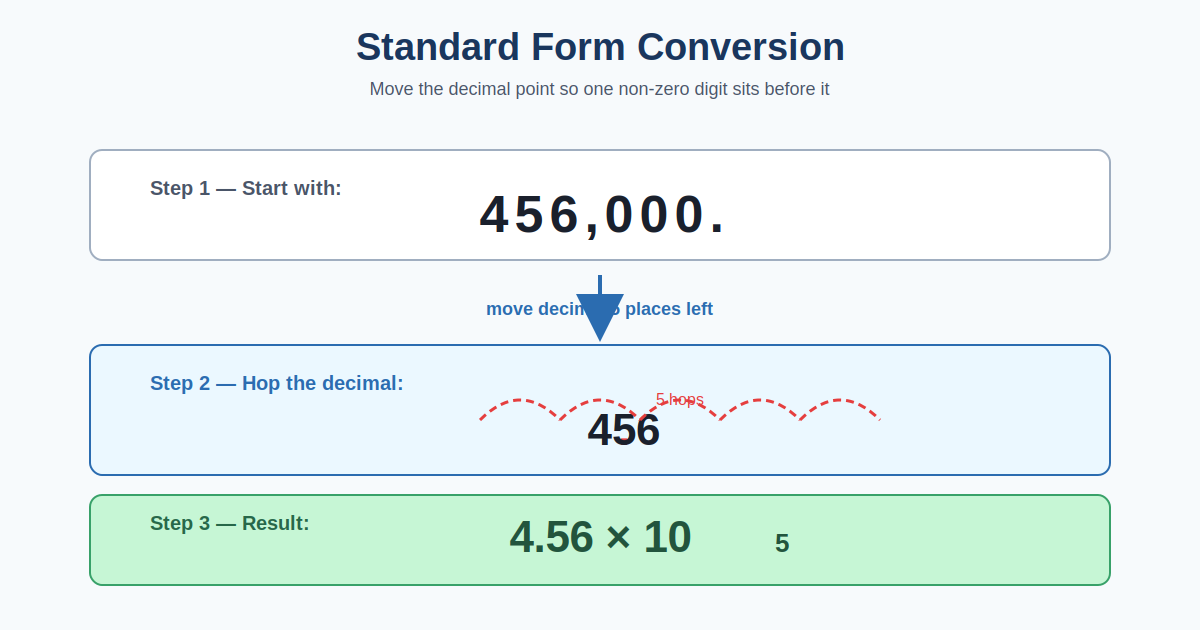
Scientific notation writes a number as a mantissa between 1 and 10 times a power of 10, for example 4.56 times 10 to the 5th. The name “standard form” is what UK mathematics calls it (also known as standard index form) — the two are identical in every rule. Engineering notation is similar but restricts the exponent to multiples of 3, matching metric prefixes like kilo (10³) and mega (10⁶), for example 456 times 10 to the 3rd. To convert by hand, count how many places the decimal point moves: each place is one power of 10, and the exponent is negative when you move the point to the right for a small number.
Step by Step: Converting to Standard Form
Large numbers. Take 456000. Move the decimal point left until one non-zero digit sits before it: 4.56. The point moved 5 places, so the exponent is +5. Result: 4.56 × 10^5. Shortcut: the exponent equals the number of digits after the first digit.
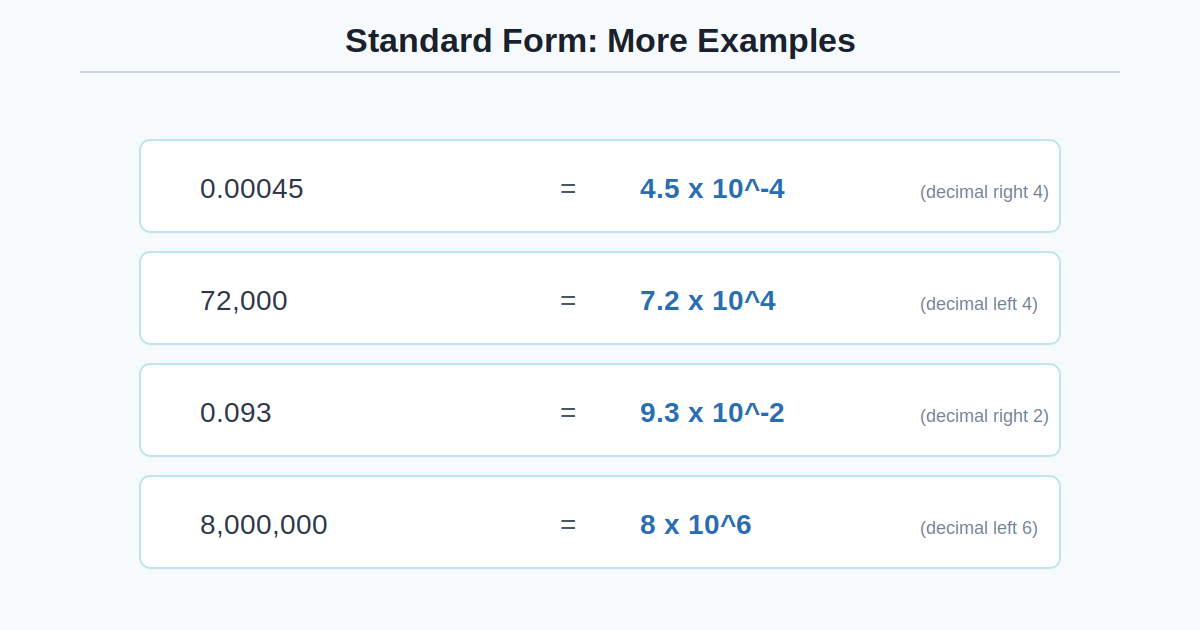
Small numbers. Take 0.000456. Move the decimal point right until one non-zero digit sits before it: 4.56. The point moved 3 places, so the exponent is −3. Result: 4.56 × 10^−4. The negative sign records that the original number was small.
Converting back. Move the decimal point by the exponent: right for a positive power, left for a negative one. 4.5 × 10³ moves the point three places right to become 4,500.
Worked Examples
| Number | Scientific notation | Engineering notation |
|---|---|---|
| 456,000 | 4.56 × 10^5 | 456 × 10^3 |
| 149,600,000 (Earth to Sun, m) | 1.496 × 10^8 | 149.6 × 10^6 |
| 300,000,000 (speed of light, m/s) | 3 × 10^8 | 300 × 10^6 |
| 0.000456 | 4.56 × 10^−4 | 456 × 10^−6 |
| 0.000034 | 3.4 × 10^−5 | 34 × 10^−6 |
| −0.000789 | −7.89 × 10^−4 | −789 × 10^−6 |
This calculator rounds the displayed mantissa to two decimal places, so 149,600,000 shows as 1.5 × 10^8. Negative numbers keep their sign on the mantissa while the exponent logic stays the same.
Working With Standard Form
Arithmetic in standard form follows simple exponent rules. To multiply, multiply the mantissas and add the exponents. To divide, divide the mantissas and subtract the exponents. For addition or subtraction, first align the exponents, then add or subtract the mantissas. Always renormalize afterward so the mantissa sits back between 1 and 10.
Multiply example: (9.109 × 10^−31) × (6.022 × 10^23) = (9.109 × 6.022) × 10^(−31+23) = 54.854 × 10^−8, renormalized to 5.4854 × 10^−7. These rules let scientists combine astronomical distances and atomic scales without drowning in zeros, keeping calculations compact and error-resistant.
E Notation and Calculator Displays
On calculator screens and in spreadsheets you will see E notation: 3.2E5 means 3.2 × 10^5, or 320,000. The E is shorthand for “times ten to the power of”, used because small displays cannot render superscripts. E6, E−4, and the rest work the same way. On graphing calculators the same idea hides behind the EE or EXP key: type 1.5, press EE, type 8, and you have entered 1.5 × 10^8.
Common Mistakes
Keeping the coefficient at 10 or above. 27.8 × 10^4 equals 278,000, but it is not proper standard form — the mantissa must be at least 1 and below 10, so the correct form is 2.78 × 10^5. Intermediate steps can use non-standard forms, but final answers should be normalized.
Wrong exponent sign. Moving the decimal right (small numbers) gives a negative exponent. 6.5 × 10^4 and 6.5 × 10^−4 differ by a factor of a hundred million — the sign is the most consequential character in the notation.
Rounding too early. Keep the mantissa to a sensible precision (two decimal places is typical), but do not round until the end of a multi-step calculation or the error compounds.
Frequently Asked Questions
What is the difference between scientific and engineering notation?
Scientific notation keeps the mantissa between 1 and 10. Engineering notation keeps the exponent a multiple of 3 to align with metric prefixes.
How do I write very small numbers?
Use negative exponents. For example 0.000456 is 4.56 times 10 to the negative 3rd. Count the places the decimal moves to the right: three places gives an exponent of negative 3. The same rule works in reverse for large numbers, where moving left gives positive exponents.
Why do engineers prefer multiples of 3?
Because metric prefixes step by thousands: milli is 10 to the negative 3rd, kilo is 10 to the 3rd, mega is 10 to the 6th.
Can standard form handle negative numbers?
Yes. The sign stays with the mantissa while the exponent logic is unchanged.
Where is scientific notation used?
Physics, chemistry, astronomy, and computing, anywhere with extremely large or tiny quantities.
What does 3.2E5 mean on a calculator display?
It is E notation: the E stands for times ten to the power of, so 3.2E5 equals 3.2 times 10 to the 5th, which is 320,000. Calculators and spreadsheets use E notation because small screens cannot show superscript exponents.
Is standard form the same as scientific notation?
Yes. Standard form is the name used in UK classrooms (also called standard index form), while scientific notation is the US and international name. Both write a number as a mantissa between 1 and 10 times a power of 10.
Related Calculators
Try our Scientific Calculator and Decimal to Fraction Calculator for more math tools.