Estimate bricks for any wall: enter dimensions, pick standard or jumbo brick, and add a waste allowance. Get an accurate order quantity in seconds. Free tool.
Results are estimates for planning purposes and are not financial, medical, or professional advice.
How to Use the Brick Calculator
Ordering too few bricks stalls your project, and ordering far too many wastes money and yard space. This brick calculator gives you an accurate order quantity. Enter the wall size, choose your brick type, add a waste allowance for cuts and breakage, and get the number to order.
- Enter the wall length and height in feet, measuring the outside face of the wall. For multiple walls, add their lengths together at the same height, or run the calculator once per wall and add the results.
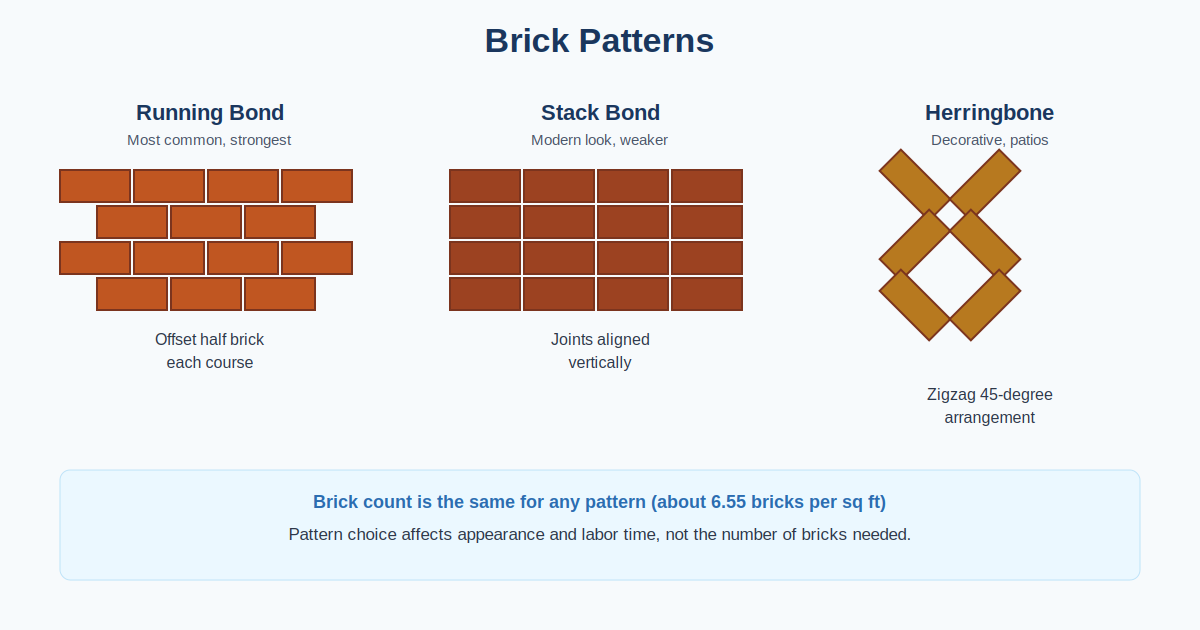
- Select your brick type. Standard bricks need about 6.55 bricks per square foot with a normal mortar joint, while jumbo bricks need about 5.76.
- Enter a waste allowance. Five percent suits straight walls, while walls with many corners, arches, or cuts need 10 percent.
- Order the number of bricks shown, rounded up to full pallets if your supplier sells that way.
Brick Formula
The estimate starts with wall area in square feet, which is length times height. Each brick type covers a known number of bricks per square foot once the mortar joint is included: a standard brick with a three-eighths inch joint works out to 6.55 bricks per square foot, and a jumbo brick works out to 5.76. The rate comes from the face of one brick plus its share of mortar joint — a standard brick face is about 8 by 2 1/4 inches, and with a 3/8-inch joint each brick covers roughly 22 square inches of wall, which divides into 144 square inches per square foot to give about 6.55. Multiply the wall area by the rate for the raw count, then multiply by one plus the waste percentage and round up, because you cannot order a fraction of a brick and running short is far worse than having a few spares.
Example Calculation
A 10 by 8 foot wall using standard brick with 5 percent waste: wall area equals 80 square feet. Raw bricks equal 80 times 6.55, which is 524 bricks. With waste, multiply 524 by 1.05 to get 550.2, and round up to 551 bricks to order.
Bricks Needed for Common Wall Sizes
| Wall area | Standard brick, 5% waste | Jumbo brick, 5% waste |
|---|---|---|
| 50 sq ft | 344 | 303 |
| 100 sq ft | 688 | 605 |
| 200 sq ft | 1,376 | 1,210 |
| 500 sq ft | 3,439 | 3,024 |
These counts are for one wythe — a wall one brick thick. A double-wythe (two-brick) structural wall doubles the number, and so does brick veneer on both faces of a partition.

Ordering and Mortar Tips
Order from one batch. Brick color varies slightly between production runs. Buying the whole job from the same batch keeps the wall uniform; a top-up order later can visibly mismatch, especially on large flat faces.
Think in pallets. A standard pallet (one cube) holds about 500 to 550 bricks. The 551-brick example above is exactly one pallet plus a handful — order two pallets only if the supplier will take back full unopened pallets, or accept a small overage for future repairs.
Mortar estimate. Plan on roughly 7 bags of mortar mix (70 to 80 lb each) per 1,000 bricks laid, with Type S the common choice for exterior walls and Type N for general above-grade work. Joint thickness and whether the mortar is pre-bagged or mixed on site with sand both move the number, so add a small margin.
Openings. Small doors and windows are usually not deducted — the bricks “saved” get consumed by cuts around the opening. For a large garage door or picture window, deduct the opening area from the wall before calculating, or deduct half of it to stay safe.
Storage. Keep pallets on flat ground and covered. Bricks are forgiving, but mud splash and winter freeze-thaw on saturated bricks cause staining and spalling headaches later.
Frequently Asked Questions
How many bricks are in a square foot?
About 6.55 for standard brick with a three-eighths inch mortar joint, and about 5.76 for jumbo brick. Thinner joints need slightly more bricks per square foot.
What waste percentage should I add?
Five percent is standard for simple straight walls. Add 10 percent for walls with corners, openings, arches, or soldier courses that need many cuts.
How many bricks come on a pallet?
A standard pallet holds about 500 to 550 bricks depending on the manufacturer, roughly one cube. Large projects order by the pallet or by the thousand.
Do I count both sides of a wall?
This calculator estimates one wythe, meaning one brick thick. For a double-wythe wall, double the result or run the calculator twice.
How much mortar do I need?
Plan on roughly 7 bags of mortar mix (70 to 80 pounds each) for every 1,000 bricks laid — about one bag per 140 bricks, or per 22 square feet of standard brick wall. Joint size, brick texture, and whether the mortar is pre-bagged or mixed on site with sand all shift this figure, so buy a little extra.
How many bricks do I need for a 100 square foot wall?
With standard brick: 100 times 6.55 equals 655 bricks, plus 5 percent waste gives 688 to order. With jumbo brick: 100 times 5.76 equals 576, plus 5 percent waste gives 605.
What size is a standard brick?
A standard modular brick measures about 7 5/8 by 2 1/4 by 3 5/8 inches (length by height by width). Laid with a 3/8-inch mortar joint, each brick plus its joint covers about 22 square inches of wall face — the basis of the 6.55 bricks per square foot rate.
Related Calculators
Building more? Try our Square Footage Calculator, Drywall Calculator, and Flooring Calculator.