Roll virtual dice online: up to 100 dice with 4, 6, 8, 10, 12, or 20 sides. See every individual roll and the total instantly. Free dice roller for games.
Results are estimates for planning purposes and are not financial, medical, or professional advice.
How to Use the Dice Roller
No dice handy for game night? This virtual dice roller handles everything from a single d20 to a full bucket of d6s. Choose how many dice to roll and how many sides each has, and see every individual result plus the total, so you can check the math yourself.
- Enter the number of dice to roll, from 1 up to 100.
- Select the die type: d4, d6, d8, d10, d12, or d20.
- Read the results: the dice notation like 2d6, each individual roll, and the summed total.
- Roll again for a fresh result. Every roll is independent of the last — a die has no memory.
Dice Notation Cheat Sheet
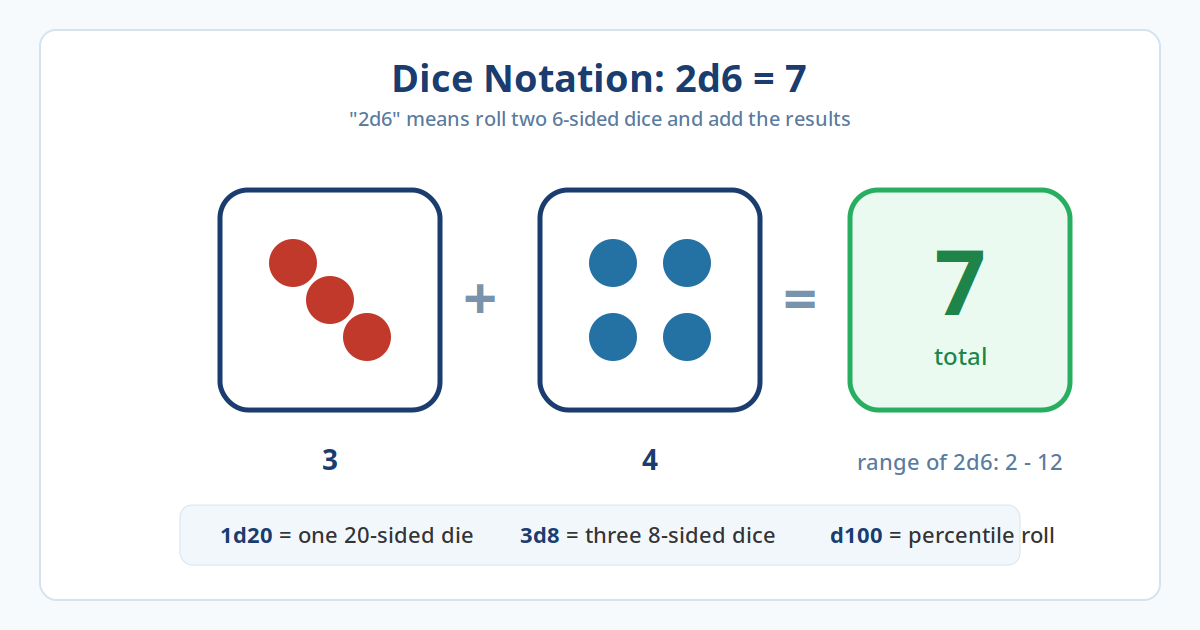
Game books write rolls in dice notation: NdX, where N is the number of dice and X is the number of sides on each die. So 3d8 means roll three 8-sided dice and add them. This roller covers the six classic polyhedral dice:
| Die | Sides | Typical uses |
|---|---|---|
| d4 | 4 | Small weapon and spell damage in role-playing games |
| d6 | 6 | Classic board games, Yahtzee, most weapon damage, character stats |
| d8 | 8 | Mid-size weapon damage, hit dice for several character classes |
| d10 | 10 | Percentile rolls (two d10s), larger weapon and spell damage |
| d12 | 12 | Heavy weapon damage, the barbarian class hit die |
| d20 | 20 | Attack rolls, saving throws, and skill checks in d20-based games |
Some games write modifiers after the notation, such as 2d6+3 (“add 3 to the total”) or 4d6kh3 (“roll 4, keep the highest 3”). This roller shows you every individual die, so you can apply those house rules yourself: roll the dice, then add the modifier or drop the lowest result by eye.
How Dice Rolls Work
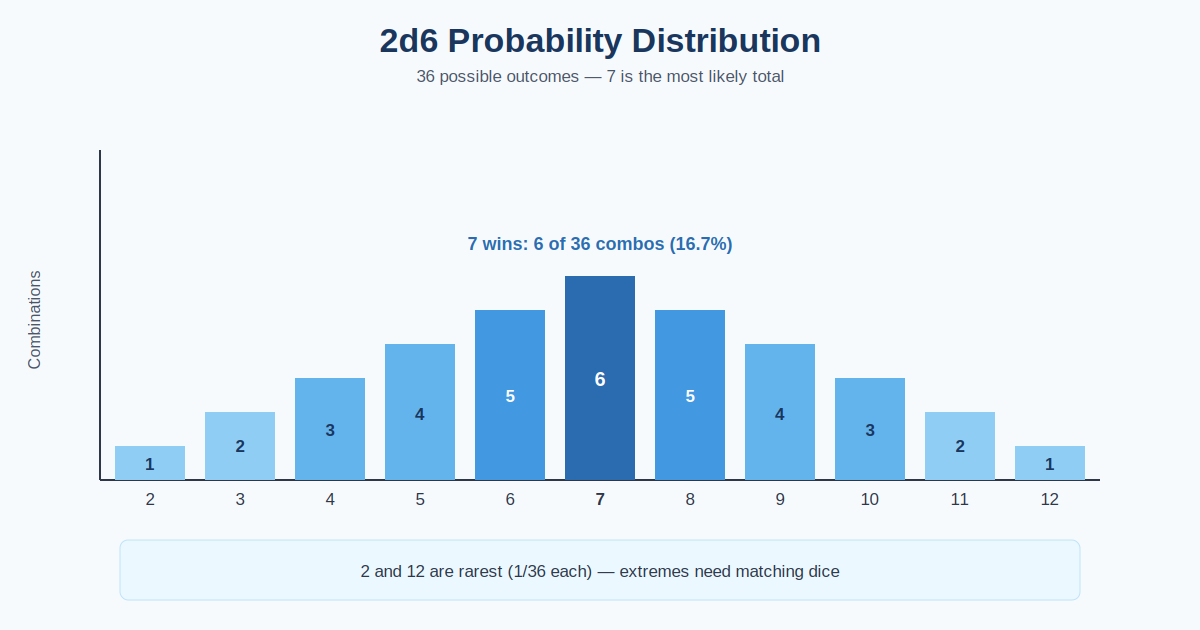
Each die produces a random whole number from 1 up to its number of sides, with every face equally likely. Rolling 2d6 means two independent 6-sided dice whose results are added together, giving totals from 2 to 12. The most common total for 2d6 is 7, because six of the thirty-six combinations make 7, while only one combination makes 2 or 12. That is why two dice feel “bell-curved”: middle totals happen often and extremes are rare.
| 2d6 total | Combinations | Chance |
|---|---|---|
| 2 | 1 of 36 | 2.78% |
| 3 | 2 of 36 | 5.56% |
| 6 | 5 of 36 | 13.89% |
| 7 | 6 of 36 | 16.67% |
| 8 | 5 of 36 | 13.89% |
| 11 | 2 of 36 | 5.56% |
| 12 | 1 of 36 | 2.78% |
A single die, by contrast, has a flat distribution: a d20 gives every number from 1 to 20 an equal 5 percent chance, which is why role-playing games use it for yes-or-no checks like attacks and saves. One more useful number: the average of a single die is (sides + 1) divided by 2 — 3.5 for a d6 and 10.5 for a d20.
Example
Rolling 2d6 might produce 4 and 5, for a total of 9. Rolling a single d20 produces one number between 1 and 20, such as 17. Rolling 4d6, common for character stats, produces four numbers like 3, 6, 2, and 5, totaling 16 — and since character creation usually keeps the best three, you would drop the 2 and keep 13.
Probability Tips for Game Night
A few patterns are worth knowing at the table. First, expected totals: multiply the single-die average by the number of dice. 2d6 averages 7, 4d6 averages 14, and 3d10 averages 16.5. Second, a natural 20 on a d20 has exactly a 5 percent chance — one roll in twenty — no matter how “due” it feels. Third, games with advantage mechanics (roll two d20s, keep the higher) work fine here: set the dice count to 2, choose d20, and read both results. Advantage helps a lot in the middle of the range: a roll that needs 11 or better succeeds 50 percent of the time normally, but about 75 percent with advantage.
Frequently Asked Questions
What does 2d6 mean?
It means roll two 6-sided dice and add the results. The first number is the dice count and the second is the sides per die, so 3d8 is three 8-sided dice.
Are online dice rolls fair?
Yes. Each face has an equal probability on every roll, matching physical dice. This roller uses your device’s random number generator, which is fair for games.
What is a d20 used for?
The 20-sided die is the signature die of tabletop role-playing games, used for attack rolls, saving throws, and skill checks where every outcome from 1 to 20 is equally likely.
Can I roll 100 dice at once?
Yes, up to 100 dice per roll. The results list every individual die so you can verify the total.
Why do board games use two dice instead of one twelve-sided die?
Two dice create a bell curve centered on 7, making middle results common and extremes rare. A single d12 gives every number equal odds, which plays very differently.
What is the average roll of a d6?
3.5. The average of a single die is (sides + 1) divided by 2, so a d6 averages 3.5 and a d20 averages 10.5. Multiply by the number of dice: 2d6 averages 7 and 4d6 averages 14.
How do I roll with advantage using this dice roller?
Set the number of dice to 2 and choose the d20. For advantage, take the higher of the two individual rolls shown; for disadvantage, take the lower. The results line lists both dice so you can compare them at a glance.
Related Calculators
More game-night tools: try our Random Number Generator, Percentage Calculator, and Average Calculator.