Find how long your speech takes: enter a word count or paste your script, pick a speaking pace, and get the exact duration. Free speaking time calculator.
Results are estimates for planning purposes and are not financial, medical, or professional advice.
How to Use the Speaking Time Calculator
Wedding toast, class presentation, or conference talk: knowing your speech length before you stand up matters. This calculator converts your script into speaking time. Paste the full text for an automatic count, or enter the word count, then choose your speaking pace. It is the fastest and easiest way to check whether your talk fits the time slot.
- Paste your speech script into the box, or enter the word count if you already know it.
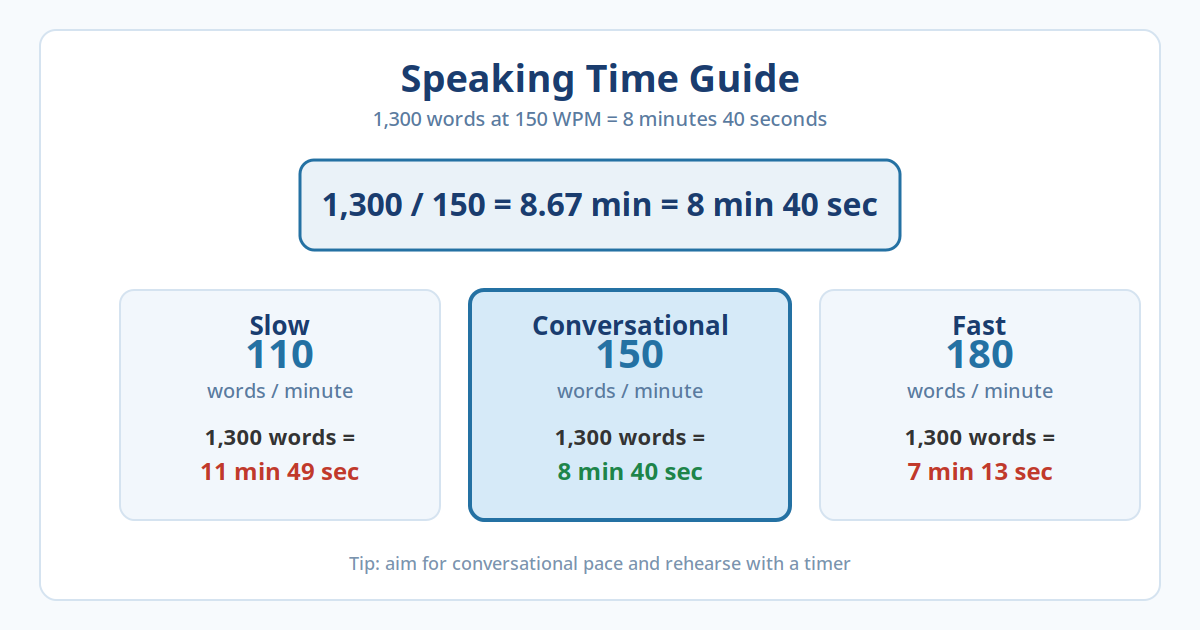
- Choose your pace: 110 words per minute for slow deliberate delivery, 150 for natural conversation, 180 for fast energetic speaking.
- Read the duration in minutes and seconds.
- Rehearse out loud once, since pauses and audience reactions add real time.
Speaking Time Formula
Speaking time equals the word count divided by words per minute, converted to minutes and seconds. Most people speak at 120 to 160 words per minute in conversation, while trained presenters often land near 150. Auctioneers and sports commentators can exceed 200, but audiences struggle to follow. Nerves make most speakers rush, so planning at a conversational 150 words per minute with pauses built in is the safest approach for important talks.
Example Calculation
A 1,300-word speech at a conversational 150 words per minute takes 1,300 divided by 150, which is 8.667 minutes. Multiply the fraction by 60 seconds to get 8 minutes and 40 seconds of speaking time.
Words-to-Time Quick Reference
Speech and reading aloud run at very different speeds. Use 130 words per minute for a natural speaking pace and 238 words per minute for reading aloud:
| Words | Speaking time (130 wpm) | Reading time (238 wpm) |
|---|---|---|
| 250 | ~2 min | ~1 min |
| 500 | ~4 min | ~2 min |
| 750 | ~6 min | ~3 min |
| 1,000 | ~8 min | ~4 min |
| 1,500 | ~12 min | ~6 min |
| 2,000 | ~15 min | ~8 min |
| 3,000 | ~23 min | ~13 min |
| 4,000 | ~31 min | ~17 min |
| 5,000 | ~38 min | ~21 min |
Measure Your Own Speaking Pace
Averages are a starting point; your pace is personal. Pick 300 to 400 words of your own script, read them aloud at your natural presentation speed while timing yourself, then divide the word count by the minutes. That is your personal words-per-minute rate.
Most speakers land between 125 and 150 wpm. Below 100 sounds sluggish, above 170 strains comprehension. If you are over time, cut words — never just talk faster. And always budget a 10 to 15 percent buffer for pauses, audience reactions, and questions.
Frequently Asked Questions
How many words is a 5-minute speech?
About 650 to 750 words at a natural pace. Plan for 700 words and leave room for pauses and audience reactions.
How many words per minute should I speak?
Aim for 130 to 160 words per minute. Slower sounds thoughtful, faster sounds energetic, but going much above 180 hurts clarity.
Why do I always run over time?
Nerves speed most speakers up while pauses for laughter, questions, and slide changes add time. Rehearse with a timer and trim 10 percent as a buffer.
How long is a 10-minute presentation in words?
Roughly 1,300 to 1,500 words. Slides with demos or videos cut into that, so reduce the word count when visuals carry part of the talk.
Does the calculator count pauses?
No, it measures pure speaking time. Add 10 to 15 percent for natural pauses, transitions, and audience interaction.
How many words is a 20-minute presentation?
About 2,600 to 3,000 words at a normal speaking pace of 130 to 150 words per minute. If your talk includes demos or videos, plan fewer words — visuals eat clock time fast.
Should I budget extra time for pauses and questions?
Yes — add 10 to 15 percent on top of your script time for natural pauses, transitions, and audience reactions. For interactive sessions, reserve a separate Q&A block rather than squeezing questions into your speaking minutes.
Related Calculators
Preparing a talk? Try our Word Counter, Business Days Calculator, and Reading Time Calculator.