Check password strength instantly: entropy bits, crack-time estimate, and tips to improve. See if your password is weak or very strong. Free online checker.
Results are estimates for planning purposes and are not financial, medical, or professional advice.
How to Use the Password Strength Checker
Wondering if your password would survive an attack? Type it into the checker to see its entropy in bits, a strength rating, and how long it would take to crack. Your password never leaves your device: the entire check runs in your browser.
- Type or paste the password you want to test.
- Read the entropy score, measured in bits. More bits mean exponentially more guesses needed.
- Check the strength rating from Weak to Very Strong.
- Follow the tip shown to fix the weakest part of your password, then test the improved version.
Password Entropy Formula
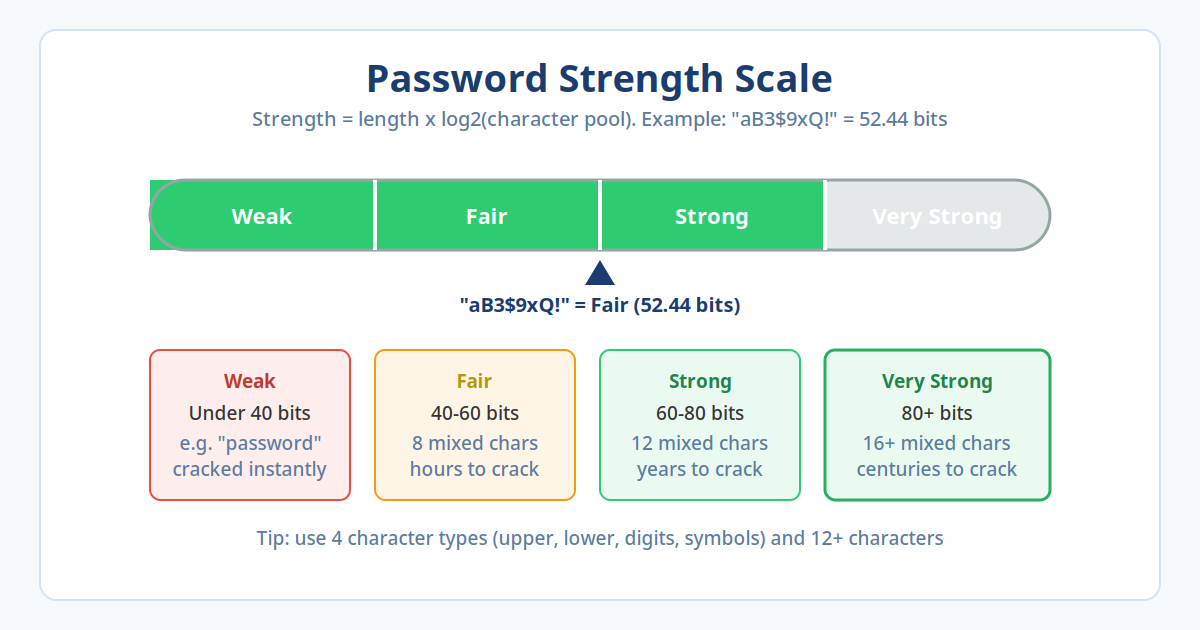
Entropy equals password length multiplied by the base-2 logarithm of the character pool size. The pool depends on which character types you use: 26 for lowercase only, 52 for mixed case, 62 adding digits, and 94 adding symbols. An 8-character password using all four types has 8 times log2(94), about 52.4 bits of entropy. Crack time estimates assume an attacker trying 10 billion guesses per second, then halve the total combinations since the password is found halfway through on average. Each extra bit of entropy doubles the cracking time, which is why length beats complexity.
Example
The password aB3$9xQ! is 8 characters using lowercase, uppercase, digits, and symbols, so the pool is 94. Entropy equals 8 times 6.55, which is 52.44 bits, rated Fair. Estimated crack time is a few days against a fast attacker, which is why experts now recommend 12 or more characters.
How Long Would Your Password Take to Crack?
Brute-force time grows with the size of the character set raised to the password’s length. At ten billion guesses per second — roughly one modern graphics card — the numbers look like this:
| Password | Time to exhaust |
|---|---|
| 8 lowercase letters | About 21 seconds |
| 8 full characters | About 7 days |
| 10 full characters | About 170 years |
| 12 full characters | About 1.5 million years |
| 16 full characters | Practically forever |
Two lessons jump out. First, length beats complexity: adding one character multiplies crack time by the size of the alphabet. Second, an 8-character password is crackable on commodity hardware no matter how complex it looks — real security starts around 12 random characters.
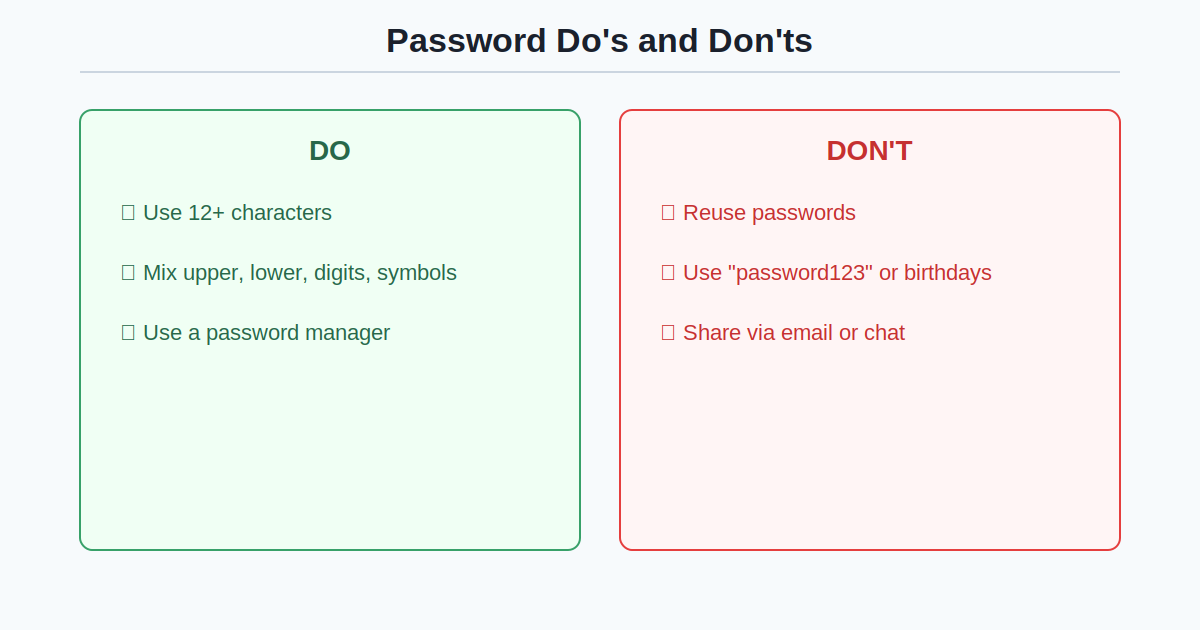
Attackers rarely brute-force blindly, though. Dictionary words, leaked passwords, and personal details fall in seconds regardless of these tables. That is why random passphrases and a password manager matter more than any single clever password.
Frequently Asked Questions
What is a good password entropy?
Aim for at least 60 bits for important accounts, which means about 12 random characters using mixed types, or 5 random words.
Is a long simple password better than a short complex one?
Usually yes. Four random words like correct horse battery staple have around 52 bits and are easy to remember, beating most 8-character complex passwords.
What does crack time assume?
Ten billion guesses per second, roughly one modern graphics card. Organized attackers with many machines go much faster, while online login limits make guessing far slower.
Should I still change passwords regularly?
Only if there is a breach. Forced rotation pushes people toward weaker passwords. Use a unique strong password per site and a password manager instead.
Does this checker store my password?
No. The calculation runs entirely in your browser and nothing is sent anywhere. Still, avoid testing your actual banking password on any website.
Are passphrases safer than complex passwords?
Usually yes. Four or five random words give around 50 to 65 bits of entropy and are far easier to remember than a 12-character jumble. The key word is random — a famous song lyric is not a passphrase.
Should I use a password manager?
Yes. A manager generates and stores a unique, long, random password for every site, so one breach cannot cascade into your other accounts. It also removes the temptation to reuse passwords.
Related Calculators
Need a stronger password? Try our Password Generator, Scientific Calculator, and Percentage Calculator.