Compare unit prices and find the better deal: enter two products with prices and quantities. See unit costs, the winner, and your savings percent. Free.
Results are estimates for planning purposes and are not financial, medical, or professional advice.
How to Use the Unit Price Calculator
Bigger packages look cheaper, but the shelf price hides the real cost per ounce, per pound, or per sheet. This unit price calculator compares two products side by side, finds the true better deal, and shows your savings as a percentage. Never overpay for groceries or household goods again.
- Enter the price and quantity of product A, plus its unit, for example ounces.
- Enter the price and quantity of product B in the same unit. Both products must use matching units to compare fairly.
- Compare the unit prices shown for each product.
- See which product wins and how much you save as a percentage.
Unit Price Formula
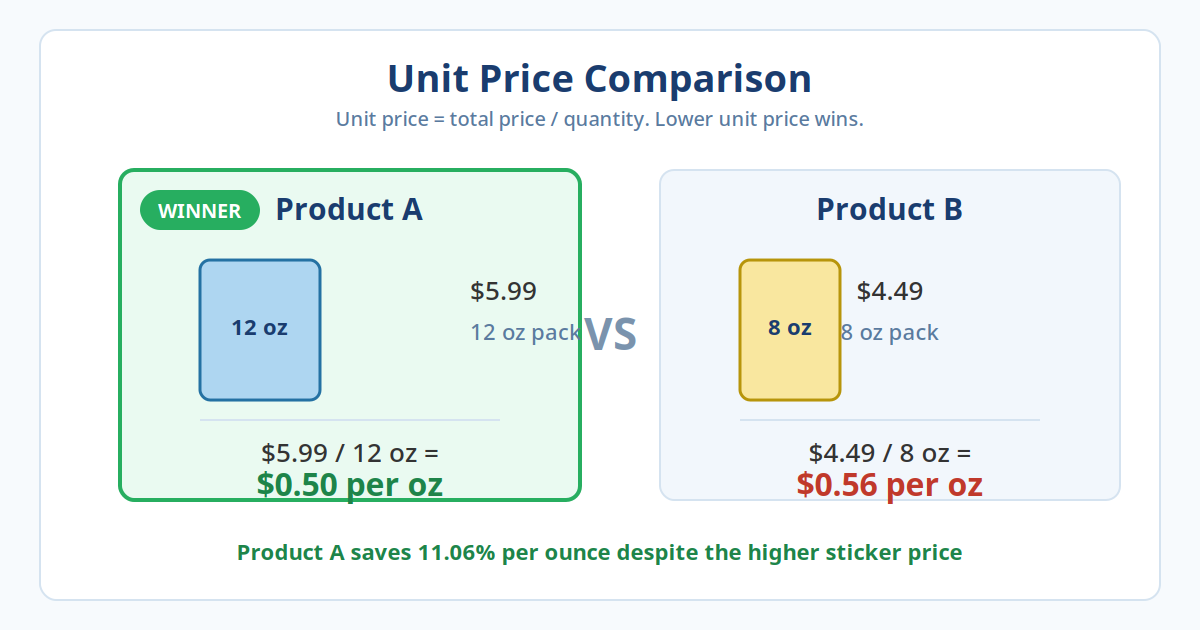
Unit price equals the total price divided by the total quantity. For product A at 5.99 dollars for 12 ounces, the unit price is 5.99 divided by 12, or about 50 cents per ounce. Compare the two unit prices directly: the lower one is the better value. Savings percent equals the higher unit price minus the lower, divided by the higher, times 100. This works for any unit, ounces, pounds, liters, sheets, or packs, as long as both products use the same one.
Example
Product A costs 5.99 dollars for 12 ounces, giving a unit price of 50 cents per ounce. Product B costs 4.49 dollars for 8 ounces, giving 56 cents per ounce. Product A is the better value, and you save 11.06 percent versus product B by choosing it.
Comparing Across Units: Conversions That Matter
Unit price only works when both products share the same unit, so keep these conversions handy: 1 ounce equals 28.35 grams, 1 pound equals 16 ounces or 453.6 grams, 1 fluid ounce equals 29.57 milliliters, and 1 kilogram equals 1,000 grams or about 2.205 pounds.
Try a real shelf comparison. A 340 gram jar at 3.49 dollars costs 3.49 divided by 3.4 — about 1.03 dollars per 100 grams. A 1 kilogram bag at 6.29 dollars costs 6.29 divided by 10 — about 0.63 dollars per 100 grams. The kilogram bag is the clear winner despite the higher sticker price.
Same-unit checks work the same way: 16 ounces of peanuts at 2.44 dollars is 2.44 dollars per pound, which beats the 2.99 dollar per pound bulk bag. Convert first, compare second, and never trust the sticker price alone.
Frequently Asked Questions
What is unit price?
The cost of one unit of a product, such as price per ounce or per pound. It lets you compare different package sizes fairly.
Is the bigger package always cheaper?
Often but not always. Stores sometimes price mid-size packages best to catch shoppers who assume biggest wins. Always check the unit price.
What if the units are different?
Convert them first so both products use the same unit. Comparing price per ounce against price per pound gives a meaningless answer.
Should I consider quality too?
Yes. Unit price only compares cost. A cheaper-per-ounce product you throw away is no bargain, so weigh quality and waste too.
Where do I find unit prices in stores?
Most shelf labels show a small unit price next to the big price, but the units vary by product. This calculator keeps the math consistent.
How do I compare price per ounce with price per pound?
Multiply the price per ounce by 16 to get price per pound, or divide the price per pound by 16 for price per ounce. The calculator handles the conversion, but knowing the factor helps you sanity-check shelf labels.
Why do stores show price per 100 grams?
Because it keeps numbers comparable across package sizes. A 340 gram jar and a 1 kilogram bag look nothing alike in per-package price, but per-100-gram figures reveal the cheaper option instantly.
Related Calculators
Shopping smarter? Try our Discount Calculator, Tip Calculator, and Percentage Calculator.