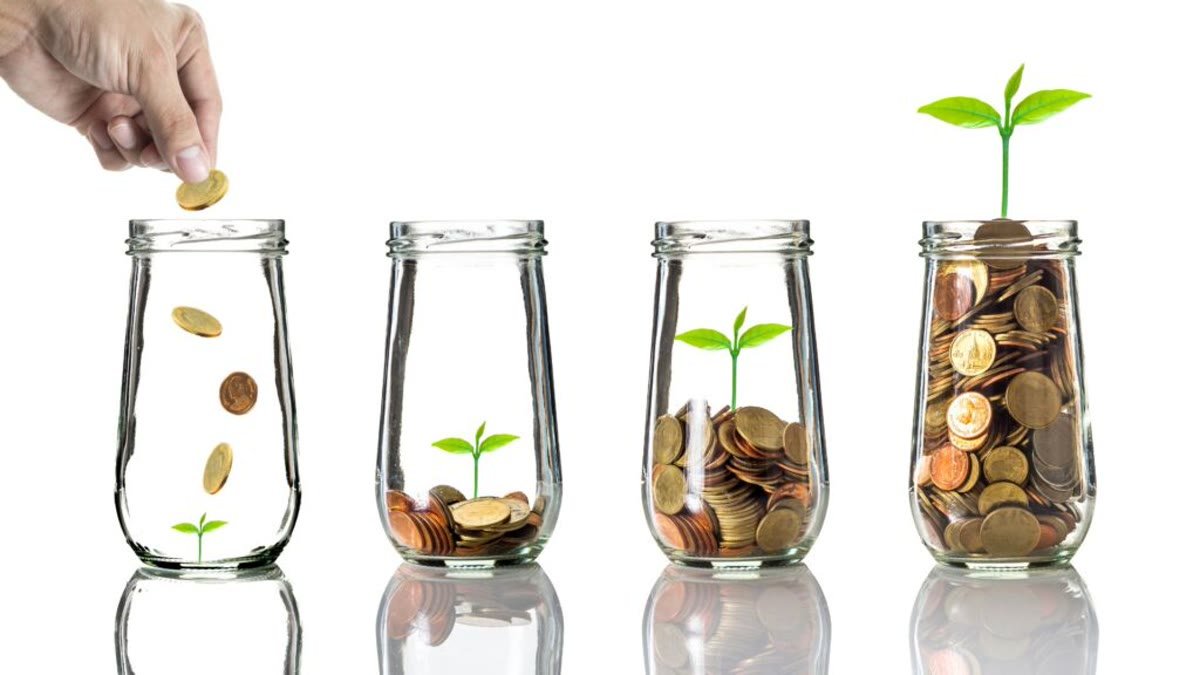
The Force That Turns Modest Savings Into Serious Wealth
If you’ve ever wondered why financial advisors keep saying “start early,” this calculator is the answer. Compound interest is the force that turns modest, steady savings into serious wealth — your interest earns interest, and then that interest earns interest of its own. Enter your initial investment, monthly contribution, expected rate, and time horizon below, and watch your money’s future unfold year by year.
Time is the most powerful lever in the formula, and the one people underestimate most. Consider two savers: Maya starts at 25, invests $200 a month at 7% until 35, then stops — $24,000 total. James starts at 35 and invests $200 a month at 7% all the way to 65 — $72,000 total. At 65, Maya has about $281,000; James has about $244,000. Maya contributed a third as much and still ends up ahead, entirely because her money had ten extra years to compound.
| Year | Start balance | Contributions | Interest earned | End balance |
|---|
Estimates assume a constant annual rate and end-of-month contributions. Real investments fluctuate, and results do not include taxes, fees, or inflation.

How to Use This Compound Interest Calculator
- Enter your initial investment. The lump sum you’re starting with — for example, $10,000. Enter 0 if you’re starting from scratch.
- Set your monthly contribution. The amount you’ll add at the end of each month — for example, $200. Set it to 0 if you’re only growing the initial amount.
- Choose your annual interest rate. Your expected yearly return as a percent — for example, 7%. Historical stock market averages hover around 7% after inflation; savings accounts are much lower.
- Pick your time horizon. How many years the money stays invested — for example, 10.
- Select the compounding frequency. Daily, monthly, quarterly, semi-annually, or annually — how often interest is added back to your balance.
- Press “Calculate.” Your final balance appears front and center, along with total contributions, total interest earned, and how many times your money multiplied — plus a year-by-year schedule so you can see exactly when compounding starts doing the heavy lifting.
What Is Compound Interest?
Compound interest is interest earned on both your original money and the interest it has already accumulated. Simple interest only pays on the principal: $1,000 at 10% simple interest earns $100 every year, forever. Compound interest pays on the growing balance: that same $1,000 at 10% earns $100 the first year, but $110 the second year (10% of $1,100), then $121 the third — each year’s earnings become part of next year’s earning base.
The effect starts slowly and accelerates dramatically. That’s why time matters more than almost anything else. And on the flip side, the same math is why credit card debt compounds against you so punishingly — compounding rewards whoever owns the claim. On savings, that’s you. On debt, that’s the lender.
The Formula (With a Worked Example)
A = final amount · P = principal (initial investment) · r = annual interest rate as a decimal (7% = 0.07) · n = compounding periods per year (12 = monthly) · t = number of years
Worked example: Invest $10,000 at 7% annual interest, compounded monthly, for 10 years.
- P = 10,000, r = 0.07, n = 12, t = 10
- A = 10,000 × (1 + 0.07/12)^(12×10) = 10,000 × (1.0058333)^120
- A = 10,000 × 2.00966 = $20,096.61
The $10,000 more than doubled — $10,096.61 of that is pure interest. Add monthly contributions of $200 on top and the total reaches roughly $54,714, even though contributions were only $34,000. A handy shortcut is the Rule of 72: divide 72 by your annual rate to estimate the years needed to double your money. At 7%, that’s about 10.3 years — matching the example above nicely.
Tips for Making Compounding Work for You
- Start earlier rather than bigger. Ten years of extra compounding beats a larger starting amount in most scenarios — run both versions in the calculator to prove it to yourself.
- Be honest about the rate. 7% reflects long-term stock market averages after inflation; use 1–4% for savings accounts and CDs.
- Don’t forget contributions in your plan. A $200 monthly habit at 7% beats a one-time $10,000 deposit over 20 years. The schedule table makes this visible.
- Check compounding frequency on loans. A credit card quoting a monthly rate is charging you more annually than it looks.
- Account for taxes and fees. Real returns are lower than the calculator’s gross estimate — subtract your marginal tax rate and fund fees for a realistic picture.
- Inflation erodes the headline number. A $1 million balance in 30 years won’t buy what $1 million buys today. Consider using an inflation-adjusted rate.
- Reinvest, don’t withdraw. Every dollar you pull out early loses not just its own growth but the compounding of that growth.
More Financial Tools
Starting Early Beats Investing More
Here is the cleanest comparison: two savers who each invest $200 a month at 7% until age 65 — one starts at 25, the other waits until 35.
| Start age | Years invested | You contribute | Interest earned | Value at 65 |
|---|---|---|---|---|
| 25 | 40 | $96,000 | $428,963 | $524,963 |
| 35 | 30 | $72,000 | $171,994 | $243,994 |
The early starter contributes only $24,000 more, yet finishes with about $281,000 more. The difference is not discipline — it is ten extra years in which the interest itself does most of the work. Time is the one input in the formula you can never buy back, which is why starting small today usually beats starting bigger later.
Frequently Asked Questions
What is the formula for compound interest?
A = P(1 + r/n)^(nt), where P is the principal, r is the annual rate as a decimal, n is compounding periods per year, and t is years. For example, $10,000 at 7% compounded monthly for 10 years grows to about $20,097.
How is compound interest different from simple interest?
Simple interest is paid only on the original principal, so earnings are constant each year. Compound interest is paid on the principal plus all previously accumulated interest, so earnings grow every period — the longer the money stays invested, the bigger the difference.
Which compounding frequency is best?
More frequent compounding earns slightly more — daily beats monthly, which beats annually. But the differences are small: the interest rate and time invested matter far more than the compounding schedule.
How much will $10,000 grow in 10 years at 7%?
With monthly compounding, $10,000 at 7% for 10 years grows to approximately $20,097 — about $10,097 of that is interest earned.
What is the Rule of 72?
A mental shortcut: divide 72 by your annual interest rate to estimate the years needed to double your money. At 8%, money doubles in about 9 years; at 6%, about 12 years. It works best for rates between 4% and 12%.
Does compound interest work for debt too?
Yes — and painfully so. Credit card balances compound monthly on what you owe, so carrying a balance means interest charges earn interest charges of their own. Getting out of high-interest debt is the highest-return “investment” available to most households.
How much does compounding frequency actually matter?
Less than most people expect. $10,000 at 5% for 10 years grows to $16,288.95 compounded annually, $16,470.09 monthly, and $16,486.65 daily. Daily beats annual by under $200 over a whole decade — rate, time, and contributions matter far more.
What if the interest rate changes over time?
Real returns vary, so treat any single rate as a planning estimate. Enter a conservative long-term average (for example 5–6% instead of a best-case 10%), rerun the calculation at one lower and one higher rate, and plan around the middle scenario.
Related Calculators
Related Guides
Learn more in our detailed guide: Compound Interest Formula With Examples.