
One Division Problem — With the Tricky Cases Done Right
Need to turn a fraction into a decimal — for homework, a recipe, a measurement, or a spreadsheet? This free fraction to decimal calculator converts any fraction to its exact decimal value in seconds. It handles proper fractions (3/4), improper fractions (11/4), and mixed numbers (2 3/4), and it doesn’t just give you the answer: it shows the percentage, the simplified fraction, and the full long-division work so you can see exactly how the result was found.
One thing most online converters gloss over: some fractions produce decimals that never end. This calculator detects repeating decimals properly and marks the repeating digits with a bar (0.3̄ for 1/3), instead of quietly chopping them off the way simpler tools do.
/
Division work (long division)
Common fractions, at a glance
| Fraction | Decimal | Fraction | Decimal |
|---|---|---|---|
| 0.5 | 0.125 | ||
| 0.333… | 0.375 | ||
| 0.666… | 0.625 | ||
| 0.25 | 0.875 | ||
| 0.75 | 0.2 | ||
| 0.1666… | 0.1 |
Tip: tap any fraction in the table to load it into the calculator. A bar over a digit (e.g. 0.3̄) means that digit repeats forever.
How to Use the Fraction to Decimal Calculator
- Enter the whole number (optional). If you're converting a mixed number like 2 3/4, type 2 here. For a plain fraction, leave it at 0.
- Enter the numerator — the top number of the fraction (e.g. 3).
- Enter the denominator — the bottom number (e.g. 4). It must be at least 1, since division by zero is undefined.
- Click Calculate. The result appears instantly: the exact decimal, the percentage, the simplified fraction, and a rounded value for quick use.
- Review the division work. The step-by-step long division shows every bring-down and remainder, so you can follow (or copy) the method for your own work.
- Use the quick table. The common-fractions reference at the bottom is clickable — tap 5/8 or 2/3 to load it straight into the calculator.
What Is a Fraction?
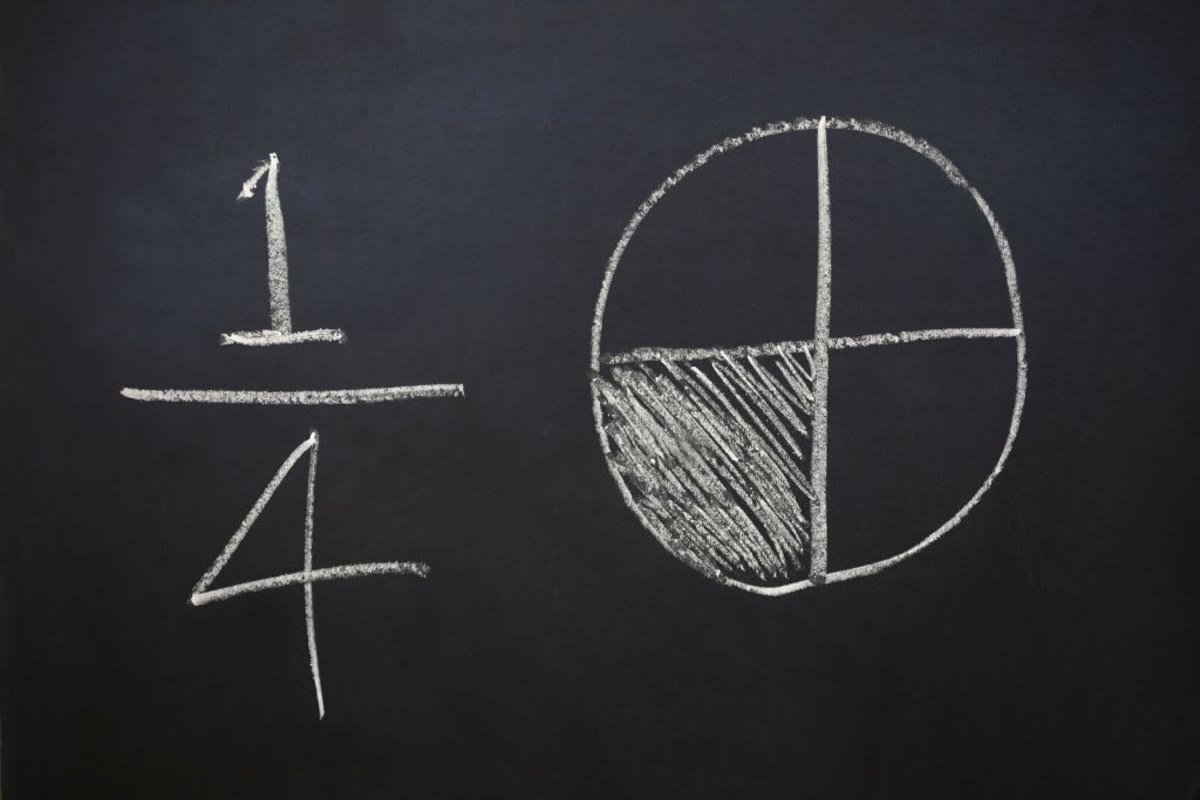
A fraction is a way of writing a part of a whole: the numerator (top number) tells you how many parts you have, and the denominator (bottom number) tells you how many equal parts the whole is split into. So 3/4 means "3 out of 4 equal parts."
A proper fraction has a smaller numerator than denominator (3/4). An improper fraction has a numerator equal to or larger than the denominator (7/4) — its value is 1 or more. A mixed number combines a whole number with a proper fraction (1 3/4, which equals 7/4). All three are just different ways of writing the same kind of number, and all three can be converted to decimals.
The Formula: Divide the Numerator by the Denominator
The fraction bar literally means "divided by" — the top number goes inside the division bracket, the bottom number goes outside.
Worked example: 7/8
- Write it as a division: 7 ÷ 8. Since 8 doesn't go into 7, the integer part is 0.
- Bring down a zero → 70. 8 goes into 70 8 times (8 × 8 = 64), remainder 6. So far: 0.8.
- Bring down a zero → 60. 8 goes into 60 7 times (7 × 8 = 56), remainder 4. So far: 0.87.
- Bring down a zero → 40. 8 goes into 40 5 times (5 × 8 = 40), remainder 0.
- The remainder is 0, so the division ends: 7/8 = 0.875.
This is a terminating decimal — it ends. It happens whenever the denominator, once the fraction is simplified, is built only from the prime factors 2 and 5 (denominators like 4, 8, 10, 16, 20, 25, 100 all qualify).
When the Decimal Never Ends: Repeating Decimals
Now try 1/3. Divide 1 by 3: 3 goes into 10 three times (3 × 3 = 9), remainder 1. Bring down a zero → 10 again. Remainder 1 again. This loop never breaks: you get 0.333… forever. That's a repeating decimal, marked with a bar over the repeating digits: 0.3̄. More examples: 1/6 = 0.16̄, 2/3 = 0.6̄, 1/7 = 0.1̄4̄2̄8̄5̄7̄ (a six-digit cycle). If the simplified denominator has any prime factor other than 2 or 5 (like 3, 6, 7, 9, 11, or 12), the decimal repeats.
Converting Mixed Numbers
Set the whole number aside, convert the fraction part, then add: 2 3/4 → 3 ÷ 4 = 0.75 → 2 + 0.75 = 2.75. Improper fractions work the same way — just divide straight through: 11/4 = 2.75, the exact same number.
Tips for Converting Fractions to Decimals
- Check whether the decimal will terminate. If the denominator (in lowest terms) has only 2s and 5s as prime factors — like 4, 8, 20, or 25 — the decimal terminates. Any other prime factor (3, 6, 7, 11…) means it repeats.
- Simplify first for mental math. 9/12 is easier as 3/4 — and 3/4 is the familiar 0.75.
- Know your common eighths. 1/2 = 0.5, 1/4 = 0.25, 3/4 = 0.75, 1/8 = 0.125, 3/8 = 0.375, 5/8 = 0.625, 7/8 = 0.875.
- For mixed numbers, keep the whole separate. Convert only the fraction part (3/4 → 0.75), then add the whole number (2 + 0.75 = 2.75).
- Match the rounding to the task. Money usually needs 2 decimal places; measurements might need 3 or 4. Carry extra digits through every step of a multi-step calculation and round only the final answer.
More Math Tools
Common Fractions as Decimals (Quick Reference)
Keep these conversions handy — the sixteenths are especially useful with tape measures and tools, where measurements are marked in fractions but readouts come in decimals:
| Fraction | Decimal | Fraction | Decimal |
|---|---|---|---|
| 1/16 | 0.0625 | 1/8 | 0.125 |
| 1/6 | 0.1666… | 1/5 | 0.2 |
| 1/4 | 0.25 | 5/16 | 0.3125 |
| 3/8 | 0.375 | 7/16 | 0.4375 |
| 1/2 | 0.5 | 5/8 | 0.625 |
| 2/3 | 0.6666… | 7/8 | 0.875 |
The two entries marked with "…" repeat forever, for the reason explained above: once simplified, their denominators (6 and 3) contain a prime factor other than 2 or 5. Every other fraction in the table terminates, because its denominator is built only from 2s and 5s. In practical work, 7/16 (0.4375) and 5/8 (0.625) come up constantly — both are worth memorizing.
Frequently Asked Questions
How do you convert a fraction to a decimal?
Divide the numerator (top number) by the denominator (bottom number). For 3/4, calculate 3 ÷ 4 = 0.75. The fraction bar literally means "divided by," so this works for every fraction.
What is 1/3 as a decimal?
1 ÷ 3 = 0.333…, where the 3 repeats forever. It's written 0.3̄ with a bar over the 3. The calculator above shows this correctly instead of cutting the decimal off.
Which fractions give terminating decimals?
A fraction in lowest terms terminates if its denominator's only prime factors are 2 and 5 — for example 1/4 = 0.25 (4 = 2²) or 3/20 = 0.15 (20 = 2² × 5). Denominators with other prime factors, like 3 or 7, produce repeating decimals.
How do I convert a mixed number to a decimal?
Convert just the fraction part and add the whole number. For 2 3/4: 3 ÷ 4 = 0.75, then 2 + 0.75 = 2.75. The calculator does this automatically when you enter the whole number.
How do you convert a fraction to a decimal without a calculator?
Use long division: put the numerator inside the division bracket and the denominator outside, then divide, adding a decimal point and bringing down zeros as needed until the remainder is 0 or starts repeating.
What is a repeating decimal?
A decimal whose digits fall into a pattern that repeats forever, like 0.142857142857… for 1/7. The repeating part (the repetend) is conventionally marked with a bar over the digits.
What is 7/16 as a decimal?
7 ÷ 16 = 0.4375 exactly. It is a conversion that comes up constantly in woodworking and construction, where 7/16 of an inch is a common material thickness.
What is 5/8 as a decimal?
5 ÷ 8 = 0.625, which is also 62.5 percent. Because 8 is a power of 2, the decimal terminates instead of repeating.