Calculate profit, loss, and ROI on cryptocurrency trades with fee adjustments.
How to Use the Crypto Profit Calculator
Crypto trades look simple until fees, spreads, and partial fills muddy the math. This calculator gives you the true bottom line on any trade by accounting for what you actually paid and what you actually received. Start with the coin and the amount you traded.
- Select the cryptocurrency. The math is identical for any coin, but labeling your trade keeps your records organized for tax time.
- Enter the amount of coins. Use the exact quantity from your exchange history, including decimals. Half a bitcoin is 0.5, not 1.
- Enter the buy price per coin. This is the price you paid at the time of purchase, before fees. Check your order history for the fill price.
- Enter the sell price per coin. Use your actual execution price. If you sold in multiple batches, use the average price or run each batch separately.
- Enter buy and sell fees as percentages. Most exchanges charge 0.1 to 1 percent per trade. These small percentages compound painfully for active traders, so do not skip them.
- Click Calculate. You will see total cost, net revenue, profit or loss, ROI, and the break-even price you needed just to cover fees.
How Crypto Profit Is Calculated
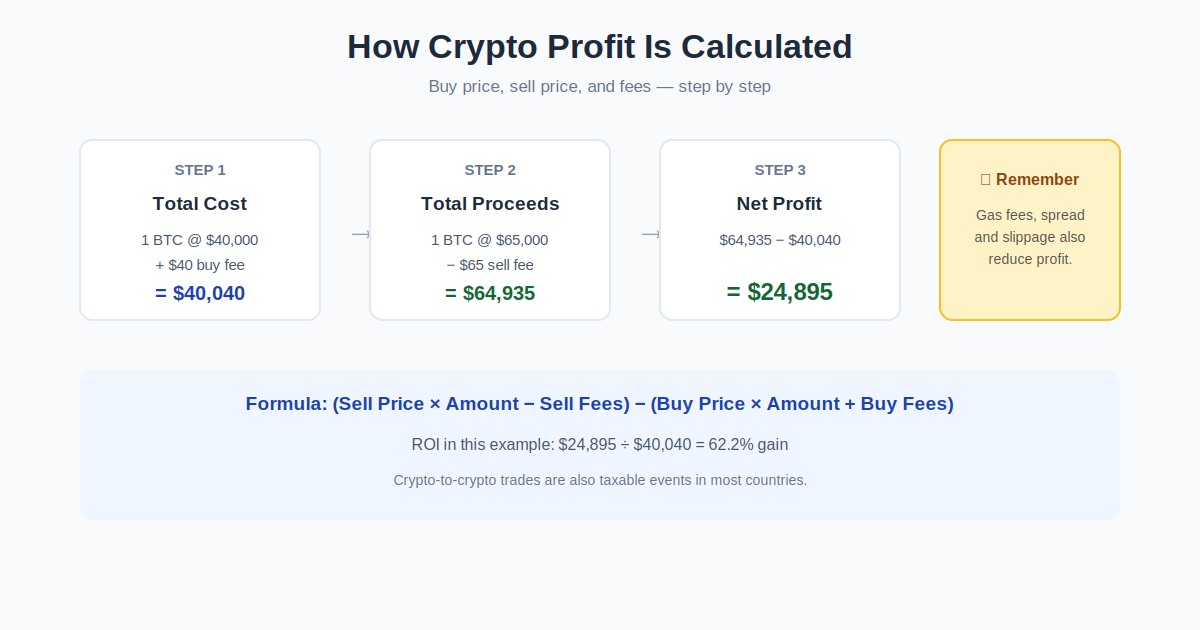
Profit equals what you received minus what you paid, with fees added to your cost and subtracted from your revenue. The formula looks like this: profit = (amount times sell price minus sell fee) minus (amount times buy price plus buy fee). Return on investment divides that profit by your total cost and multiplies by 100 to get a percentage.
Fees deserve special attention because crypto traders often underestimate them. A 0.5 percent fee on each side of a trade means you need roughly a 1 percent price move just to break even. If you trade ten times a month at those rates, fees alone can erase 10 percent or more of your capital over a year even before any losses. The break-even price shown by the calculator tells you exactly where fees stop and profit starts.
Taxes add another layer. In the United States, cryptocurrency is treated as property, not currency. That means every sale, swap of one coin for another, or purchase made with crypto is a taxable event. Your cost basis is what you paid including fees, and your gain is the sale value minus that basis. Short-term gains on crypto held under a year are taxed as ordinary income, while long-term gains get the lower capital gains rates. Stablecoin-to-stablecoin swaps and wallet transfers between your own wallets are generally not taxable, but coin-to-coin trades are.
Record keeping matters more in crypto than in stocks because exchanges do not always issue tidy tax forms, and moving coins between wallets can confuse cost-basis tracking. Save your trade confirmations, note the fair market value in dollars at the time of each transaction, and consider dedicated crypto tax software if you trade actively.
Worked Example
Suppose Priya buys 0.5 BTC at 60,000 dollars per coin on an exchange charging 0.5 percent. Her gross cost is 30,000 dollars and the buy fee adds 150 dollars, so her total cost basis is 30,150 dollars. Months later she sells the 0.5 BTC at 85,000 dollars per coin. Gross revenue is 42,500 dollars, and the 0.5 percent sell fee takes 212.50 dollars, leaving net revenue of 42,287.50 dollars.
Her profit is 42,287.50 minus 30,150, which equals 12,137.50 dollars. Her ROI is 12,137.50 divided by 30,150, about 40.26 percent. Total fees were 362.50 dollars. Her break-even sell price was roughly 60,604 dollars per coin, meaning any sale below that price would have lost money after fees despite the coin rising from her 60,000 dollar entry.
For taxes, her taxable gain is the same 12,137.50 dollars. If she held longer than a year, it qualifies for long-term capital gains rates. If she sold within a year, it is taxed as ordinary income. Either way, she owes tax on the full gain even though fees reduced her actual profit, which is why including fees in your planning matters.
Worked Example: One Bitcoin Trade, Fees Included
Most profit estimates that ignore fees flatter your results. Here is what a realistic trade looks like: you buy 1 BTC at 50,000 dollars with a 0.2 percent fee and later sell at 65,000 dollars with the same fee.
The buy fee is 100 dollars, so your true cost basis is 50,100 dollars. The sell fee is 130 dollars, so you actually receive 64,870 dollars. Total fees: 230 dollars. Net profit is 64,870 minus 50,100 — 14,770 dollars — and the true return on investment is 14,770 divided by 50,100, or 29.5 percent. Ignoring fees would have shown a flat 30 percent on a 15,000 dollar gain.
The break-even sell price is the buy price times (1 + fee) divided by (1 – fee): 50,000 x 1.002 / 0.998 = 50,200.40 dollars. Anything below that and you are losing money despite the higher sell price. Keep records of every trade’s cost basis — your tax software will need the dates, amounts, and fees for each one.
Related Calculators
Need the tax angle? Our Capital Gains Tax Calculator estimates what you will owe on profits, and our Roth IRA Calculator shows how tax-free growth compares to taxable trading.

Frequently Asked Questions
How do I calculate profit on a crypto trade?
Subtract your total cost (coins times buy price plus buy fee) from your net revenue (coins times sell price minus sell fee). Divide profit by total cost for ROI. This calculator does all of it including both fees.
Are crypto-to-crypto swaps taxable?
In the US, yes. Trading Bitcoin for Ethereum is treated as selling Bitcoin for dollars and then buying Ethereum. Each swap realizes a gain or loss based on fair market value at the time.
Do transfer fees between my own wallets count?
Network gas fees paid to move coins between your own wallets generally add to your cost basis rather than triggering a taxable sale. Keep records of amounts and dollar values.
What is the break-even price on a crypto trade?
The sell price per coin needed to cover both your purchase cost and all fees. It is always higher than your buy price because fees apply on both sides. The calculator shows it for every trade.
How are crypto losses handled on taxes?
Crypto losses offset gains dollar for dollar, and up to $3,000 of net losses can offset ordinary income per year. Unused losses carry forward. Wash-sale rules currently do not apply to crypto, though that could change.
Should I look at gross or net profit?
Net profit — always. Gross profit ignores trading fees, spreads, and network costs, which can quietly eat several percent per round trip. A trade that looks profitable before fees can be a loser after them.
How do I calculate profit on a partial sell?
Treat the sold portion separately: multiply the coins sold by the sell price, subtract fees on that sale, then subtract the same fraction of your total cost basis. Repeat the same math for each partial exit.