Estimate your life expectancy based on lifestyle factors, daily habits, and family history. Adjust the inputs to see how small changes can add years to your life.
Enter your details below for a statistical estimate of your longevity.
How to Use the Life Expectancy Calculator
- Enter your current age and sex. Baseline longevity differs by sex because of well documented demographic patterns.
- Select your smoking status honestly. Smoking is the single largest controllable factor in the model.
- Enter how many days per week you exercise for at least thirty minutes. Both cardio and strength work count.
- Rate your diet quality. A diet rich in vegetables, fruits, whole grains, and lean protein scores highest.
- Enter your average nightly sleep. Both chronic short sleep and very long sleep are linked with shorter lives.
- Select your alcohol use level, then note whether close family members lived past eighty, which hints at genetic influence.
- Click Calculate to see your estimated longevity, remaining years, and the net effect of your lifestyle choices.
Life Expectancy Calculation Method
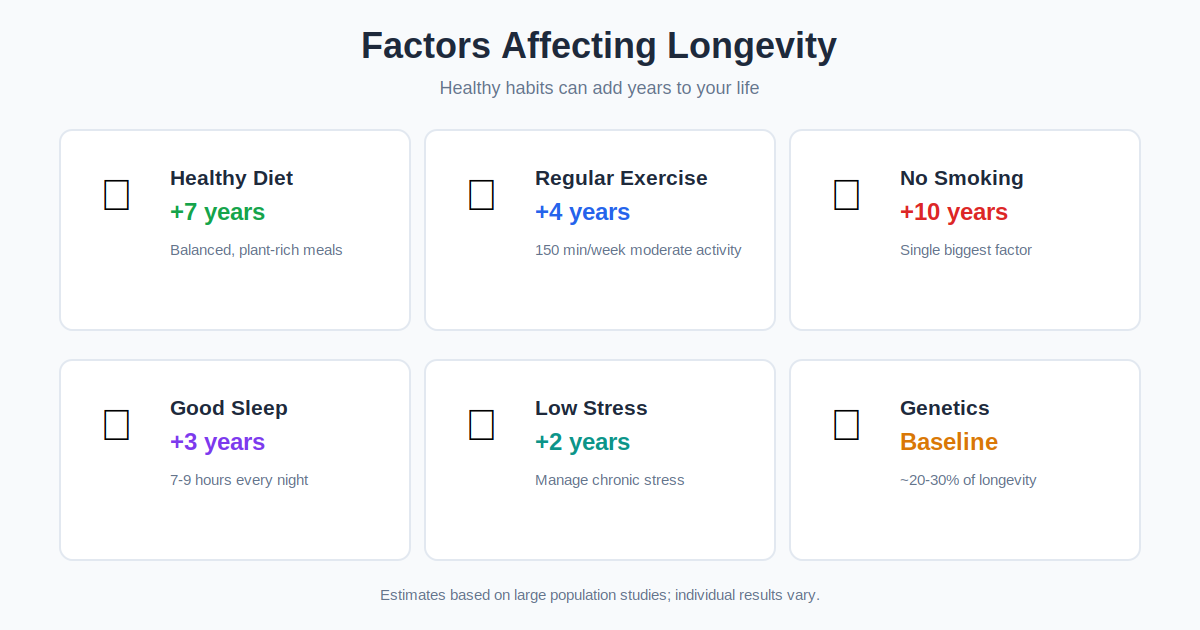
This calculator starts from a baseline life expectancy drawn from modern actuarial data, roughly seventy eight years for men and eighty three years for women in developed countries, then adjusts that baseline up or down using published risk research. Current smoking subtracts about ten years, a finding repeated across many large cohort studies, while former smoking subtracts around three. Regular exercise of three or more days per week adds about three years, and even one or two days adds one. A high quality diet adds two years while a poor diet subtracts two. Sleeping seven to eight hours adds one year, sleeping under six subtracts two, and regularly sleeping over nine subtracts one. Heavy alcohol use subtracts four years, moderate use adds a small half year benefit in some studies, and having long lived parents or grandparents adds two years as a rough proxy for favorable genetics. These adjustments are additive approximations, not precise medical science. Real longevity also depends on blood pressure, cholesterol, stress, social connection, income, air quality, and plain luck, none of which a short questionnaire can capture. Treat the result as a motivational planning number. The most useful output is often the lifestyle adjustment line, because it shows in concrete years what your habits may be costing or granting you.
Worked Example
Consider a forty year old man who never smoked, exercises three days a week, eats an average diet, sleeps seven and a half hours, drinks moderately, and had a grandfather who lived past eighty. His baseline is seventy eight. Adjustments: plus three for exercise, plus one for sleep, plus half for moderate alcohol, plus two for family history, totaling plus six and a half. His estimated expectancy is eighty four and a half years, leaving about forty four and a half years remaining. Now imagine the same man as a current smoker who never exercises and sleeps five hours. Adjustments: minus ten for smoking, zero for exercise, minus two for sleep, for a net minus twelve before the small positives, giving roughly sixty nine years. The gap between the two scenarios is about fifteen years, which illustrates why lifestyle researchers say habits can matter more than genes for most people. If this man quits smoking, the model suggests he could recover roughly seven of those ten lost years over time, since former smoker risk falls substantially after quitting.
Reading Your Result: An Average, Not a Prediction
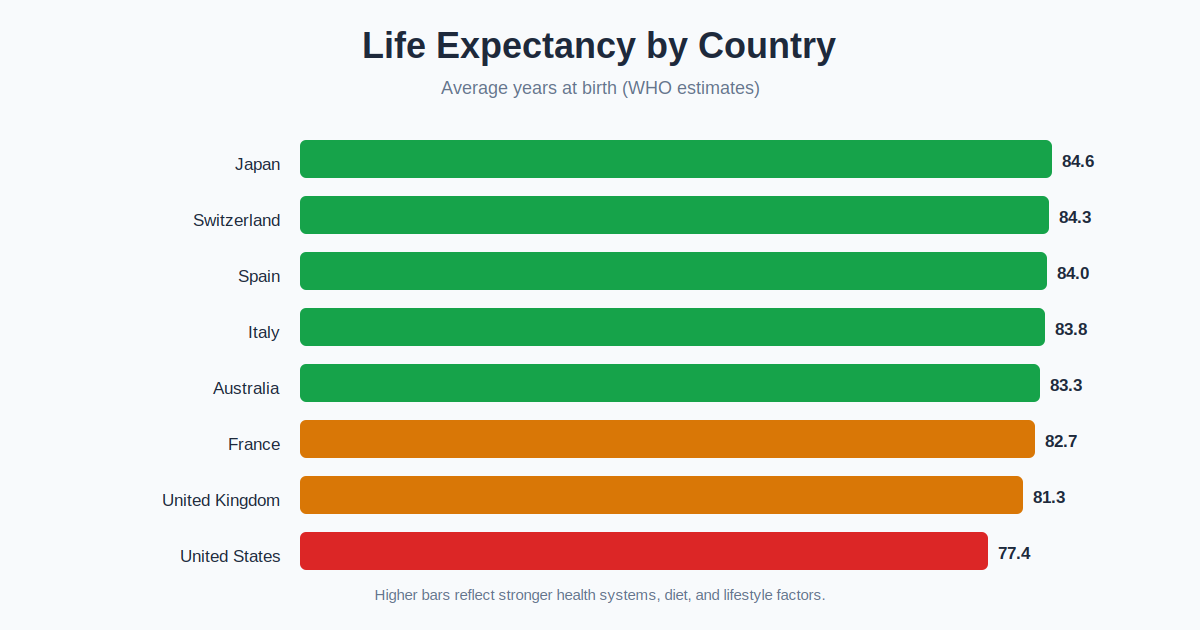
Two statistical ideas help you read any life-expectancy number sensibly. First, life expectancy depends on the age you start from. Official life tables (such as the US Social Security Administration’s) quote life expectancy at birth — about 79 for the US population overall — but the expected age for someone who has already reached 65 is higher, roughly 83 for men and 86 for women, because that person has already survived the risks of earlier decades. The older you are, the later the average finishing line sits. Second, an average is a midpoint: by definition, about half of people outlive it. That is why financial planners often test retirement plans against ages 95 or 100 rather than the headline average — a plan that “ends at the average” has roughly even odds of running out while you are still here.
What Moves the Number Most
In the model behind this calculator, your starting point is a baseline of 78 years for men and 83 for women, and each habit nudges it. The single biggest factor, by a wide margin, is smoking: a current smoker’s estimate drops by 10 years, and even a former smoker carries a 3-year reduction compared with someone who never smoked. Regular exercise (3 or more days a week) adds 3 years — the largest positive lifestyle factor in the model — with 1–2 days adding 1. A good diet adds 2 years and a poor one subtracts 2; sleeping 7–8 hours adds 1, while under 6 hours subtracts 2; heavy drinking subtracts 4; and having long-lived parents adds 2. Notice the asymmetry: the harms you can remove (smoking, heavy drinking) are worth more than most of the bonuses you can add, which is exactly why quitting tops every longevity advice list.
What to Do With the Estimate
Used well, this number is a planning tool, not a verdict. It gives a sensible horizon for retirement saving and pension decisions, a rough guide for choosing insurance terms, and a concrete way to compare habits — run the calculator twice, once as you are and once as you would like to be, and the gap between the two results is the honest size of the prize. More sophisticated actuarial tools add blood pressure, BMI, and detailed health history and express results as survival probabilities; if a number here prompts a serious financial or medical decision, treat it as the start of a conversation with a professional, not the end of one.
Frequently Asked Questions
How accurate is a life expectancy calculator?
It is a rough statistical estimate, not a prediction about you personally. It combines population averages with average risk adjustments from research studies. Individual outcomes vary widely because of genetics, medical care, and chance.
Can I really add years to my life by changing habits?
Research consistently shows that not smoking, exercising regularly, eating well, sleeping enough, and limiting alcohol are associated with several extra years of life on average. The effect is probabilistic, not guaranteed, but the odds shift in your favor.
Do genetics matter more than lifestyle?
For most people, lifestyle and environment explain more of the variation in lifespan than genes do. Exceptional longevity past one hundred does run in families, which is why the calculator gives a small bonus for long lived relatives.
Why does the calculator ask about sleep?
Large studies link both short sleep (under six hours) and very long sleep (over nine hours) with higher mortality. Seven to eight hours is the sweet spot associated with the longest lives in most research.
Should I use this for financial or insurance planning?
It can help you think about retirement horizons, but do not base major financial decisions on it alone. Actuaries and financial planners use far more detailed models. Consider this a conversation starter, not professional advice.
Why do women live longer than men on average?
In most countries women outlive men by about 4–5 years, which is why this calculator starts from 83 for women and 78 for men. The gap reflects a mix of biology and behavior — lower rates of smoking, accidents, and cardiovascular risk among other factors.
What is the difference between life expectancy at birth and at my current age?
Life expectancy at birth (about 79 in the US) averages in all early-life risks. If you have already reached 65, your expected age rises to about 83 for men and 86 for women, because you have survived those earlier risks. Older people have higher remaining life expectancies.
Can life expectancy keep rising as I get older?
In the arithmetic sense, yes — your expected age at death keeps rising with each year you survive. Whether it rises in real life depends on your health, but the calculator updates your estimate the same way: enter your current age and habits for a fresh number.
Related Calculators
Track the inputs behind this estimate with our BMI Calculator and plan the nutrition side with our Calorie Calculator for a complete picture of your health trajectory.