Calculate your optimal daily protein intake based on body weight, activity level, and fitness goal. Get a personalized gram target with per-meal splits.
Enter your weight and lifestyle to get your daily protein target.
How to Use the Protein Intake Calculator
- Enter your body weight in kilograms. If you know pounds, divide by 2.2 first.
- Choose the activity level that best matches your typical week, being honest about training intensity.
- Select your primary goal: maintaining weight, losing fat, or building muscle. Each shifts the target slightly.
- Click Calculate to get your daily gram target, a sensible range, and a per-meal split.
- Use the per-meal number to plan plates: aim for a palm-and-a-half sized portion of protein-rich food at each meal.
Protein Intake Formula
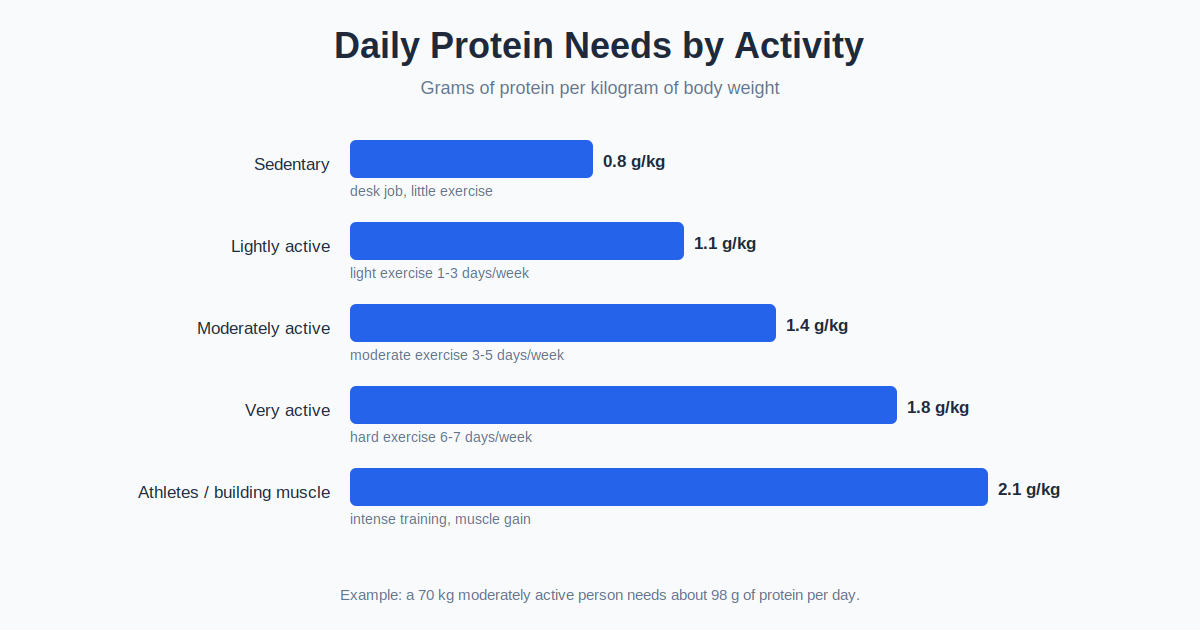
The calculator multiplies your body weight by a protein factor in grams per kilogram, chosen from sports nutrition research. Sedentary adults get 0.9 g/kg, which sits just above the basic RDA of 0.8. Lightly active people get 1.2, moderately active 1.6, very active 2.0, and competitive athletes 2.2. These values come from the International Society of Sports Nutrition position stands, which find that 1.4 to 2.0 g/kg supports most training goals. If your goal is fat loss, the calculator adds 0.2 g/kg and enforces a floor of 1.6, because higher protein preserves muscle in a calorie deficit and increases satiety. For muscle gain it also adds 0.2, since a small surplus of building material helps. The result is presented as a target with a ten percent range on either side, because day-to-day precision matters less than consistent averages. Dividing by four gives a per-meal guide based on evidence that muscle protein synthesis responds best to 25 to 40 gram doses spread through the day rather than one giant dinner portion.
Worked Example
A 75 kilogram person who trains moderately four times a week and wants to maintain weight gets a factor of 1.6 g/kg. Seventy five times 1.6 is 120 grams per day, with a range of 108 to 132 grams. Split across four meals, that is about 30 grams per meal, roughly a chicken breast, a cup of Greek yogurt, or three eggs plus a slice of cheese. If the same person switches their goal to fat loss, the factor rises to 1.8, giving 135 grams per day. The extra 15 grams helps protect lean mass while calories drop. For a 90 kilogram athlete training twice daily with a muscle gain goal, the factor is 2.4, giving 216 grams per day or about 54 grams per meal, which realistically requires deliberate planning with shakes or dense protein sources. Note that these are total daily targets including all foods, not just meat: grains, legumes, dairy, and even vegetables contribute. Most people overestimate how much protein they eat and underestimate how much they need when training hard, which is exactly the gap this calculator closes.
The RDA Is a Floor, Not a Target
You will often see the figure 0.8 g/kg quoted as “the” protein requirement. That is the Recommended Dietary Allowance — the minimum shown to prevent deficiency in sedentary adults, not an optimal intake for people who train, diet, or are getting older. This calculator’s sedentary factor (0.9 g/kg) sits slightly above the RDA for that reason, and the activity factors climb from there: 1.2 for light activity, 1.6 for moderate training, 2.0 for very active people and 2.2 for athletes. For context, sports-nutrition research commonly puts muscle building in the 1.6–2.2 g/kg band — exactly where this tool’s moderate-to-athlete factors and the muscle-goal adjustment land.
Protein in Real Food
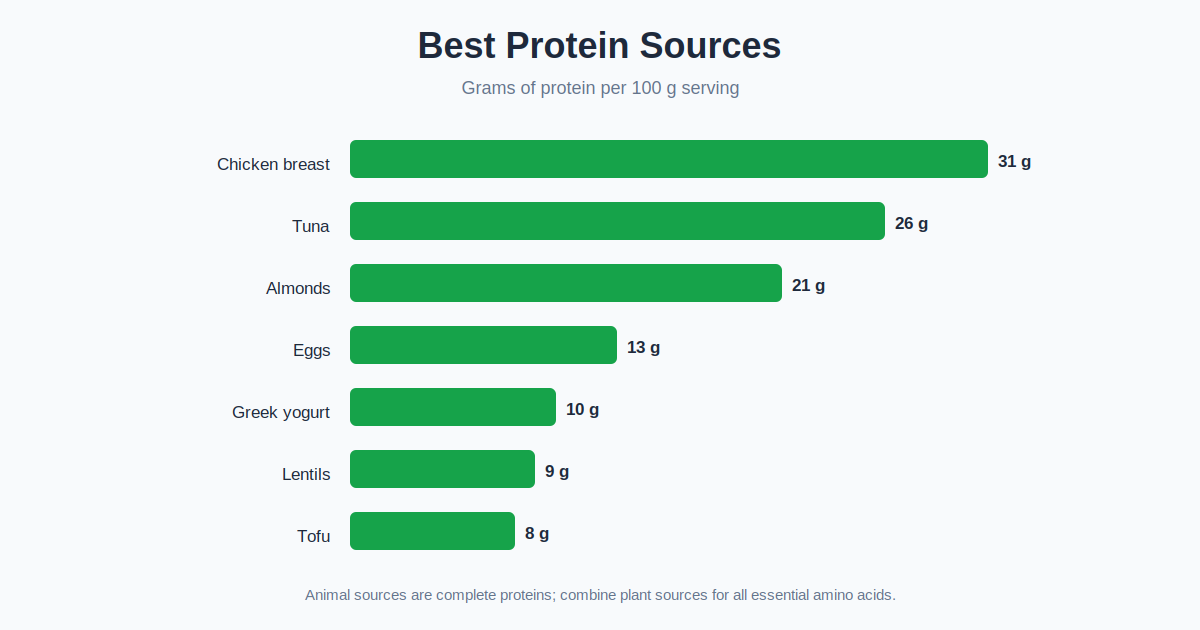
Gram targets only become useful when you can picture them on a plate. Use these standard values (USDA nutrient data) to sanity-check your day:
| Food | Portion | Protein |
|---|---|---|
| Chicken breast, cooked | 100 g | ≈ 31 g |
| Eggs, large | 2 eggs | ≈ 12 g |
| Greek yogurt, plain | 170 g pot | ≈ 17 g |
| Whey protein | 1 scoop (30 g) | ≈ 24 g |
| Lentils, cooked | 100 g | ≈ 9 g |
| Firm tofu | 100 g | ≈ 8 g |
| Milk | 250 ml glass | ≈ 8 g |
So a target of 120 g could look like eggs and yogurt at breakfast (~29 g), a chicken-breast lunch (~31 g per 100 g), a scoop of whey after training (24 g) and a normal protein-containing dinner — no exotic diet required.
Spreading Protein Across the Day
The calculator splits your daily target across four eating occasions because distribution matters modestly: research on muscle protein synthesis suggests most people make good use of roughly 20–40 g per meal. The pattern to avoid is the “catch-up dinner” — almost no protein all day and then a huge amount at night. The total still counts toward the daily number, but spreading intake is both easier to sustain and at least as effective. A practical rule: anchor each meal to one clear protein source from the table above, and let snacks close any remaining gap.
Frequently Asked Questions
Can I eat too much protein?
For healthy people, intakes up to about 2.5 g/kg appear safe in research. Very high intakes mainly waste money and displace other nutrients. People with kidney disease should follow their doctor’s guidance instead.
Does protein timing matter?
Total daily intake matters most. Spreading it across 3 to 5 meals gives a small edge for muscle building, and a protein-rich meal within a few hours of training is sensible, but the anabolic window is wider than once believed.
What are the best protein sources?
Lean meats, fish, eggs, dairy, soy, lentils, and beans. Animal sources have complete amino acid profiles; plant eaters should combine sources like rice and beans across the day.
Do I need protein powder?
No, it is optional convenience. Whole foods work just as well. Powders help when your target is high or your appetite is low, but they are not magic.
Should older adults eat more protein?
Yes, research suggests adults over 60 benefit from 1.0 to 1.2 g/kg minimum to fight age-related muscle loss, higher if active. This calculator’s activity factors already push in that direction.
What does 100 grams of protein look like in food?
Roughly: 100 g of cooked chicken breast gives about 31 g, two large eggs about 12 g, a 170 g pot of Greek yogurt about 17 g, a scoop of whey about 24 g, and 100 g of cooked lentils about 9 g. A normal eating day reaches 100 g without exotic foods.
Should I base protein on my current weight or goal weight?
For most people, current weight is fine. If your BMI is over 30, several sports-nutrition sources recommend using your goal or lean weight instead, because excess body fat needs far less protein than muscle — using current weight can overshoot by a wide margin.
Do vegans need to eat more protein?
They may need slightly more — plant proteins are digested a little less efficiently and individual sources lack some essential amino acids. Eating a variety of legumes, soy, grains, and nuts across the day covers it; the g/kg targets above still apply.
Related Calculators
Pair this with our Calorie Calculator to set your energy target and our BMI Calculator to track overall body composition changes.