Add, subtract, multiply, and divide complex numbers. Also get modulus, conjugate, and polar form for each operand.
Enter two complex numbers and choose an operation.
First number (a + bi)
Second number (c + di)
How to Use the Complex Number Calculator
- Enter the real part a and imaginary part b of the first complex number a + bi.
- Enter the real part c and imaginary part d of the second number c + di.
- Choose addition, subtraction, multiplication, or division.
- Click Calculate to see the result plus the modulus and conjugate of each input.
- For division, make sure the second number is not zero; the calculator will warn you if it is.
Complex Number Formulas
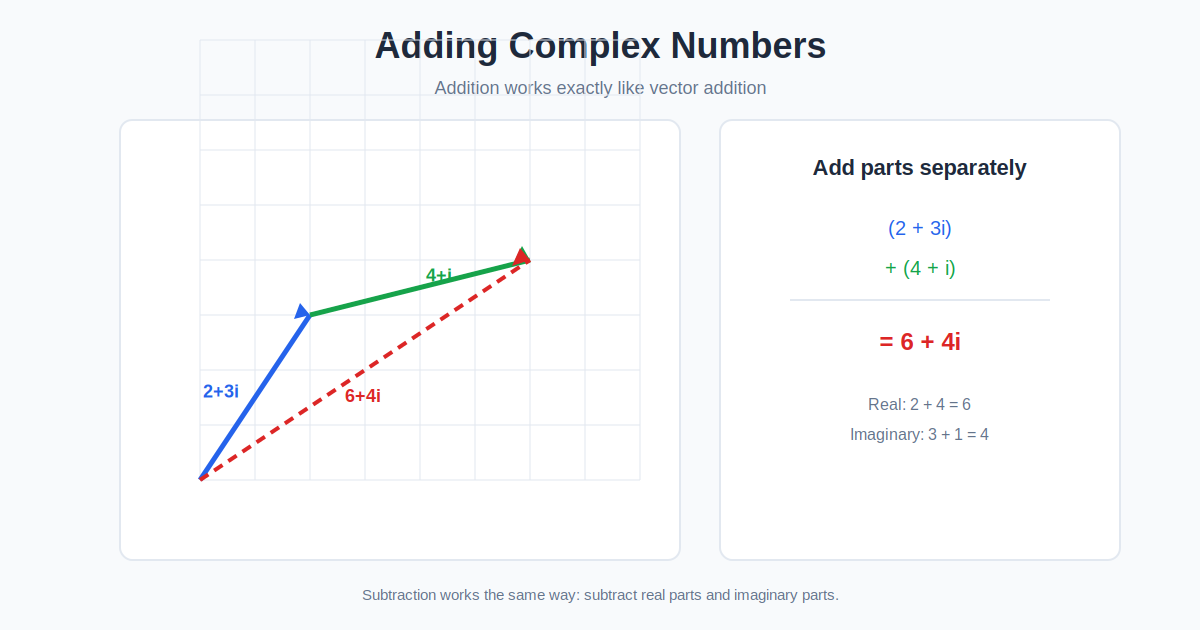
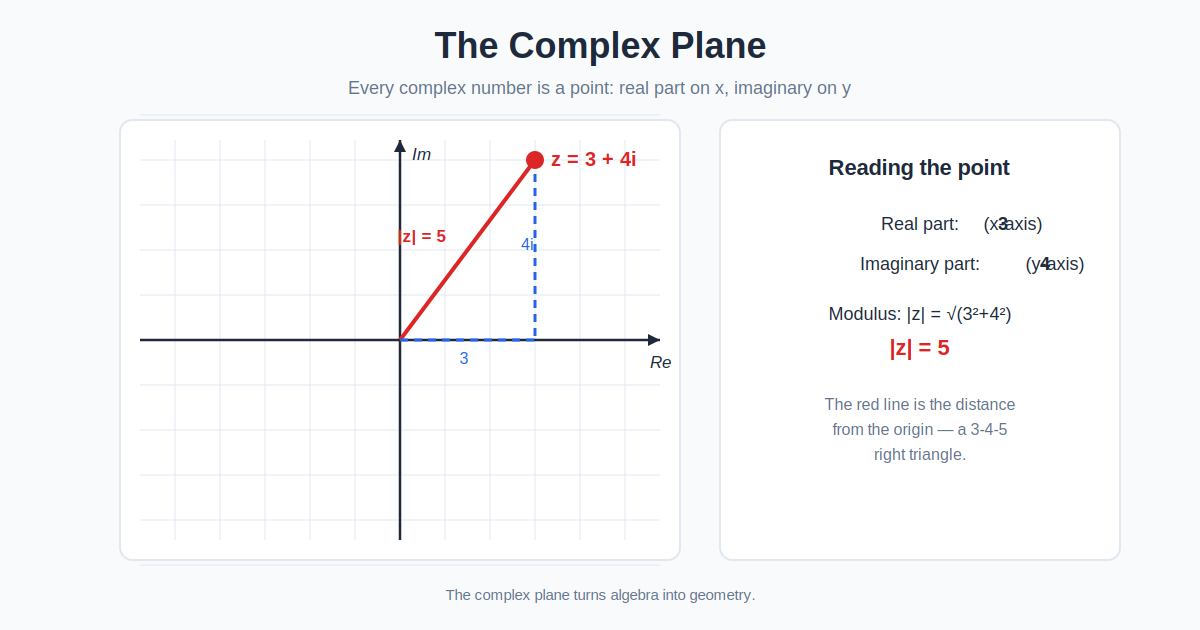
A complex number has the form a + bi, where i is the imaginary unit with the defining property i² = −1. Addition and subtraction work component-wise: (a+bi) ± (c+di) = (a±c) + (b±d)i. Multiplication uses FOIL: (a+bi)(c+di) = ac + adi + bci + bdi², and since i² = −1 this simplifies to (ac − bd) + (ad + bc)i. Division multiplies numerator and denominator by the conjugate of the divisor: (a+bi)/(c+di) = [(ac+bd) + (bc−ad)i] / (c²+d²). The modulus |z| = √(a²+b²) is the distance from the origin in the complex plane, and the conjugate ā = a − bi reflects the number across the real axis. In polar form, z = r(cos θ + i sin θ) where r is the modulus and θ = atan2(b, a) is the argument. Multiplication then becomes beautifully simple: multiply moduli and add arguments, which is why complex numbers model rotations and waves so well. Electrical engineers use them for AC circuits, physicists for quantum mechanics, and signal processing for Fourier analysis.
Worked Example
Take (3 + 4i) and (1 + 2i). Addition: (3+1) + (4+2)i = 4 + 6i. Subtraction: (3−1) + (4−2)i = 2 + 2i. Multiplication: real part 3×1 − 4×2 = 3 − 8 = −5; imaginary part 3×2 + 4×1 = 6 + 4 = 10; result −5 + 10i. Verify with FOIL: 3×1 = 3, 3×2i = 6i, 4i×1 = 4i, 4i×2i = 8i² = −8; summing gives (3 − 8) + (6i + 4i) = −5 + 10i. Division: denominator 1² + 2² = 5; real part (3×1 + 4×2)/5 = 11/5 = 2.2; imaginary part (4×1 − 3×2)/5 = (4 − 6)/5 = −0.4; result 2.2 − 0.4i. Modulus of the first number is √(9+16) = 5, a 3-4-5 triangle in the complex plane, and its conjugate is 3 − 4i. Notice that multiplying (3+4i) by its conjugate gives 9 + 16 = 25, which is the modulus squared, always a real number. This property is exactly what makes division work.
Powers of i: The Four-Step Cycle
Multiples of i follow a simple loop: i¹ = i, i² = −1, i³ = −i, i⁴ = 1, and then the pattern repeats. Any power of i is found by dividing the exponent by 4 and looking at the remainder: remainder 1 means i, remainder 2 means −1, remainder 3 means −i, and remainder 0 means 1. That is why i²⁰²⁵ = i (2025 leaves remainder 1) and i¹⁰⁰ = 1. Questions like these turn up constantly in algebra classes, and the cycle is all you ever need.
From Rectangular to Polar Form
Every complex number also has a polar description: a length (the modulus r) and an angle (the argument θ). For z = a + bi, r = √(a² + b²) and θ = atan2(b, a), measured from the positive real axis. Our example number 3 + 4i becomes r = 5 and θ ≈ 53.13°, written z = 5(cos 53.13° + i sin 53.13°). Polar form is what makes multiplication meaningful to look at: multiplying two complex numbers multiplies their lengths and adds their angles, which is why engineers use it for rotating vectors and AC signals. Multiplying any number by i alone rotates it exactly 90° counterclockwise — try 3 + 4i with the multiply operation above and a second number of 0 + 1i, and the result −4 + 3i still has modulus 5.
Why Engineers Write j Instead of i
In electrical engineering you will see the imaginary unit written as j, because the letter i is already taken — it stands for electric current. The maths itself is identical: j² = −1 in every equation. If your textbook or a piece of software writes 3 + 4j, enter it here as 3 + 4i and every result will match. Engineers use complex numbers daily in AC circuit analysis, where voltage and current waveforms are treated as rotating phasors and the real and imaginary parts capture in-phase and out-of-phase components that a single real number cannot express.
Frequently Asked Questions
What is the imaginary unit i?
It is defined by i² = −1. No real number squares to a negative, so mathematicians extended the number system. Complex numbers combine a real part with an imaginary multiple of i.
What is the modulus of a complex number?
The modulus |a+bi| = √(a²+b²) is the number’s distance from the origin on the complex plane. It generalizes absolute value to two dimensions.
What is a complex conjugate and why does it matter?
The conjugate of a+bi is a−bi. Multiplying a number by its conjugate gives the real number a²+b², which is the trick that makes complex division possible.
Where are complex numbers actually used?
AC electrical engineering (impedance), quantum mechanics (wave functions), signal processing (Fourier transforms), and control systems all rely on them daily.
Can the result be a plain real number?
Yes. For example (2+3i) + (4−3i) = 6 + 0i = 6. When the imaginary parts cancel, you are left with an ordinary real number.
What is the argument of a complex number?
The argument is the angle the number makes with the positive real axis, measured in radians or degrees. For 3 + 4i it is about 53.13°. Together with the modulus it gives the polar form of the number.
Is a real number also a complex number?
Yes — real numbers are complex numbers with zero imaginary part. The calculator shows this as 0i, so entering 5 gives modulus 5 and conjugate 5, all consistent.
What does multiplying by i do geometrically?
It rotates the number 90° counterclockwise around the origin, leaving its modulus unchanged. That is why multiplying by i twice (a 180° rotation) is the same as multiplying by −1.
Related Calculators
For real-number work use our Scientific Calculator and solve quadratic equations (which can have complex roots) with our Quadratic Equation Solver.