Plan wedding spending by category. Enter your total budget and adjust the percentage for each category to see exactly where every dollar goes.
Set your total budget, then fine-tune each category’s share.

How to Use the Wedding Budget Calculator
Weddings have a way of expanding to fill every available dollar. This calculator forces discipline: you set one total budget, assign a percentage to each category, and instantly see the dollar amount each choice implies.
- Enter your total budget. Be honest about the real number you can spend, including any family contributions.
- Review the default splits. The presets reflect typical wedding spending: venue and catering usually take about 40 percent, the single biggest share.
- Adjust to your priorities. Love photography? Raise it to 12-15 percent and trim decor. Keep the total at 100 percent — the calculator warns you if it drifts.
- Protect contingency. Keep at least 5-10 percent in "other" for surprises. Almost every wedding has them.
Wedding Budget Breakdown Guide
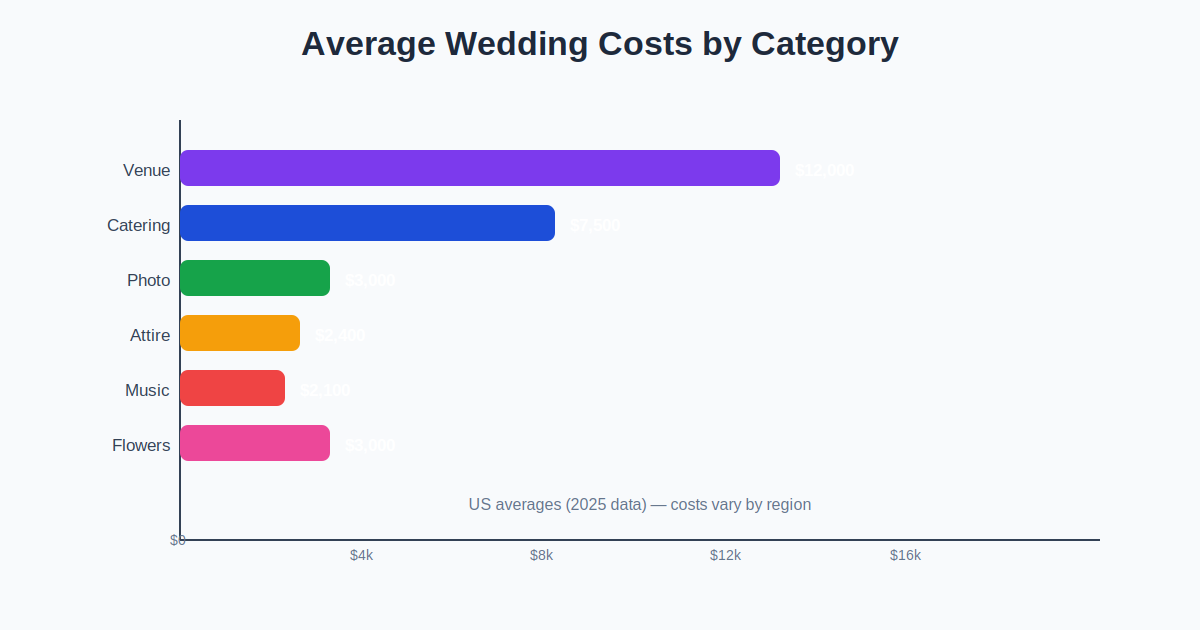
Financial planners often suggest this rough allocation for a traditional wedding. Venue, catering, cake, and rentals: 40-45 percent. Photography and videography: 10-12 percent. Attire, hair, and makeup: 8-10 percent. Flowers and decor: 8-10 percent. Music and entertainment: 8-10 percent. Rings, gifts, and stationery: 5-8 percent. The rest — 5-15 percent — covers officiant fees, transportation, tips, and a contingency cushion.
The formula behind the table is simple: category amount = total budget x (category percent / 100). The discipline comes from the constraint that percentages must sum to 100. Every increase somewhere demands a decrease elsewhere, which is exactly the tradeoff thinking that keeps weddings on budget.
Worked Example
With a 30,000 dollar budget at default splits: venue + catering gets 40 percent = 12,000 dollars. Photography at 10 percent = 3,000 dollars. Attire + beauty at 8 percent = 2,400 dollars. Flowers + decor at 8 percent = 2,400 dollars. Music at 8 percent = 2,400 dollars. Rings + gifts at 6 percent = 1,800 dollars. Other/contingency at 20 percent = 6,000 dollars. Total: 30,000 dollars, 100 percent allocated. Enter these numbers above to see the full table.
Wedding Budget Breakdown for a $30,000 Wedding
The worked example above, as a table — these are the calculator's default percentages, so you can reproduce every row by entering a $30,000 budget with the preset splits:
| Category | Share | Amount |
|---|---|---|
| Venue + catering | 40% | $12,000 |
| Photography | 10% | $3,000 |
| Attire + beauty | 8% | $2,400 |
| Flowers + decor | 8% | $2,400 |
| Music + entertainment | 8% | $2,400 |
| Rings + gifts | 6% | $1,800 |
| Other / contingency | 20% | $6,000 |
| Total | 100% | $30,000 |
Cost Per Guest: The Fastest Sanity Check
Divide your total budget by your guest count. A $30,000 wedding with 100 guests is $300 per guest — a useful figure because so many costs scale with the headcount: catering is quoted per person (industry benchmarks run around $80 per guest for food and drink alone), and rentals, stationery, favors, and transport all grow with the list. Other costs barely move — photography, attire, and the officiant cost about the same for 60 guests as for 120. That asymmetry is why trimming ten guests usually saves more than cutting three small decor items, and why a small wedding is cheaper but never half the price of a big one.
Costs Couples Forget to Budget
The contingency slice exists because of a predictable list of surprises: service charges and sales tax on catering (often 18 to 22 percent on top of the per-person price), tips for vendors, meals for the photographer and DJ, dress and suit alterations, the marriage license, postage, overtime fees if the reception runs long, and a weather backup such as tent walls or heaters for an outdoor ceremony. Industry surveys put these overlooked extras at roughly 9 percent of the average budget — close to $3,000 on a typical wedding — so a contingency of at least 5 to 10 percent is not pessimism, it is arithmetic.
Frequently Asked Questions
What is a realistic wedding budget?
It varies enormously by region. Many couples spend 20,000 to 35,000 dollars, but intimate weddings can cost under 10,000 while large metro weddings often exceed 50,000. Set a number tied to your actual finances, not averages.
What is the biggest wedding expense?
Venue and catering, typically 40-45 percent of the total. Locking this in first makes every other decision easier because the remaining budget is then fixed.
How much should I keep for unexpected costs?
Aim for 5-10 percent contingency. Common surprises include overtime fees, extra alterations, weather backup plans, and vendor tips you forgot to budget.
Can I have a nice wedding on a small budget?
Absolutely. Prioritize ruthlessly: guest count drives cost more than anything, so a smaller list is the fastest way to cut spending without feeling cheap.
When should I start budgeting?
As soon as you set a date — ideally 12 months out. Book the venue first (it constrains everything else), then allocate remaining categories with this calculator.
What is the average cost of a wedding?
Recent US industry surveys (The Knot and Zola) put the average wedding at roughly $33,000 to $35,000, but the average hides a wide spread — many couples spend under $15,000, and large metro weddings regularly pass $50,000. Guest count and city move your number far more than any single vendor choice, which is why starting from your own total matters more than the average.
What percentage of the budget should go to the venue and catering?
Together they are normally the largest block: about 40 to 50 percent of the total. This calculator starts them at 40 percent combined. If your venue bundles catering, rentals, and staffing into one package, a combined figure toward the top of that range is normal — just make sure the remaining categories still get realistic shares.
Related Calculators
Saving up for the big day? The Savings Goal Calculator shows how long it takes to reach your target. For the honeymoon road trip afterward, plan the drive with the Road Trip Cost Calculator.