Track daily caffeine from coffee, tea, energy drinks vs safe 400mg limit.
How to Use the Caffeine Calculator
Most of us reach for caffeine without realizing how quickly it adds up across coffee, tea, soda, and energy drinks. This calculator totals your daily intake and compares it against widely used safety guidelines, so you can see exactly where you stand.
- Add every caffeinated drink. Select each beverage type you had today and enter how many servings. Use the serving sizes shown — an 8-ounce cup of brewed coffee is very different from a 16-ounce energy drink.
- Review your total. The calculator adds up the milligrams from every drink and shows your daily total in one clear number.
- Compare against the 400 mg guideline. Health authorities generally consider up to 400 mg per day safe for healthy adults. You will see your intake as a percentage of that limit.
- Check the clearance estimate. Caffeine lingers for hours. Using a 5.5-hour half-life, the tool estimates how long your total takes to drop below 50 mg — a level most people can sleep through — so you can time your last cup.
Caffeine Calculator Formula
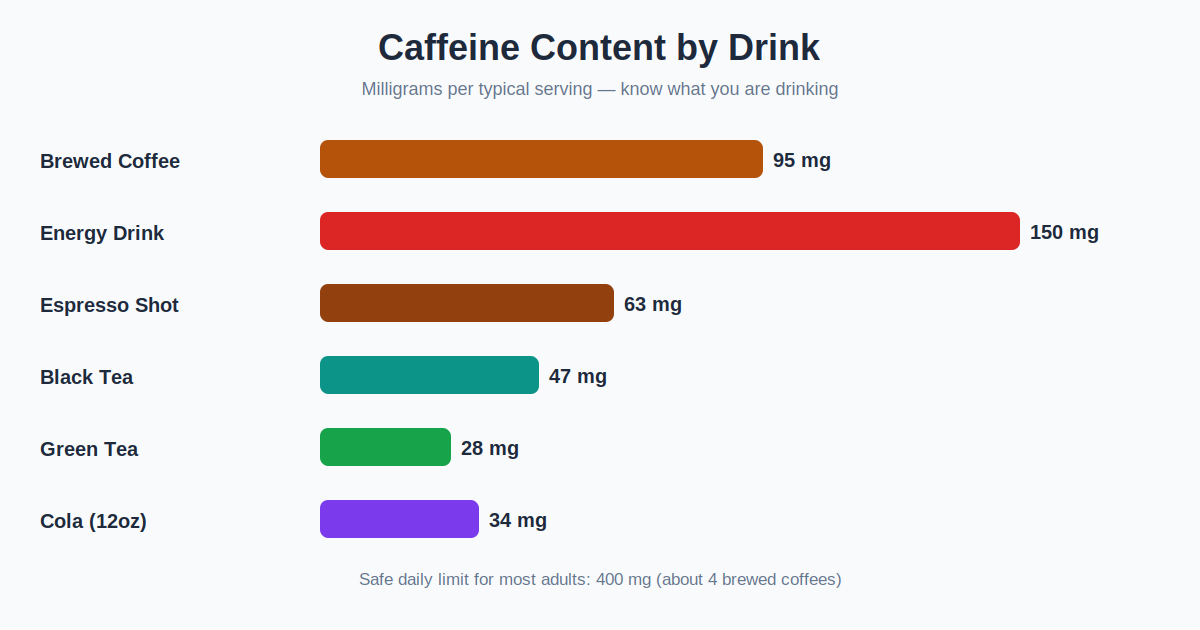
The math is straightforward addition, but the reference values matter. Each beverage has a typical caffeine content per serving: brewed coffee about 95 mg per 8 ounces, espresso about 63 mg per 1-ounce shot, black tea about 47 mg per 8 ounces, green tea about 28 mg, cola about 34 mg per 12 ounces, and energy drinks anywhere from 80 to 200 mg depending on brand and size. Your total is simply the sum of servings multiplied by each drink's caffeine content.
That total is then compared to the 400 mg daily guideline for healthy adults set by food safety authorities. The percentage shown is your total divided by 400, multiplied by 100. Pregnant women are usually advised to stay under 200 mg, and adolescents under 100 mg, so the same total means different things for different people.
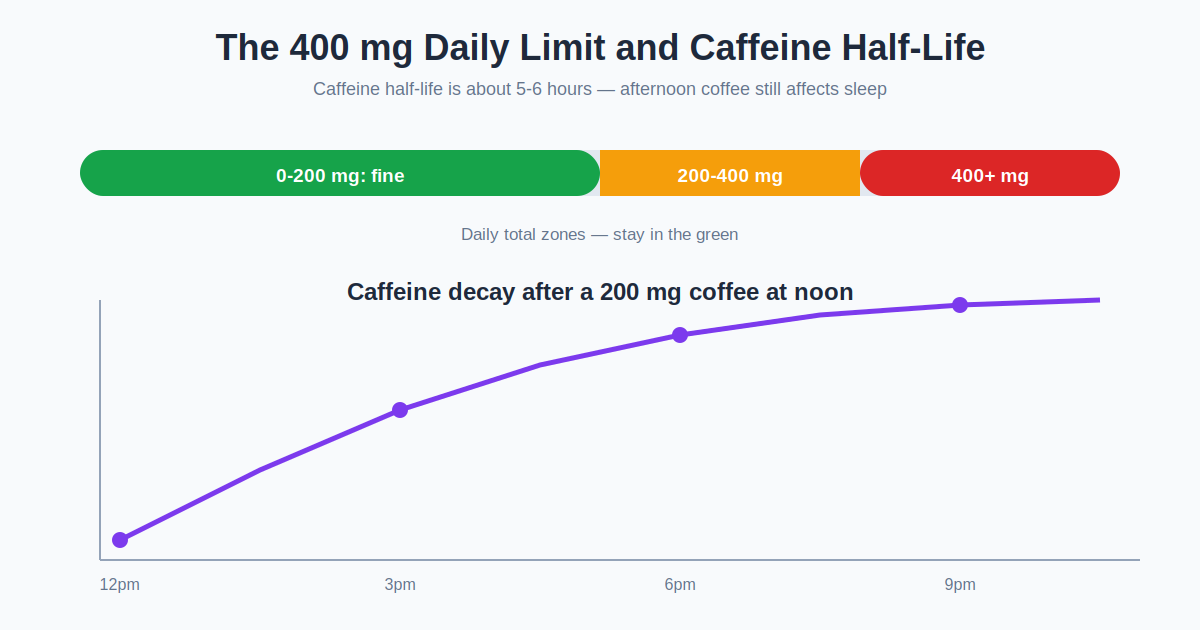
The bedtime estimate uses caffeine's half-life — the time for your body to clear half of it — typically 5 to 6 hours, though genetics, pregnancy, smoking, and some medications can stretch it to 10 hours or more. Remaining caffeine equals your total multiplied by one-half raised to the power of hours elapsed divided by the half-life. That is why an afternoon coffee can still be working at midnight.
Example Calculation
Suppose your day includes two 8-ounce cups of brewed coffee, one 12-ounce cola at lunch, and two 8-ounce energy drinks in the afternoon. The math: 2 times 95 equals 190 mg from coffee, plus 34 mg from cola, plus 2 times 80 equals 160 mg from the energy drinks, for a total of 384 mg. That is 96 percent of the 400 mg guideline — just under the limit, but with almost no room left.
Now consider timing. If your last drink was at 3 PM and you go to bed at 11 PM, 8 hours have passed. With a 5.5-hour half-life, roughly 384 times one-half to the power of 8 divided by 5.5 remains — about 140 mg, equivalent to a strong cup of tea, still circulating at bedtime. This is why the calculator may suggest moving that afternoon energy drink earlier or swapping it for a smaller option.
Caffeine Content of Common Drinks
The calculator counts the six drinks in the table's top rows; the rest are listed so you can estimate drinks it does not cover. All figures are typical averages — the same drink can vary by brand, bean, and brew strength, so treat them as planning numbers, not lab results.
| Drink | Typical serving | Caffeine |
|---|---|---|
| Brewed coffee | 8 oz cup | 95 mg |
| Espresso | 1 shot (1 oz) | 63 mg |
| Black tea | 8 oz cup | 47 mg |
| Green tea | 8 oz cup | 28 mg |
| Energy drink | 8 oz can | 80 mg |
| Cola | 12 oz can | 34 mg |
| Cold brew coffee | 8 oz | about 155 mg |
| French press coffee | 8 oz | about 107 mg |
| Matcha | 8 oz | about 70 mg |
| Instant coffee | 8 oz | about 60 mg |
| Decaf coffee | 8 oz | 2 to 15 mg |
When to Stop: Protecting Your Sleep
Falling asleep is only half the story — caffeine still in your bloodstream also lightens deep sleep, which is why a full night can still feel unrefreshing after a late coffee. Sleep researchers often use roughly 50 mg as the level below which caffeine stops disturbing most people's sleep, and that is the threshold behind the "time to drop below 50 mg" figure in your results. The math is just repeated halving: a 200 mg coffee takes two half-lives — about 11 hours at a 5.5-hour half-life — to fall below 50 mg, so a noon coffee is only reaching that level around 11 PM. As a rule of thumb, most people sleep best with an 8-to-10-hour caffeine cutoff before bed, and slow metabolizers, pregnant women, and anyone on medication that stretches the half-life should stop earlier still.
Frequently Asked Questions
How much caffeine is safe per day?
For healthy adults, up to 400 mg per day — roughly four 8-ounce cups of brewed coffee — is generally considered safe by food safety authorities. Pregnant women should stay under 200 mg, and children and adolescents under 100 mg. Individual sensitivity varies, so if you feel jittery or anxious below these levels, your personal limit is lower.
How long does caffeine stay in your system?
Caffeine's half-life is about 5 to 6 hours in most adults, meaning half is still present after that time. It takes roughly five half-lives — 25 to 30 hours — to clear almost completely. For sleep, most experts suggest avoiding caffeine within 8 hours of bedtime, since even 100 mg late in the day can fragment sleep.
Which common drink has the most caffeine?
Brewed coffee leads most daily routines at about 95 mg per 8 ounces, but energy drinks can match or exceed it — a 16-ounce can often holds 160 to 200 mg. Espresso has about 63 mg per shot but is served small. Black tea has around 47 mg, green tea about 28 mg, and cola roughly 34 mg per 12 ounces.
Does caffeine affect everyone the same way?
No. Genetics play a big role — some people metabolize caffeine quickly and barely feel an evening coffee, while slow metabolizers feel wired for hours. Pregnancy slows clearance dramatically, smoking speeds it up, and certain medications and oral contraceptives can extend the half-life. Age and habitual use also change sensitivity.
Can I build a tolerance to caffeine?
Yes. Regular daily use leads to tolerance within one to two weeks, so the same dose feels weaker and stopping suddenly can cause withdrawal headaches, fatigue, and irritability. If you want to cut back, taper gradually — reduce by about a quarter every few days — rather than quitting cold turkey.
How much caffeine is in decaf coffee?
Decaf is not caffeine-free. An 8-ounce cup typically contains 2 to 15 mg — about 97 to 99 percent of the caffeine is removed, but the small remainder still counts if you drink several cups, and it can matter for people who are highly sensitive or avoiding caffeine completely.
Related Calculators
Try our BMI Calculator and Calorie Calculator for more calculations.