Adjust cooking times when changing oven temperature.
How to Use the Cooking Time Converter
Recipes are written for a specific oven temperature, but real kitchens rarely cooperate — maybe your oven runs hot, the recipe’s temperature doesn’t match your other dishes, or you’re adapting for altitude. This converter estimates how cooking time shifts when you change the temperature, so dinner still lands on the table on schedule.
- Enter the original temperature. Use the temperature the recipe calls for, in Fahrenheit or Celsius.
- Enter the original cooking time. This is the time stated in the recipe at that temperature.
- Enter your new temperature. Type the temperature you actually plan to use.
- Calculate and verify. The tool estimates the adjusted time — but always confirm doneness with a thermometer or visual cues, since this is an approximation.
Cooking Time Converter Formula
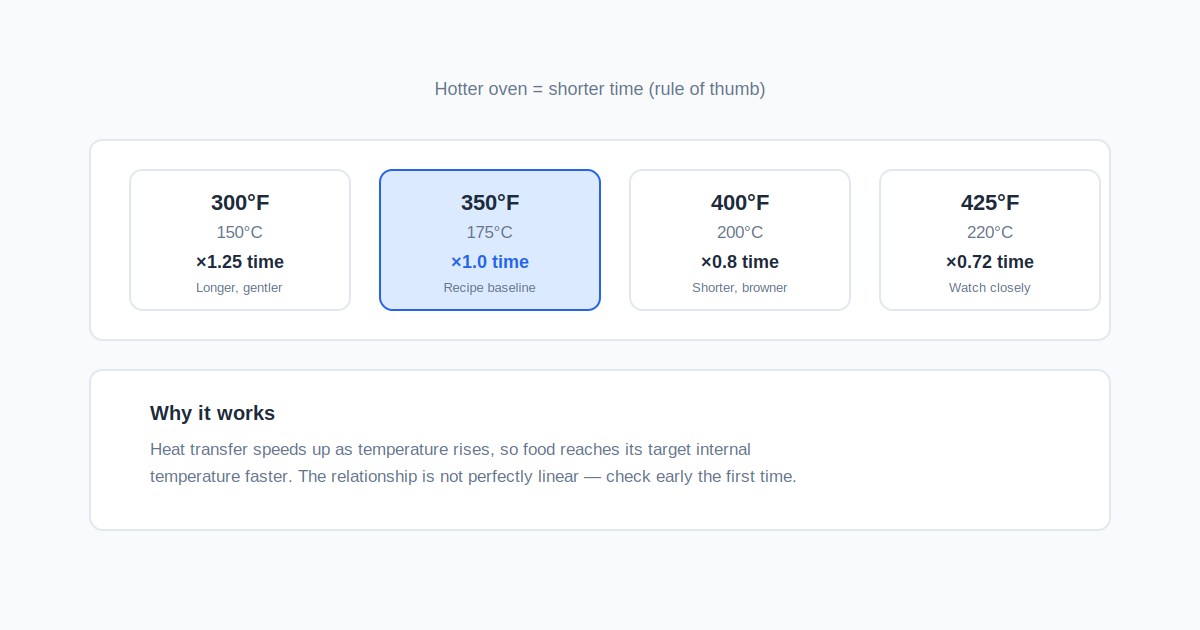
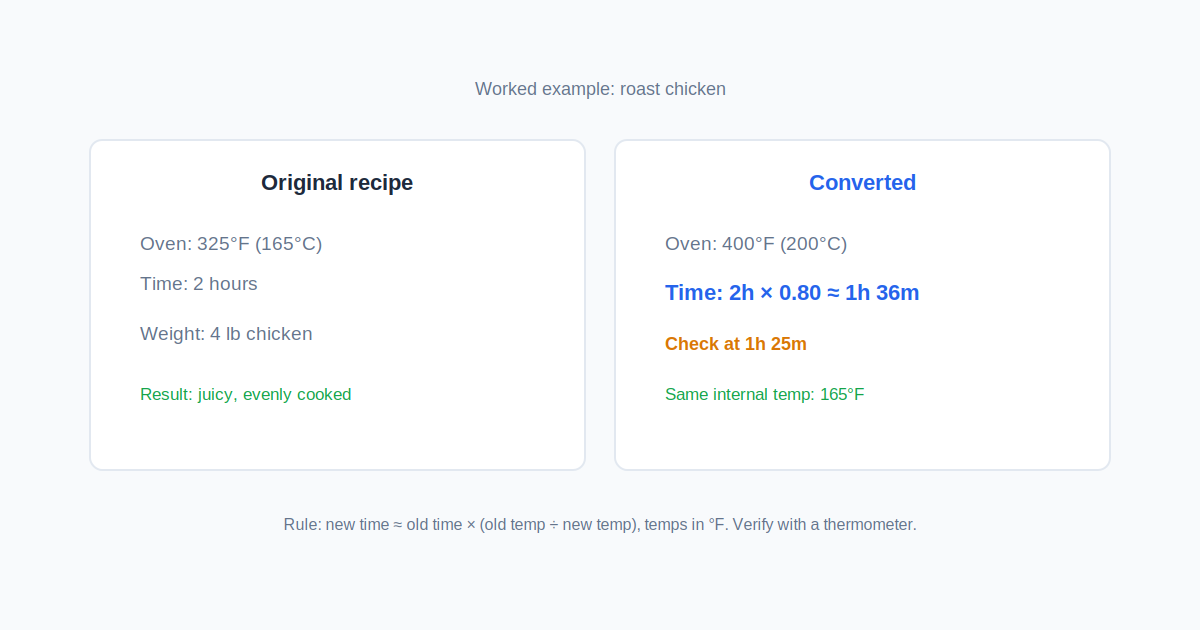
There is no exact physics formula for cooking time versus temperature — heat transfer into food depends on the dish’s size, shape, water content, and the oven’s behavior. This converter uses a transparent approximation: it rescales time by the ratio of absolute temperatures. Converting both temperatures to the Rankine scale (degrees Fahrenheit + 459.67), the new time = original time × (old °R ÷ new °R). Raising the heat from 350°F to 425°F moves the absolute temperature only from 809.67°R to 884.67°R — about 9% — so the converted time shrinks modestly rather than collapsing. That conservatism is deliberate: the estimate keeps you out of trouble, and you fine-tune by checking the dish.
Why only approximate? Cooking is chemistry as well as heat. The Maillard reaction that browns meat accelerates dramatically with temperature, while a custard’s proteins set within a narrow window regardless of oven heat. Dense items like a whole turkey respond sluggishly to temperature changes; thin items like cookies respond quickly. The converter gives you a sensible starting estimate, and your eyes, nose, and thermometer do the rest.
One hard rule overrides every estimate: food safety. Poultry must reach 165°F (74°C) internally, ground meats 160°F (71°C), and reheated leftovers 165°F. If a lower temperature means a longer time in the bacterial danger zone (40–140°F), keep the hotter temperature. No time estimate is worth a foodborne illness.
Example Calculation
A casserole recipe calls for 60 minutes at 350°F, but your oven is already at 425°F for another dish and you want to cook them together. The converter rescales: 60 × (350 + 459.67) ÷ (425 + 459.67) = 60 × 0.915 ≈ 55 minutes. That is a smaller saving than kitchen folklore suggests — folklore overpromises; absolute temperature is the honest yardstick. Start checking at 45 minutes anyway, since the exposed top browns faster at the higher heat, and tent with foil if it runs ahead.
Going the other direction: cookies bake 12 minutes at 375°F, but you drop to 325°F for a gentler bake. Rescaling: 12 × (375 + 459.67) ÷ (325 + 459.67) = 12 × 1.064 ≈ 13 minutes. The cookies will spread a little less and bake more evenly — a trade-off many bakers prefer, and here it costs barely a minute.
Safe Internal Temperatures (USDA)
Time estimates plan the meal; temperature decides doneness. Check the thickest part, away from bone:
| Food | Safe internal temperature |
|---|---|
| Poultry (all cuts, whole birds) | 165°F (74°C) |
| Ground meats | 160°F (71°C) |
| Beef, pork, lamb roasts and steaks | 145°F (63°C) + 3-minute rest |
| Fully cooked ham (reheating) | 140°F (60°C) |
| Leftovers and casseroles | 165°F (74°C) |
Roasts keep cooking after they leave the oven: internal temperature typically rises another 5–10°F during a 15–20 minute rest (carryover cooking). That is why experienced cooks pull a roast a few degrees early and let the rest finish the job — and why the resting time is part of the recipe, not dead time.
When Not to Rescale the Time
Some foods care about temperature far more than this arithmetic assumes. Custards and cheesecakes set in a narrow window and crack or curdle if pushed hotter. Soufflés and meringues depend on gentle, stable heat for structure. Yeasted breads need their oven spring at the intended temperature — a rescale changes the crust-to-crumb balance. And slow cookers are a different regime entirely: converting oven recipes to a slow cooker follows its own rules (roughly, an hour at 350°F ≈ 4–5 hours on High) and should not be improvised from this converter. Within about ±25–50°F, for sturdy dishes — roasts, casseroles, cookies, roasted vegetables — the rescale works well.
Frequently Asked Questions
How accurate is cooking time conversion?
It is a starting estimate, not a guarantee — expect ±20% error. Food size, shape, starting temperature, and oven accuracy all shift real times. Always verify with a thermometer or doneness tests rather than trusting the clock alone.
Is it safe to cook at a lower temperature for longer?
Usually yes for most dishes, but watch the danger zone: perishable food should not sit between 40°F and 140°F for more than 2 hours total. For poultry and ground meat, verify the safe internal temperature with a thermometer regardless of time.
Do I need to adjust for a convection oven?
Yes — convection circulates hot air and cooks about 25% faster. The standard advice is to reduce the recipe temperature by 25°F and check 5–10 minutes early. Our converter assumes conventional ovens; apply the convection adjustment on top.
Does this work for all foods equally?
No. Thin, uniform items (cookies, fish fillets) scale most predictably. Large roasts and baked goods with chemical leaveners are fussier — big temperature swings can ruin texture even if the timing math works. Stay within 50°F of the recipe when possible.
Should I change the time or the temperature when multitasking?
Change the temperature only if you must share the oven, and keep the change small (±25°F). Otherwise, cook dishes sequentially at their ideal temperatures — or choose recipes designed for the same heat. Resting meat buys you flexible serving time.
Why does the converted time change less than I expected?
Because the converter scales by absolute temperature, not by the Fahrenheit numbers on the dial. Going from 350°F to 425°F looks like a 21% jump in Fahrenheit, but in absolute (Rankine) terms it is only about 9% hotter, so the time adjusts by roughly that much. Bakers’ rules of thumb that slash 20–25% per 25°F step overstate the effect and regularly produce underdone middles. This converter is deliberately conservative — and you should still start checking early, since browning speeds up faster than the center cooks.
Can I use this converter for an air fryer?
Not directly — an air fryer is a small, intense convection oven, and the usual conversion is different: reduce the recipe temperature by about 20–25°F and the time by roughly 20%. If you bake the same dish in a regular oven at a changed temperature instead, that is exactly what this converter is for. Either way, check doneness early the first time you adapt a recipe.
Related Calculators
Pair this with our Oven Temperature Converter to translate the setpoint itself (°F, °C, Gas Mark), and the Cooking Measurement Converter for cups, grams, and spoons.