Estimate fencing cost by material, linear feet, and gates.
Need material calculations? Try our Fence Calculator.
How to Use the Fence Cost Calculator
A new fence is one of the highest-ROI outdoor projects — but material prices vary wildly, and the extras (posts, gates, concrete, labor) often exceed the pickets themselves. This calculator builds your estimate from linear footage, material choice, gates, and installation method.
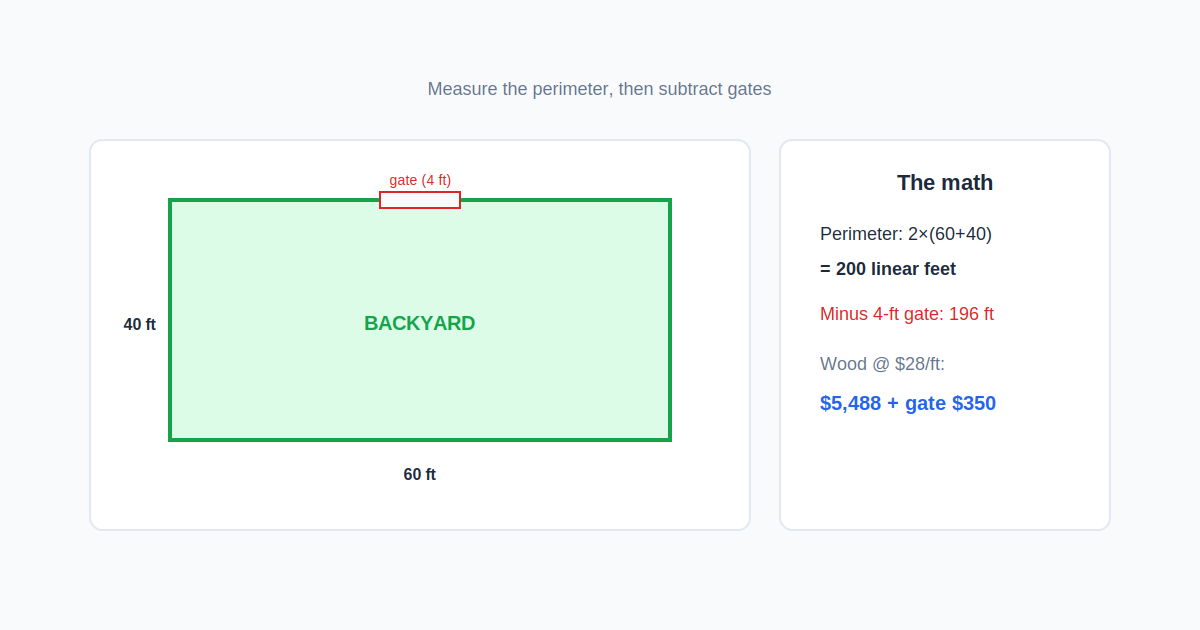
- Measure the linear feet. Walk the fence line with a tape or measuring wheel; subtract existing structures like the house wall the fence ties into.
- Choose your material and height. Wood, vinyl, chain-link, and metal each have very different per-foot costs; 6-foot privacy costs notably more than 4-foot picket.
- Add gates. Each walk gate and drive gate adds material plus hardware and extra posts — enter the count and widths.
- Select DIY or professional installation. Labor typically doubles the material cost; the calculator shows both so you can decide.
Fence Cost Calculator Formula
The estimate builds from three components: total = (linear feet × material cost per foot) + (gates × cost per gate) + (linear feet × labor per foot). The per-foot material rate bundles everything in the run itself — pickets or panels, rails, posts, and the concrete to set them — which is how fencing is actually sold. Gates are priced individually because their cost varies so widely, and labor is a separate per-foot rate (enter 0 if you are building it yourself).
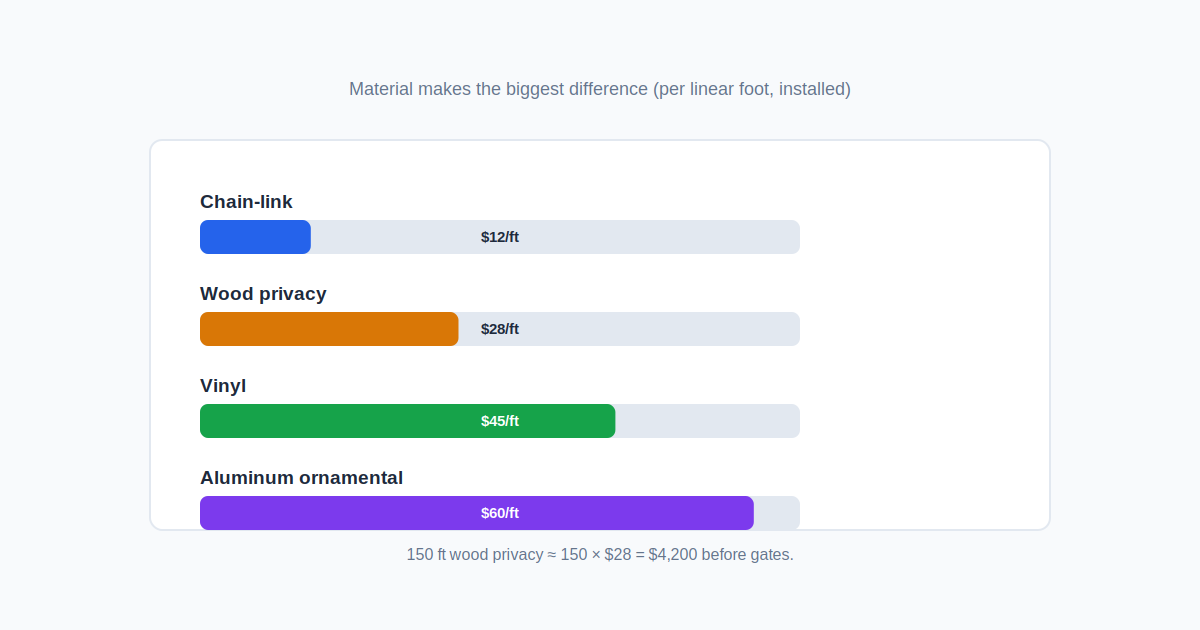
Material choice dominates the math. As rough 2026 ranges: pressure-treated pine runs $15–$30 per foot installed-equivalent in materials, cedar $25–$45, vinyl $35–$65, chain-link $10–$20, and ornamental metal $40–$80+. Gates are the great multiplier — a single 4-foot walk gate adds $150–$400 in materials and hardware, while a 12-foot double drive gate can add $800–$2,000.
Labor is the other half of the equation. Professional installation typically adds $15–$35 per linear foot depending on terrain, soil (rocky soil slows post-setting dramatically), and old-fence removal. DIY saves that — but budget a full weekend per 100 feet for a two-person crew, plus tool rental for an auger and a level.
What Each Material Costs per Foot
These are the material rates built into the calculator above, with typical lifespans and what a 150-foot run costs fully installed at a mid-range $25/ft labor rate:
| Material | Materials $/ft | Typical lifespan | 150 ft installed (incl. $25/ft labor) |
|---|---|---|---|
| Chain link | $18 | 20–25 years | $6,450 |
| Wood | $28 | 10–15 years | $7,950 |
| Aluminum | $42 | 25–30 years | $10,050 |
| Vinyl | $55 | 25–30 years | $12,000 |
Regional quotes run above and below these national figures — use your own contractor’s rate in the calculator whenever you have one. For the material quantities behind these numbers (posts, pickets, rails), use our Fence Calculator.
Cost per Year: The Fair Comparison
Upfront price misleads, because fences live for very different lengths of time. Divide the installed totals above by each material’s typical lifespan midpoint and the ranking flips:
| Material | Installed (150 ft) | Cost per year of life |
|---|---|---|
| Chain link | $6,450 | ~$287/yr |
| Aluminum | $10,050 | ~$365/yr |
| Vinyl | $12,000 | ~$436/yr |
| Wood | $7,950 | ~$636/yr |
Wood looks second-cheapest on day one and most expensive per year of service — before counting the staining and board replacement it needs along the way. If you plan to stay in the home a decade or more, the low-maintenance materials usually win this comparison.
Example Calculation
You need 150 linear feet of 6-foot wood privacy fence with one walk gate, professionally installed. Enter 150 feet, the wood rate of $28/ft, one gate at $300, and labor at $25/ft. Materials: 150 × $28 = $4,200. Gate: 1 × $300 = $300. Labor: 150 × $25 = $3,750. Total: $8,250 — exactly the breakdown the calculator shows.
DIY the same fence by setting labor to $0 and the total drops to $4,500 — a saving of $3,750 for roughly two weekends of work. Many homeowners split the difference: DIY the straight runs, hire out the gates and tricky corners. Just remember the per-foot rates assume a typical run; rocky soil, slopes, and old-fence removal push real quotes up.
Costs That Catch People Out
Gates are never in the per-foot price. A simple walk gate runs $150–$400 in materials and hardware, a double drive gate $800–$2,000, and an automatic driveway gate several thousand. That is why the calculator prices them separately.
Old fence removal. Hauling away a previous fence typically adds a few dollars per foot or a flat disposal fee — easy to forget until demo day.
Permits and surveys. Many towns require a permit, and building on the wrong side of the property line is an expensive mistake; a survey can be cheaper than a dispute.
Ground conditions. Slopes need stepped or racked panels, and rocky soil slows every post hole. Get the 811 utility marking done before anyone digs.
Frequently Asked Questions
What is the cheapest fence material?
Chain-link is cheapest ($10–$20/ft), followed by pressure-treated pine ($15–$30/ft). But factor lifespan: pine needs restaining every 2–3 years, while vinyl’s higher upfront cost comes with near-zero maintenance for decades.
How far apart should fence posts be?
8 feet on center for wood privacy fences (the standard panel width), 6–8 feet for picket styles, up to 10 feet for chain-link. In windy areas or with heavy gates, go closer. Every post should be set 1/3 of its length underground — a 6-foot fence needs 8-foot posts.
Do I need a permit for a fence?
Often yes. Most municipalities regulate height (usually 6 ft max in backyards, 4 ft in front), require setback from property lines, and some mandate permits above a cost threshold. Always check local rules and call 811 for utility marking before digging.
Should I DIY or hire a professional?
DIY saves roughly half the total cost but demands real labor: digging 20+ post holes, keeping everything level and plumb, and hauling materials. Hire out if the ground is rocky, the line is long (200+ ft), or you want it done in days rather than weekends.
How long do different fences last?
Pressure-treated pine: 10–15 years with maintenance. Cedar: 15–25 years. Vinyl: 25+ years. Chain-link: 20+ years. Metal: 25+ years. Maintenance — staining wood, washing vinyl — is what separates the short end from the long end of each range.
How much does a 150-foot fence cost?
Using this calculator’s rates with $25/ft labor and one $300 gate: chain link about $6,450, wood about $8,250 with the gate ($7,950 without), aluminum about $10,050, and vinyl about $12,000. That is why most real-world quotes for a typical backyard run land between roughly $6,000 and $12,000 installed.
Does fence height change the cost?
Yes. Taller fences need longer posts, more material per foot, and more labor. Industry estimates put an 8-foot privacy fence at roughly 25–35% more per foot than the same fence at 6 feet. The rates in this calculator reflect typical 6-foot privacy and 4-foot chain-link installations; scale up proportionally for taller designs.
Related Calculators
Use the Fence Calculator for post, picket, and rail quantities, and the Concrete Bags Calculator to work out footing concrete.