Should you take the monthly pension or lump sum? Compare with break-even analysis.

How to Use the Pension vs Lump Sum Calculator
When your employer offers a pension buyout, you face one of retirement’s biggest one-way decisions: guaranteed monthly checks for life, or a single lump sum you invest yourself. This calculator compares both paths honestly.
- Enter the monthly pension amount offered and the age payments would begin.
- Enter the lump sum amount being offered as the alternative.
- Add your expected investment return, inflation estimate, and life expectancy.
- Compare: total lifetime pension income vs projected lump-sum growth, and the break-even age.
Pension vs Lump Sum Formula
The comparison hinges on present value. A pension paying $P per month for life has a present value equal to the lump sum that, invested at a reasonable return, could reproduce those payments. The quick check: divide the annual pension by the lump sum offer. A $36,000-a-year pension against a $500,000 lump sum implies a 7.2% payout rate — meaning the lump sum must earn over 7.2% annually just to match the pension, before inflation.
Formally, the present value of a monthly pension is the annuity formula: PV = payment × [1 − (1 + r)−n] ÷ r, where r is the monthly return and n the number of monthly payments. Run Robert’s pension through it at 6% (r = 0.005) over 22 years (n = 264): PV = $2,800 × 146.4 ≈ $410,000 — slightly less than the $430,000 lump sum on offer, which is another way of saying his lump sum could fund the same income for about 24 years at that return. Change the assumed return and the answer flips, which is why the calculator lets you test several rates.
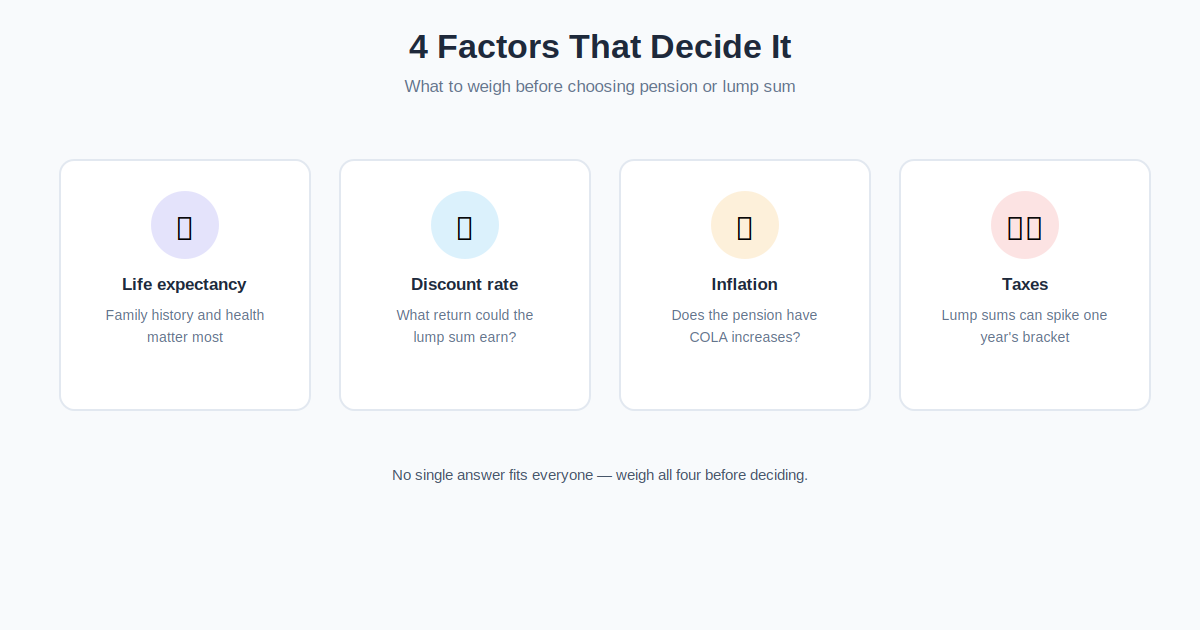
Three factors tilt the scales. Longevity favors the pension: every year you live past the break-even age (often 78–82) is pure profit the lump sum cannot match, and the pension is longevity insurance you cannot outlive. Investment returns favor the lump sum only if you truly earn more than the implied rate net of fees and taxes — most retirees overestimate this. Inflation cuts both ways: fixed pensions lose purchasing power while invested lump sums can grow, but few retirees sustain the 7%+ real returns needed. Taxes matter too: lump sums rolled into an IRA defer tax, while pension payments are taxed as ordinary income each year.
Seven Factors That Decide Pension vs Lump Sum
The math above gives you a fair-value estimate, but the right choice also depends on circumstances the formula cannot see. Work through these seven factors — for most retirees, two or three of them dominate the decision.
| Factor | Favors the pension | Favors the lump sum |
|---|---|---|
| Life expectancy | You and your spouse are healthy with long-lived families | Health concerns suggest a shorter retirement |
| Investment comfort | You prefer guaranteed income and dislike market swings | You are a confident, disciplined long-term investor |
| Survivor needs | Your spouse depends on this income and needs it to continue | Your spouse has their own pension or ample assets |
| Plan security | Well-funded plan, strong sponsor, PBGC coverage | Underfunded plan or a shaky employer |
| Inflation protection | The pension includes a cost-of-living adjustment (COLA) | The pension is fixed, and you want growth assets to fight inflation |
| Tax planning | You want income spread evenly across retirement years | You want flexibility, e.g. Roth conversions in low-income years |
| Other income | Little Social Security or savings income besides this pension | Strong other income already covers your essential spending |
Notice how rarely one option wins every row. A healthy 62-year-old with a dependent spouse and a COLA pension almost always keeps the pension; a retiree with a paid-off house, a large IRA, and a fixed pension from a struggling company often should not.
Example Calculation
Robert, 65, is offered $2,800/month for life or a $430,000 lump sum. Annual pension: $33,600, an implied payout rate of 7.8% ($33,600 ÷ $430,000). If Robert invests the lump sum at 6% and draws the same $2,800 a month, the money lasts about 24 years — to age 89. Live past 89 and the pension wins; die earlier and the lump sum wins (with money left for heirs). The pension also continues for a surviving spouse at a reduced rate, while the lump sum’s remainder passes to heirs directly. For Robert, whose parents lived into their 90s, the pension’s longevity insurance is worth more than the lump sum’s flexibility.
What This Calculator Doesn’t Model
Survivor options. Choosing a joint-and-survivor pension lowers the monthly amount but keeps income flowing to a spouse. Compare like with like: value the survivor version you would actually elect, not the higher single-life figure.
Credit risk. A pension is a promise decades long. In the US, most private plans are insured by the PBGC up to a legal cap (roughly $85,000–$95,000 a year at age 65, adjusted yearly); a lump sum, once rolled into your own IRA, no longer depends on your former employer at all.
The decision is usually final. Pension elections are typically irrevocable once the deadline passes, often 30 to 60 days before retirement. Run several return and lifespan scenarios — and for a decision this size, a fee-only financial planner who can read your actual plan document is worth the fee.
Frequently Asked Questions
Is a pension or lump sum better?
It depends on longevity, returns, and risk tolerance. Pensions win for long lives and conservative investors; lump sums win if you earn high returns, want an inheritance for heirs, or doubt the plan’s solvency. There is no universal answer.
What is the break-even age?
The age where total pension payments received equal what the lump sum would have grown to. Living past it favors the pension. For typical offers it falls around 78–84 — uncomfortably close to average life expectancy, which is exactly why the decision is hard.
What if my company goes bankrupt?
Private pensions are backstopped by the PBGC up to annual limits (roughly $85,000–$95,000 a year at age 65, adjusted yearly), though benefits above the cap can be cut. Government pensions carry sovereign risk instead. Check your plan’s funding level.
Can I roll a lump sum into an IRA?
Yes — a direct rollover to a traditional IRA avoids all immediate tax, preserving the full amount to invest. Taking the cash outright triggers ordinary income tax on the entire sum plus a 10% penalty if you are under 59½.
Does the pension include cost-of-living adjustments?
Some do, most private pensions do not. A fixed $2,800/month loses roughly half its purchasing power over 25 years at 3% inflation — a critical detail that can flip the math toward the lump sum.
Is a pension lump sum taxable?
Not if you move it correctly. A direct rollover into a traditional IRA avoids all immediate tax, and the money keeps growing tax-deferred until you withdraw it. If the lump sum is paid to you personally instead, the plan must withhold 20% for federal taxes, the full amount counts as ordinary income for that year, and a 10% early-withdrawal penalty can apply before age 59½. A 60-day indirect rollover exists, but you must replace the withheld 20% from other funds to defer the whole amount.
What is the hurdle rate in a pension decision?
The hurdle rate is the investment return your lump sum would have to earn, year after year, to match the pension’s guaranteed payments over your lifetime. If the hurdle rate is low — say 3–4% — a cautious portfolio might plausibly clear it, strengthening the case for the lump sum. If it is 7–8% or more, matching the pension requires aggressive investing with real risk of falling short, which usually strengthens the case for keeping the pension.
Related Calculators
Try our Compound Interest Calculator to model lump-sum growth, or How Long Retirement Savings Last to test a drawdown plan.