Solve a/b = c/d for the unknown with cross-multiplication steps.
Solve a / b = c / d. Fill three boxes and leave the unknown empty.
How to Use the Proportion Solver
A proportion states that two ratios are equal, like 3/4 = x/20. When three of the four values are known, the fourth is forced — this solver finds it and shows the cross-multiplication steps.
- Enter the three known values. Fill in a, b, c, or d in the equation a/b = c/d, leaving the unknown blank or marked with x.
- Mark which value is unknown. Select the position you want to solve for so the algebra aims at the right target.
- Read the answer with steps. The calculator cross-multiplies, isolates the unknown, and shows each line of working.
- Check the verification. Both sides are evaluated as decimals to confirm they match, proving the solution.
Proportion Solver Formula
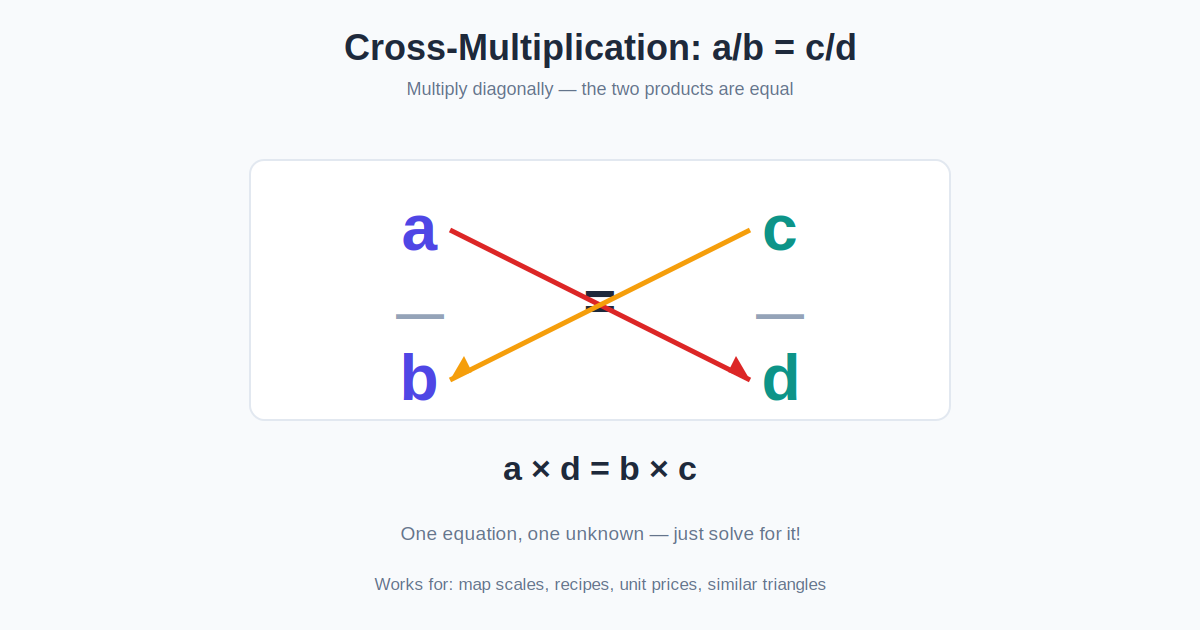
The entire method rests on one move: cross-multiplication. If a/b equals c/d, then multiplying both sides by b times d gives a times d equals b times c. The fractions vanish and you are left with a plain equation. To solve for any single unknown, use the diagonal-pair rule: the unknown equals the product of the two values on the opposite diagonal, divided by the one remaining value. In 3/4 = x/20, the pair opposite x is 3 and 20, so x = (3 × 20) / 4 = 15.
This works because proportions assert equal rates. Scaling is linear: doubling one side's numerator while holding the proportion demands doubling the other. Cross-multiplication is just the algebraic bookkeeping that enforces this consistency, and it is valid for decimals and fractions as inputs, not only whole numbers.
One caveat: the method assumes a direct proportion, where quantities grow together. If the relationship is inverse — more workers, less time — the setup flips to a times b equals c times d with the pairing reversed. The calculator notes this distinction so you set up the right equation before solving.
Example Calculation
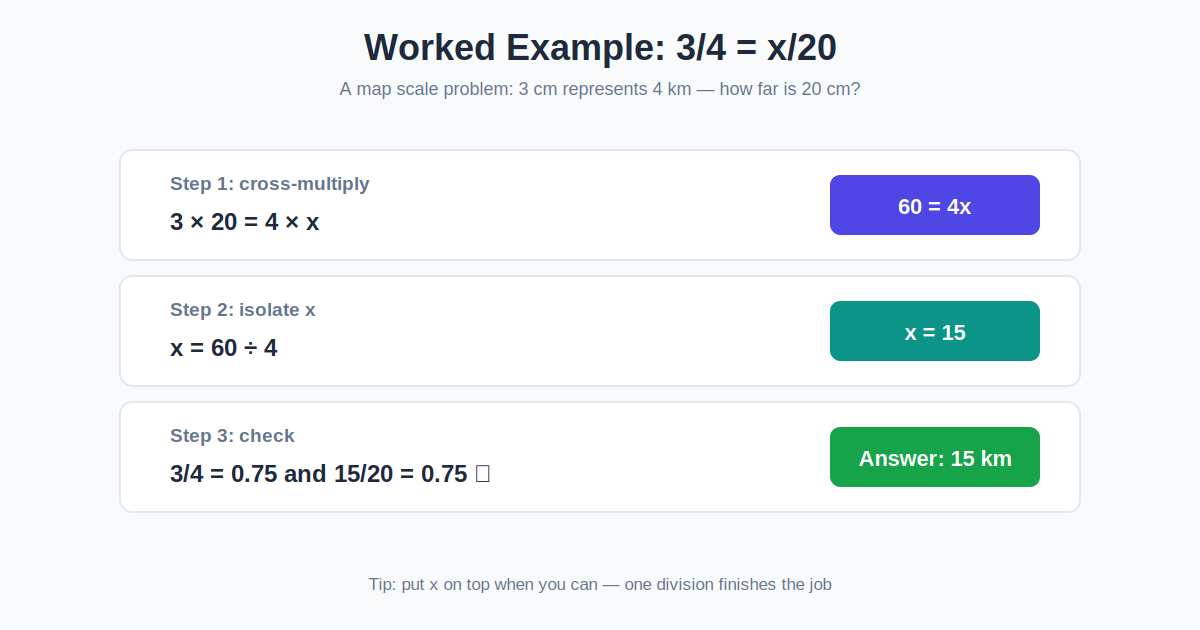
Solve 3/4 = x/20. Cross-multiply: 4 times x equals 3 times 20, so 4x = 60, and x = 15. Verify: 3/4 is 0.75 and 15/20 is 0.75 — both sides match.
A kitchen version: a recipe uses 2 cups of flour for 12 cookies, and you want 30 cookies. Set up 2/12 = x/30. Cross-multiply: 12x = 60, so x = 5 cups. The proportion guarantees the dough keeps the same consistency at the larger batch size — that is the whole power of proportional reasoning in one line of algebra.
Proportion Quick-Reference Table
Reading a few solved proportions end to end builds intuition fast. Every row below is verified — both ratios reduce to the same value.
| Proportion | Unknown | Cross-multiplication |
|---|---|---|
| 2/5 = x/15 | 6 | 5x = 2 × 15 = 30 |
| 6/9 = x/12 | 8 | 9x = 6 × 12 = 72 |
| 1/8 = x/40 | 5 | 8x = 1 × 40 = 40 |
| 4/7 = x/21 | 12 | 7x = 4 × 21 = 84 |
The same pattern runs word problems. Pencils sell at 3 for 45 cents; how many does 150 cents buy? Match the units — 3/45 = x/150 — and cross-multiply: 45x = 450, so x = 10 pencils.
Frequently Asked Questions
What is a proportion?
An equation stating that two ratios are equal, written a/b = c/d. It claims the two fractions represent the same rate or relationship. Proportions are the formal version of everyday scaling — recipes, maps, and unit prices all run on proportional thinking.
Why does cross-multiplication work?
Multiplying both sides of a/b = c/d by the common denominator b times d clears both fractions, leaving a times d equals b times c. It is not a trick; it is ordinary equation-solving with the denominators eliminated in one step. Everything after that is basic isolation of the unknown.
What is the difference between direct and inverse proportion?
In direct proportion, both quantities rise together — more flour, more cookies. In inverse proportion, one rises as the other falls — more workers, fewer hours to finish. This solver handles direct proportions; inverse ones need the products equated differently (a times b equals c times d with swapped pairing).
Can I use decimals or fractions as inputs?
Yes. Cross-multiplication works for any real numbers except zero denominators. Inputs like 0.5/1.2 = x/3.6 solve exactly the same way: 1.2x = 1.8, so x = 1.5. The calculator accepts decimals throughout.
Where are proportions used in real life?
Scaling recipes, reading map distances, converting currencies, mixing paint or concrete, calculating unit prices, and solving similar-triangle problems in geometry. Anytime you think in terms of per-something rates, a proportion is hiding underneath.
How do I set up a proportion from a word problem?
Write two ratios with matching units in matching positions: the known pair as one fraction, the unknown paired with its matching value as the other. For 3 pencils at 45 cents and a question about 150 cents, the setup is 3/45 = x/150 — pencils over cents on both sides, x where the pencils belong.
How can I check my answer to a proportion?
Substitute your answer back and cross-multiply: both products must match — for 3/4 = 15/20, 3 × 20 = 60 and 4 × 15 = 60. Then reduce both ratios to decimals; they must be identical.
Related Calculators
Try our Percentage Calculator and Fraction Calculator for more calculations.