Scale any recipe up or down — ingredient amounts recalculated.
Leave the optional fields blank to scale by servings. A limiting ingredient overrides the multiplier, which overrides servings.
How to Use the Recipe Scaler
Doubling a weeknight dinner for guests or halving a cake recipe for two should be simple arithmetic — but miscounting one ingredient ruins the dish. The recipe scaler does the math for every ingredient at once: enter what the recipe makes, what you want to make, and your ingredient list, and every quantity rescales precisely.
- Enter the original servings. How many portions does the recipe as written produce?
- Enter your target servings. How many do you actually need to feed?
- List your ingredients with amounts. Add each ingredient and its quantity; the scaler handles cups, grams, tablespoons, and counts.
- Get the scaled recipe. Every amount is multiplied by the scaling factor and rounded to practical kitchen measures.
Recipe Scaler Formula
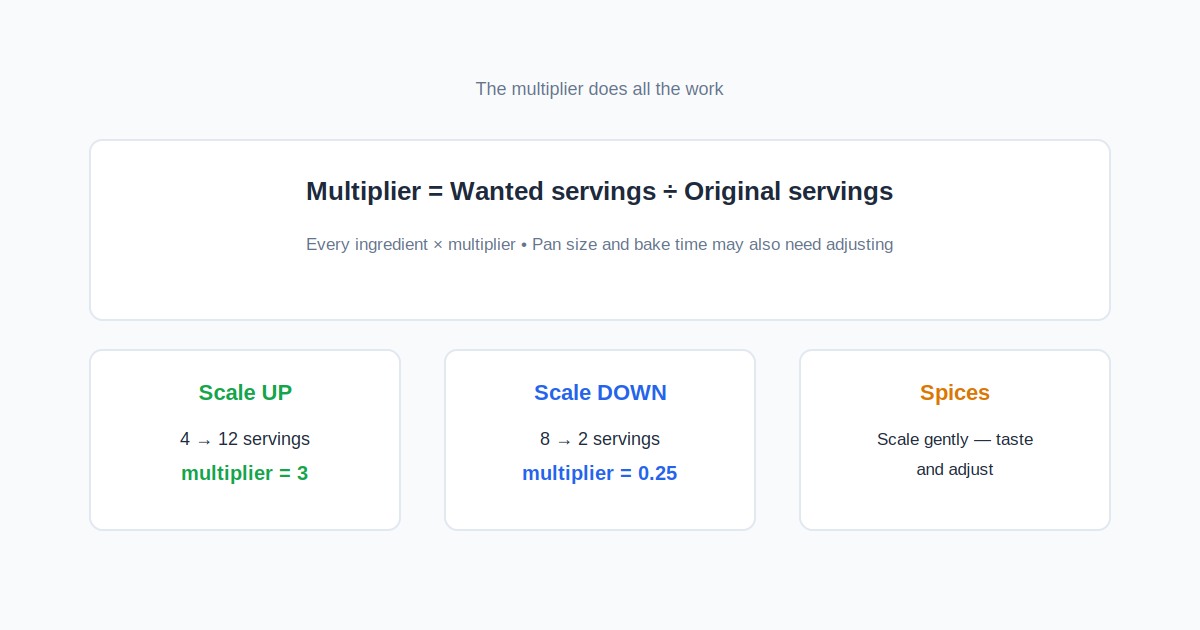
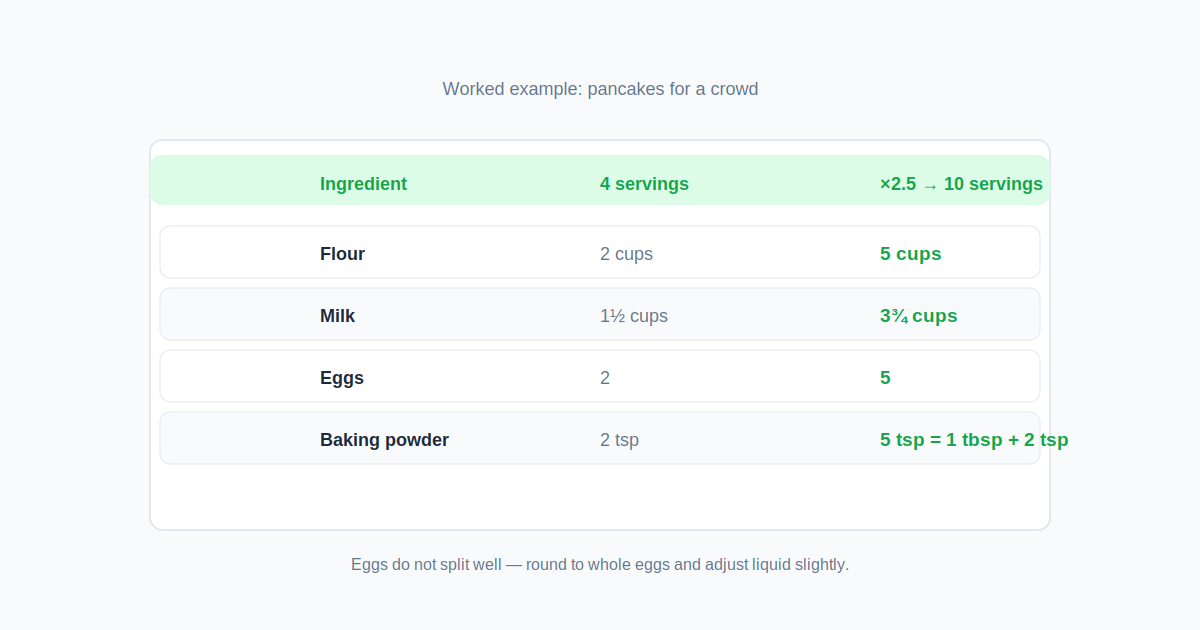
The entire operation rests on one ratio: scaling factor = target servings ÷ original servings. Every ingredient quantity is then multiplied by this factor: new amount = original amount × scaling factor. Scaling 4 servings to 10 gives a factor of 2.5, so 2 cups of flour become 5 cups and 3 eggs become 7.5 (rounded to 7 or 8 in practice).
But professional cooks know the math is only the starting point, because not everything scales linearly. Spices, salt, and potent flavorings should be scaled conservatively — increase by about 75% of the factor, then taste and adjust. Doubling the garlic in a doubled recipe often overpowers it. Leavening agents (baking powder, yeast) similarly need a gentler hand: scale by roughly the square root of the factor for large multiples to avoid soapy or yeasty off-flavors.
Equipment imposes the final constraint. A doubled cake batter in the same pan bakes up thick and gummy; you need a larger pan or two pans, and the baking time changes. Very large scaling (4× and beyond) is best done by making two separate batches. The scaler perfects the arithmetic — your judgment handles the chemistry and the cookware.
Example Calculation
A soup recipe serves 4 and calls for 1.5 cups of rice, 4 cups of broth, 2 carrots, and 1 teaspoon of salt. You need to serve 10. The scaling factor is 10 ÷ 4 = 2.5. Rice: 1.5 × 2.5 = 3.75 cups. Broth: 4 × 2.5 = 10 cups. Carrots: 2 × 2.5 = 5. Salt: 1 × 2.5 = 2.5 teaspoons — but wise cooks would start with 2 teaspoons and adjust, since salt perception doesn’t scale perfectly.
Halving works the same way. A 12-cookie recipe scaled to 6 uses a factor of 0.5: 2.25 cups of flour become 1.125 cups (1 cup plus 2 tablespoons), and 1 egg becomes half an egg — beat it and use half, or use one small egg. The calculator rounds to measures you can actually scoop.
Three Ways to Choose Your Scaling Factor
Every scaling job starts with a factor, and there are three reliable ways to find yours.
By servings: divide the servings you want by the servings the recipe makes. Doubling a 4-serving recipe to 8 means a factor of 2; cutting it to 2 servings means 0.5.
By multiplier: pick the factor directly — 1.5 for a modest bump with leftovers, 0.25 for a small trial batch.
By limiting ingredient: let your shortest ingredient decide. Four eggs called for, three in the fridge — your factor is 3 / 4 = 0.75, and everything else follows. No waste, no mid-recipe surprises.
Whichever route you take, weigh ingredients where you can: 240 g of flour at factor 1.5 is exactly 360 g, while cups drift with the scooping.
Frequently Asked Questions
Do spices scale the same as other ingredients?
Not quite. Potent seasonings — salt, pepper, garlic, chili, herbs — intensify disproportionately. Scale them by about three-quarters of the full factor, then taste and adjust. You can always add more; you cannot take it out.
What do I do about half an egg when scaling down?
Beat the egg in a small bowl and use half by volume (about 1.5 tablespoons). For recipes where the egg is structural, like custards, precision matters more — measure carefully. In forgiving dishes like meatloaf, rounding to a whole small egg is fine.
Does cooking time change when I scale a recipe?
Usually yes for baking: a deeper batter in the same pan needs longer, while two shallow pans may need slightly less. For stovetop dishes, time barely changes — a doubled soup simmers about the same duration. Always judge by doneness, not the clock.
Can I scale baking recipes reliably?
Within 2× up or down, yes, with attention to leavening and pan size. Beyond that, chemistry gets unpredictable — make multiple batches instead. Professional bakers reformulate rather than blindly multiplying past 3×.
How do I scale the pan size?
Match pan volume to batter volume. Doubling batter needs roughly double the pan area to keep the same depth — e.g., one 9-inch round becomes two 9-inch rounds, or a 9×13-inch pan. Keep depth constant and the baking time stays close to the original.
Should I scale a recipe by weight or by volume?
Weight is more accurate — multiplying grams is exact, while a cup of flour can vary by 20% or more with scooping. Use weights when given. With cups only, scale in cups and convert afterward: flour is about 125 g per cup, sugar 200 g, butter 227 g.
What do I do with an awkward scaled amount like 1.375 cups?
Break the decimal into a friendly fraction: 0.375 of a cup is 6 tablespoons, so 1.375 cups is 1 cup plus 6 tablespoons. Anchors: 0.25 cup = 4 tablespoons, 0.5 cup = 8 tablespoons, 1 tablespoon = 3 teaspoons.
Related Calculators
Try our Unit Converter and Cooking Measurement Converter for more calculations.