Estimate taxes on Restricted Stock Units at vesting and sale.
How to Use the RSU Tax Calculator
Restricted stock units feel like free money until vesting day arrives with a tax bill. RSUs are taxed as ordinary income the moment they vest, and your employer withholds shares to cover it. This calculator shows the real value you keep.
- Enter the number of RSUs vesting and the stock price on the vest date.
- Enter the price you expect to sell at if you plan to hold the shares after vesting, plus your state tax rate.
- Choose whether your employer withholds shares (sell-to-cover) or you pay cash for the withholding.
- See gross vest value, taxes withheld, shares you keep, and your net after-tax value.
RSU Tax Formula
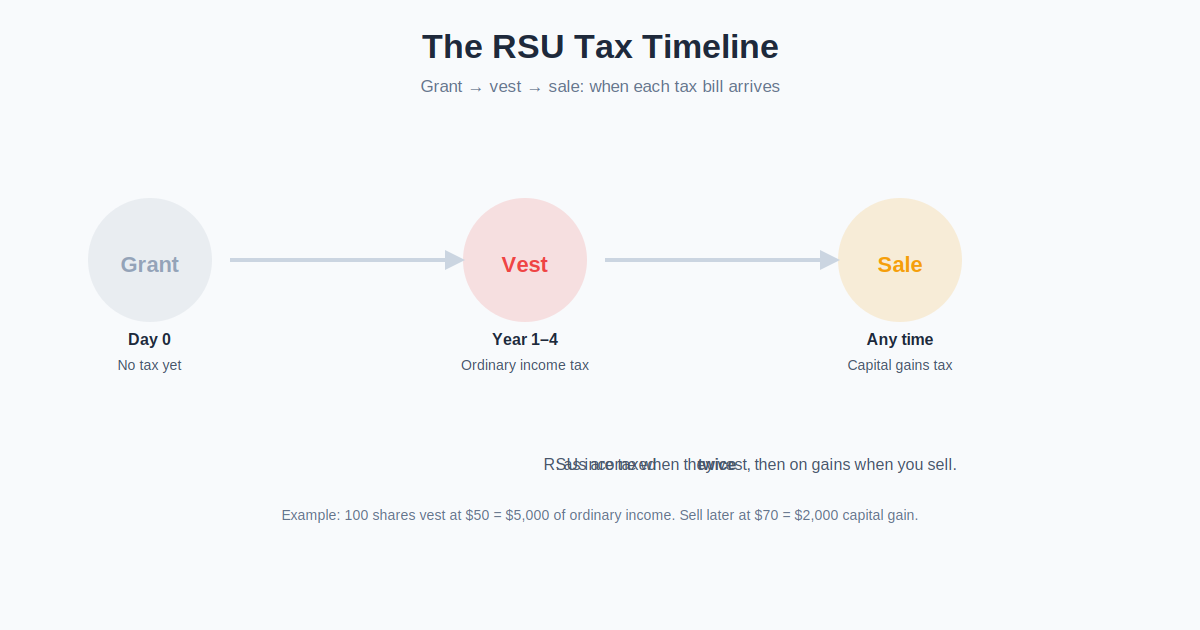
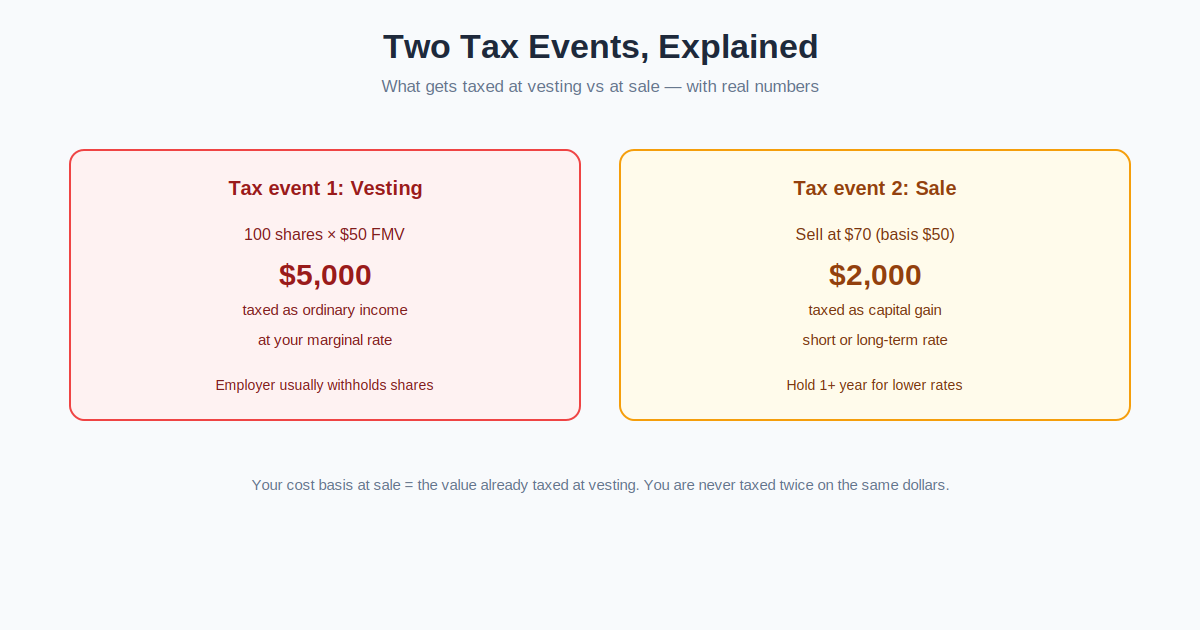
RSUs are taxed as ordinary compensation income at vesting, not at grant. The taxable amount equals the number of shares vesting multiplied by the stock’s fair market value on the vest date. If 200 shares vest at $150, you have $30,000 of ordinary income added to your W-2 — exactly as if your employer handed you a $30,000 cash bonus. Your cost basis in those shares becomes the vest-date price, so any later gain or loss when you sell is a separate capital gain or loss.
Employers must withhold on that income, typically at the 22% federal supplemental rate (up to $1 million), plus FICA and state tax. Most companies default to sell-to-cover: they liquidate enough shares to pay the withholding and deposit the rest to your brokerage account. If your marginal rate is higher than 22% — common for tech salaries — you will owe the difference at tax time. Holding the shares after vesting starts the capital-gains clock: sell within a year and gains are short-term (ordinary rates); hold over a year for long-term rates.
Example Calculation
Priya has 150 RSUs vesting when her company’s stock trades at $220. Gross vest value: 150 × $220 = $33,000, reported as ordinary income. Her employer withholds 22% federal ($7,260), 7.65% FICA ($2,525), and 9% state tax ($2,970) — total withholding $12,755. With sell-to-cover at $220 per share, about 58 shares are sold for taxes and Priya keeps 92 shares worth $20,240. Because her actual marginal federal rate is 32%, she will owe roughly another $3,300 on this income when she files, since only 22% was withheld.
The 22% Withholding Gap — and How to Close It
The most expensive RSU surprise is the gap between what your employer withholds and what you actually owe. Federal withholding on supplemental wages like RSUs is a flat 22% — 37% once supplemental wages pass $1 million in a year — but your marginal bracket may sit well above 22%.
Suppose 200 RSUs vest at $75: that is $15,000 of ordinary income. Your employer withholds 22%, or $3,300. If your salary plus the vest puts you in the 24% bracket, the real tax is 24% — leaving another 2% of $15,000, or $300, due at filing.
Three remedies close it: add extra withholding on your W-4; make quarterly estimated payments in the quarters when large vests land; or set the expected difference aside in savings at each vest. Any of the three beats an underpayment penalty.
Frequently Asked Questions
When are RSUs taxed — at grant or vesting?
At vesting. The grant is just a promise; no tax is due until shares actually vest and become yours. The vest-date market value is taxed as ordinary W-2 income that year.
What is sell-to-cover?
Your employer automatically sells enough of your newly vested shares to pay the required tax withholding, then deposits the remaining shares in your account. It is the default at most companies and requires no action from you.
Do I owe more tax if I hold RSU shares after vesting?
Only on further gains. Your cost basis resets to the vest-date price, so if the stock rises from $220 to $260 before you sell, the extra $40 per share is a capital gain — short-term if held under a year, long-term after a year.
Why do I owe extra at tax time if my employer withheld?
Employers withhold federal tax at the flat 22% supplemental rate, but many RSU earners sit in the 32% or 35% bracket. The 10-plus-point gap becomes a balance due every April unless you adjust withholding.
Should I sell RSUs immediately at vesting?
Many financial planners say yes: RSUs are already concentrated risk since your salary comes from the same company. Selling at vest and diversifying avoids doubling down on one stock — though holding is fine if you would buy the stock with cash anyway.
Are RSUs taxed twice?
No. The vest-date value is taxed once as ordinary income, and that same value becomes your cost basis. If the shares later rise and you sell, only the gain above the vest value is taxed again, as a capital gain; if the price falls, you may claim a capital loss instead.
Can I file an 83(b) election on my RSUs?
No. An 83(b) election applies to restricted stock you actually own but that is still subject to forfeiture. Standard RSUs are only a promise of future shares — you own nothing at grant, so there is nothing to elect on.
Related Calculators
Try our Compound Interest Calculator and Income Tax Calculator for more calculations.