Estimate vitamin D needs from sun exposure, diet, and current levels.
How to Use the Vitamin D Calculator
Vitamin D deficiency is remarkably common — indoor lifestyles, sunscreen, northern latitudes, and darker skin all reduce synthesis. This calculator estimates how much daily vitamin D you need to reach a healthy blood level.
- Enter your current level. If you have a recent 25(OH)D blood test, enter it in ng/mL. If not, select an estimate based on your situation — most unsupplemented adults in winter test between 12 and 22.
- Describe your sun exposure. Enter typical daily midday sun minutes on face, arms, and legs, plus your skin type, since melanin acts as natural sunscreen.
- Add current supplements. Enter the IU you already take daily, if any, so the calculator only fills the remaining gap.
- Get your target dose. The tool computes the gap to the 30 to 50 ng/mL range and suggests a daily IU dose, flagging anything near the 4,000 IU upper limit.
Vitamin D Calculator Formula
The core estimate uses a well-studied rule of thumb: in deficient adults, each 100 IU of daily vitamin D3 raises serum 25(OH)D by roughly 0.7 to 1.0 ng/mL over two to three months. The calculator takes your gap — target minus current level — and divides by this response rate. A 17-point gap therefore suggests around 1,700 to 2,000 IU daily, which is why 2,000 IU is such a common supplement dose.
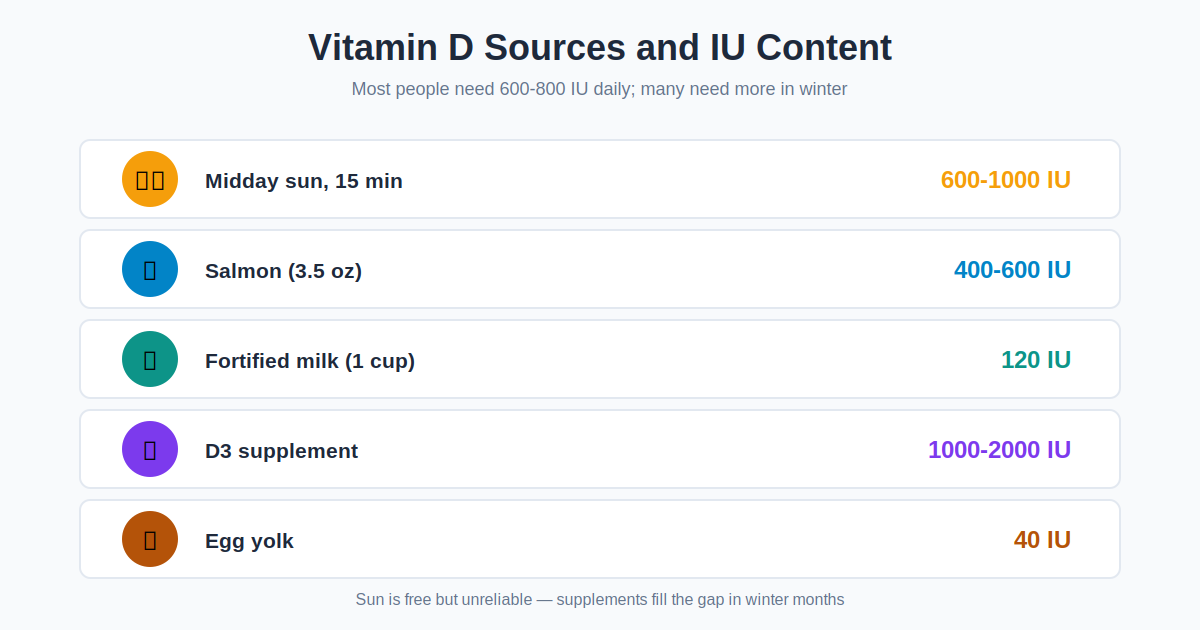
Several factors adjust the estimate. Larger body weight dilutes vitamin D in more tissue, so heavier individuals need more; some research suggests dosing by body weight. Darker skin synthesizes less from the same sun exposure, winter sun above about 37 degrees latitude is too weak for meaningful synthesis, and sunscreen blocks most production. Regular midday sun on arms and legs can contribute the equivalent of several hundred IU, which the calculator credits before recommending supplements.
A few guardrails matter. The Institute of Medicine sets the safe upper limit at 4,000 IU daily for adults; toxicity is rare and usually requires prolonged very high doses, but it can cause dangerous calcium buildup. Vitamin D3 (cholecalciferol) raises levels more effectively than D2, and because it is fat-soluble, taking it with a meal containing some fat improves absorption. Recheck blood levels after about three months, since individual response varies.
Example Calculation
Imagine your blood test shows 16 ng/mL — squarely deficient — and you want to reach 35 ng/mL, the middle of the target range. The gap is 19 points. At roughly 100 IU per point, you need about 1,900 IU daily from all sources, so a standard 2,000 IU D3 supplement is a sensible fit.
Now factor in lifestyle: you get 15 minutes of midday sun on arms and legs most days in summer. That might contribute the equivalent of a few hundred IU, but in winter it contributes almost nothing at northern latitudes. The calculator would suggest the full 2,000 IU through winter, possibly less in summer, and a retest in three months to confirm you landed in range rather than overshooting.
Reading Your Vitamin D Numbers: Units, Conversions, and Ranges
Vitamin D results arrive in two different units, and supplement labels use two more, so a little conversion skill prevents expensive mistakes.
Blood levels are reported as ng/mL in the US or nmol/L in much of Europe and Canada. Multiply ng/mL by 2.5 to get nmol/L: 30 ng/mL is 75 nmol/L, and 20 ng/mL is 50 nmol/L.
Doses are labeled in International Units (IU) or micrograms (mcg), and 1 mcg equals 40 IU. A 25 mcg softgel is a 1,000 IU dose; a 125 mcg tablet is 5,000 IU — above the 4,000 IU daily upper limit for unsupervised use.
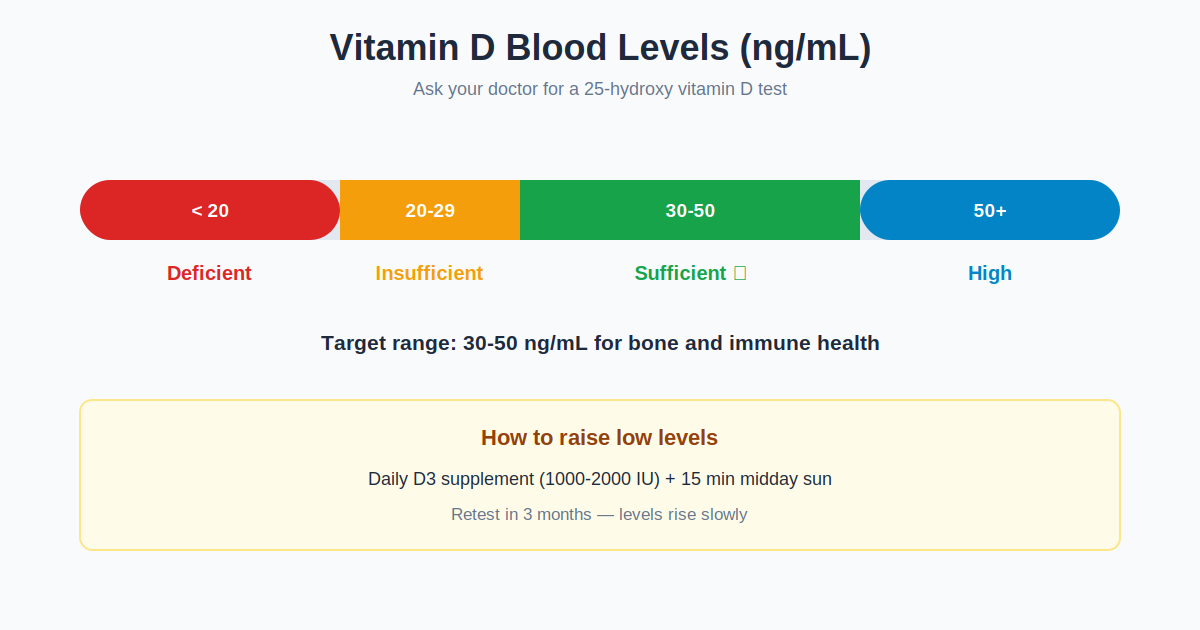
As a rough guide: below 20 ng/mL (50 nmol/L) is deficient, 20 to 29 is insufficient under many guidelines, 30 to 50 is the zone most experts target. Choosing a dose, especially a high one, belongs with your doctor.
Frequently Asked Questions
What is a good vitamin D level?
Most experts target 30 to 50 ng/mL (75 to 125 nmol/L). Below 20 is considered deficient and below 30 insufficient by the Endocrine Society, though the Institute of Medicine considers 20 adequate for bone health in most people. Above 50 offers little extra benefit for most, so more is not automatically better.
Is vitamin D3 better than D2?
Yes, modestly. D3 (cholecalciferol) raises and maintains blood levels more effectively and for longer than D2 (ergocalciferol). Most supplements and fortified foods now use D3. Both count toward total intake, but if you are choosing, D3 is the better default.
Can I get enough vitamin D from sun alone?
Sometimes. Fair-skinned people can make ample vitamin D from 10 to 30 minutes of midday summer sun on face, arms, and legs several times a week. But winter sun at higher latitudes, darker skin, sunscreen, office work, and older age all slash production — which is why deficiency is so widespread and supplements are often needed.
Can you take too much vitamin D?
Yes, though it takes a lot. Chronic intake far above the 4,000 IU daily upper limit can cause hypercalcemia — too much calcium in the blood — leading to nausea, weakness, and kidney problems. This almost never happens from sun or food; it comes from excessive supplements. Staying at or below 4,000 IU unless medically supervised keeps you safe.
Should I take vitamin D with food?
Ideally yes. Vitamin D is fat-soluble, so taking it with a meal containing some fat — eggs, olive oil, nuts, dairy — can improve absorption noticeably compared to an empty stomach. Morning works well for most people, and pairing it with magnesium-rich foods is a common complementary practice.
How do I convert vitamin D from ng/mL to nmol/L?
Multiply by 2.5: 16 ng/mL becomes 40 nmol/L, 30 becomes 75, and 40 becomes 100. To convert back, divide by 2.5.
How many IU are in 25 mcg of vitamin D?
Exactly 1,000 IU — 1 mcg equals 40 IU, so multiply micrograms by 40. A 10 mcg dose is 400 IU and a 50 mcg dose is 2,000 IU.
Related Calculators
Try our BMI Calculator and Calorie Calculator for more calculations.