Fun demo: upload a photo and get a playful, random-style age estimate for entertainment. This demo does not analyse faces — it is not real facial recognition.
Just for fun. This demo does not use real facial recognition and never uploads your photo anywhere – everything runs in your browser.
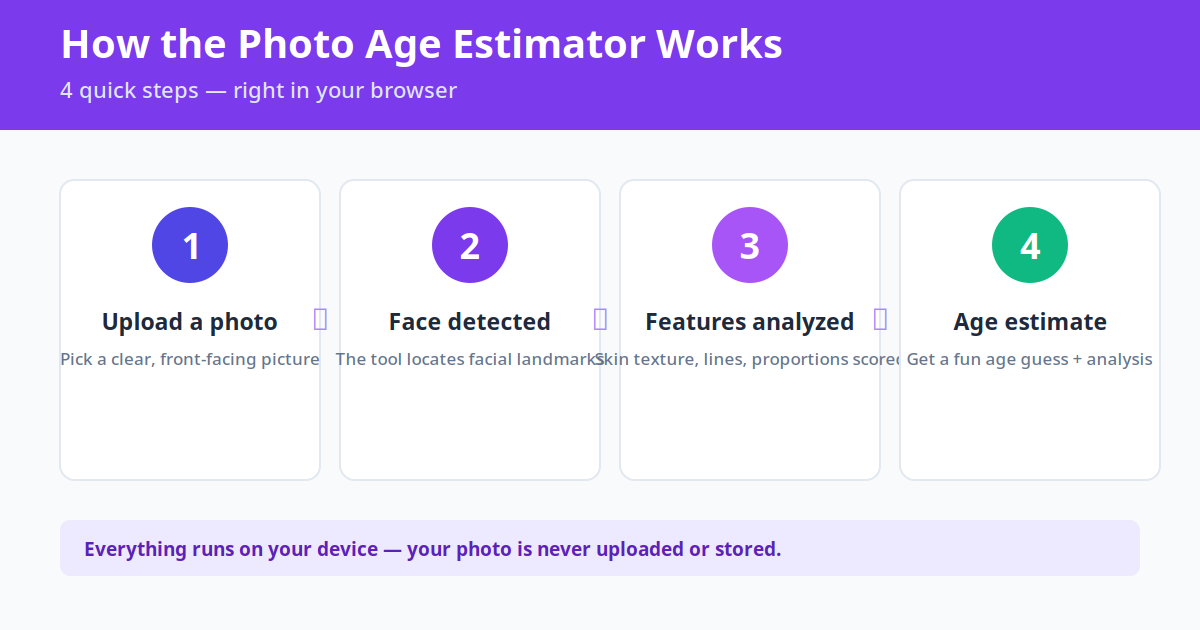

How to Use the Age Calculator by Photo
Curious how old you look in photos? This age calculator by photo gives you a fun, AI-style age estimate from any picture — with an important caveat: it is a demo estimator for entertainment, not real facial recognition, and your photo never leaves your device.
- Upload a photo. Choose a clear, front-facing picture. Good lighting and a neutral expression give the most interesting results. Nothing is uploaded — analysis happens in your browser.
- Optionally enter your real birth year. If you add it, the tool compares the estimate against your actual age and shows the difference — great for settling debates with friends.
- Get your estimate. You will see an age range (for example, 28–34) rather than a single number, because honest estimators admit uncertainty.
- Read the fun breakdown. The tool explains which visible factors influenced the result — lighting, expression, and photo quality all play a role — so you can try different photos and compare.
How Photo Age Estimation Works
Real-world age estimation from photos is done by deep learning models trained on hundreds of thousands of labeled face images. These models learn subtle patterns — skin texture changes, the geometry of facial proportions, wrinkle formation, hairline and hair color shifts — that correlate with age. Commercial systems can typically estimate age within about 4–6 years of error under good conditions.
This demo tool takes a deliberately simpler approach: it walks you through the same kinds of visual cues an estimator considers and produces a playful age-range estimate with an explanation of which factors pushed the result up or down. Everything runs locally in your browser using straightforward heuristics — there is no neural network and no face database involved.
That honesty matters because photo-based age estimation has real limitations even in professional systems: makeup can subtract years, facial hair can add them, lighting changes everything, and accuracy drops sharply for children and the elderly. By showing a range and explaining the uncertainty, the tool demonstrates both the fun and the fragility of the idea.
Example: Trying the Photo Age Estimator
Imagine uploading a clear, front-facing photo taken in good lighting. The tool analyzes visible cues — the kind of features an age estimator looks at, such as skin texture, facial proportions, and hair — and returns an estimate like “28–34 years” along with a fun breakdown of what influenced the result.
Now try the same person in a photo with harsh overhead lighting and a tired expression: the estimate might shift to “32–38 years.” This is exactly why the tool shows a range rather than a single number, and why it is framed as entertainment — lighting, angle, expression, and photo quality move the result by several years in either direction, something true biometric systems also struggle with.
Apparent Age vs Biological Age: What a Photo Really Shows
Three different ages get mixed up in tools like this one, and keeping them apart explains both the fun and the limits of a photo estimate.
Your chronological age is simply the time since you were born. Your apparent age is how old you look — the only one of the three a photo can speak to. It shifts with surface cues: lighting, camera angle, poor sleep, makeup, facial hair, expression, even a phone’s wide-angle lens. That is why the same person can score years apart in two photos taken minutes apart.
Your biological age is different again: how your body is actually aging inside, measured through blood markers and epigenetic tests. A photograph says nothing reliable about it — a young-looking face can hide fast internal aging, and a weathered face can belong to a very healthy body. Treat this tool’s number as apparent age only, never as a health measurement.
Frequently Asked Questions
Is this a real facial recognition age checker?
No. This is a fun demo estimator, not a biometric identification system. Real age-estimation AI requires trained neural networks and large datasets. Treat the result as entertainment — a party trick, not a measurement.
Why does the same person get different ages in different photos?
Lighting, camera angle, facial expression, makeup, facial hair, and image quality all change the visible cues the estimator reads. A smiling photo in soft daylight will estimate younger than a frowning photo under harsh light, even for the same person taken minutes apart.
Is my photo uploaded or stored anywhere?
No. The estimation happens entirely in your browser — your photo never leaves your device and nothing is uploaded to any server. You can verify this by disconnecting from the internet after the page loads; the tool keeps working.
What makes the best photo for an age estimate?
A clear, front-facing photo with even lighting, neutral expression, and no heavy filters gives the most consistent result. Sunglasses, hats, heavy makeup, and extreme angles all reduce accuracy — which is part of the fun of testing different photos.
Can I use this to verify someone’s age?
Absolutely not. This tool cannot verify identity or legal age and must never be used for age verification, employment, or any official purpose. It is entertainment only.
How accurate are photo age estimators?
Professional AI estimators, trained on huge photo datasets, typically land within about 4 to 6 years of a person’s real age — the best case, with a clear front-facing photo. Simpler tools like this demo are rougher, and lighting, expression, makeup, and camera angle can each shift the reading by years.
Can a photo reveal my biological age?
No. Biological age reflects what is happening inside your body — organ function, blood markers, DNA methylation — none of it visible to a camera. A photo supports only a guess about apparent age: how old you look.
Related Calculators
Try our Unit Converter and Cooking Measurement Converter.