Calculate powers, roots, and scientific notation with step-by-step explanations.

What Is an Exponent Calculator?
Exponents are shorthand for repeated multiplication: 2^5 means 2 x 2 x 2 x 2 x 2 = 32. They appear everywhere: compound interest, scientific notation, computer memory (2^10 = 1,024 bytes in a kilobyte), physics, and engineering. An exponent calculator evaluates powers instantly, including the tricky cases: negative exponents, fractional exponents (roots), and very large or small results best shown in scientific notation.
Beyond simple powers, this exponent calculator demonstrates the exponent laws step by step, converts results to scientific notation, and computes roots, since a fractional exponent like 27^(1/3) is exactly the cube root of 27. It is useful for students checking algebra homework, programmers sizing data, and anyone dealing with exponential growth.
Where Exponents Show Up
Recognizing exponent patterns helps you reach for this tool at the right moment. Finance uses them for compound growth, A = P(1+r)^t. Computing uses powers of two for memory, addressing, and bit operations. Science uses scientific notation for everything from atomic masses to astronomical distances. Statistics and machine learning use exponentials in probability distributions and activation functions. If a quantity multiplies by a fixed factor each step, an exponent is hiding in the problem.
How to Use This Exponent Calculator
- Enter the base. The number being multiplied, for example 2 in 2^5. It can be any real number, including decimals and negatives.
- Enter the exponent. How many times the base multiplies itself, for example 5. Use negatives for reciprocals (2^-3 = 1/8) and fractions for roots (9^0.5 = 3).
- Click Calculate. The result appears immediately, with very large or small values also shown in scientific notation.
- Try root mode. To find the nth root of a number, enter the number as the base and 1/n as the exponent: the cube root of 64 is 64^(1/3) = 4.
- Review the step-by-step breakdown. The tool shows which exponent law applied, so you can follow the logic, not just the answer.
- Check scientific notation. For results like 6.02 x 10^23, the notation view keeps the magnitude readable.
How Exponents Are Calculated
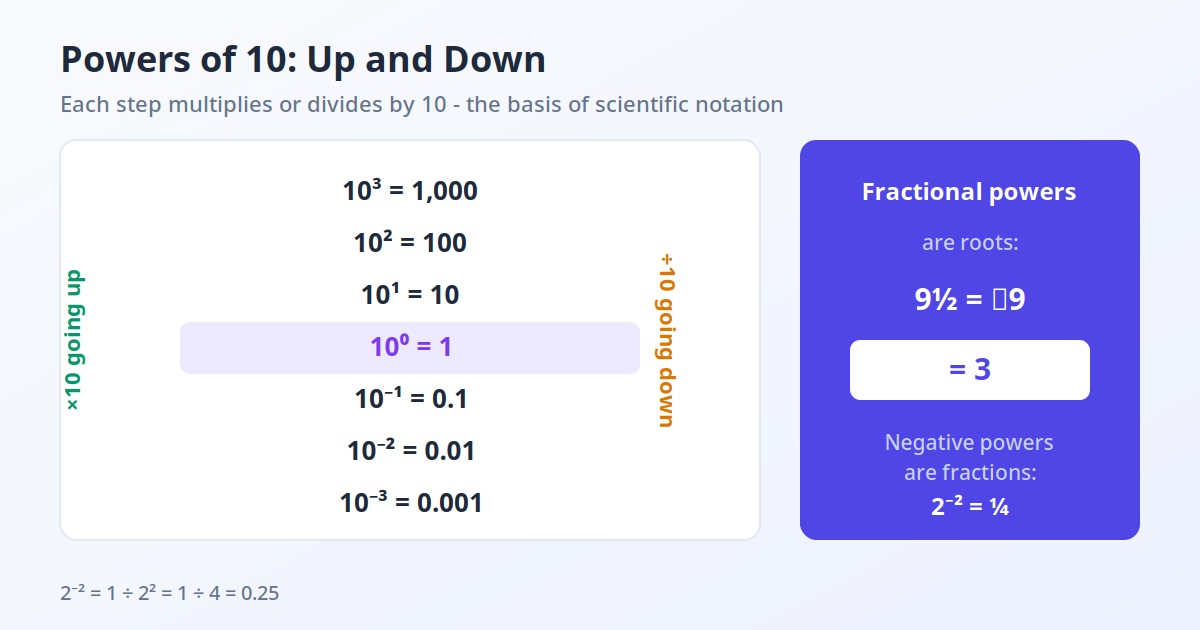
The fundamental definition: for a positive integer n, b^n = b multiplied by itself n times. Everything else extends this idea. A zero exponent always yields 1 (b^0 = 1 for b != 0), which follows from the quotient law b^n/b^n = b^0 = 1. Negative exponents denote reciprocals: b^-n = 1/b^n, so 10^-3 = 0.001. Fractional exponents encode roots: b^(m/n) is the nth root of b^m, meaning 8^(2/3) = (cube root of 8)^2 = 4.
The calculator applies the exponent laws to simplify before computing: the product law (b^m x b^n = b^(m+n)), the quotient law (b^m / b^n = b^(m-n)), and the power law ((b^m)^n = b^(mn)). For fractional exponents it computes roots via logarithms internally, b^(p/q) = e^((p/q) x ln b), which handles non-integer results that repeated multiplication cannot. Negative bases with fractional exponents, like (-8)^(1/3), are flagged, since the real-valued result requires care.
Results that overflow ordinary display switch to scientific notation, m x 10^e, keeping one digit before the decimal point. This is essential for computations like 2^100, approximately 1.26765 x 10^30, where writing all 31 digits obscures the magnitude rather than clarifying it.
Key Exponent Rules
- Product: b^m x b^n = b^(m+n)
- Quotient: b^m / b^n = b^(m-n)
- Power of a power: (b^m)^n = b^(mn)
- Negative exponent: b^-n = 1 / b^n
- Fractional exponent: b^(1/n) = nth root of b
- Zero exponent: b^0 = 1 (b != 0)
Exponents and Logarithms
Logarithms are the inverse operation: if b^y = x, then log_b(x) = y. This relationship is why fractional exponents are computed through logarithms internally, and it is also the practical way to solve for an unknown exponent. To find how many years it takes money to double at 7%, solve (1.07)^t = 2 by taking logs: t = ln(2)/ln(1.07), about 10.24 years. The exponent laws have mirror images in log laws, so fluency in one reinforces the other.
Limitations
Floating-point arithmetic introduces tiny rounding errors in fractional exponents: 27^(1/3) may display as 3.0000000004 rather than exactly 3. Even roots of negative bases have no real answer, and the calculator reports this rather than a complex number. 0^0 is mathematically indeterminate, conventionally treated as 1 in most computational contexts. Extremely large exponents may overflow to infinity.
Worked Example: Powers, Roots, and Scientific Notation
Compute 2^10, the cube root of 27, and 5^-2. Repeated multiplication gives 2^10 = 1,024. The cube root is 27^(1/3) = 3, since 3^3 = 27. And 5^-2 = 1/5^2 = 1/25 = 0.04.
| Expression | Rule applied | Result |
|---|---|---|
| 2^10 | Repeated multiplication | 1,024 |
| 27^(1/3) | Fractional exponent = cube root | 3 |
| 5^-2 | Negative exponent = reciprocal | 0.04 |
| (3^2)^3 | Power of a power: 3^6 | 729 |
| 2^100 | Scientific notation | 1.26765 x 10^30 |
Notice how the power law collapses (3^2)^3 into 3^6 = 729 without computing the intermediate 9^3: the same simplification the calculator performs internally before producing a result.
Practical Applications
Compound interest is the most financially important exponent: $10,000 at 7% for 30 years is 10,000 x 1.07^30, about $76,123, and the exponent is what makes starting early so powerful. In computing, subnet masks, color depths, and address spaces are all powers of two; a /24 network holds 2^8 = 256 addresses. In science, pH is a base-10 logarithmic scale, so each pH unit is a tenfold concentration change, and earthquake magnitudes work similarly. Whenever you see “grows by x% per period” or “ten times more,” reach for the exponent calculator.
Second Example: Compound Interest Step by Step
How does $5,000 grow at 6% annual interest compounded yearly for 20 years? The model is A = P(1+r)^t = 5000 x 1.06^20. Computing the power: 1.06^20 is approximately 3.20714, so A is about $16,035.70. The exponent does the heavy lifting: the first decade contributes roughly $3,954 of growth while the second contributes about $7,082, because each year’s gains compound on the last. Change the rate to 8% and the exponent yields 1.08^20 = 4.661, or $23,305: two extra points of return, amplified by the exponent, add more than $7,000. This is why the exponent calculator belongs in every investor’s toolkit.
Even everyday estimation benefits: doubling time for anything growing at r percent per period is about 70 / r periods, the Rule of 70, which is just the exponent equation solved approximately. Bacteria doubling every 20 minutes reach 2^36, nearly 69 billion, in 12 hours from a single cell. Recognizing these patterns turns abstract powers into concrete intuition about how fast exponential processes run away.
Common Powers of 2: A Quick Reference
Powers of 2 appear so often in computing and science that they are worth memorizing up to 2^10:
| Power | Value | Power | Value |
|---|---|---|---|
| 2^0 | 1 | 2^6 | 64 |
| 2^1 | 2 | 2^7 | 128 |
| 2^2 | 4 | 2^8 | 256 |
| 2^3 | 8 | 2^9 | 512 |
| 2^4 | 16 | 2^10 | 1,024 |
| 2^5 | 32 |
The last entry explains a famous approximation: 2^10 = 1,024, close to 10^3 = 1,000 — which is why a kilobyte was historically 1,024 bytes rather than exactly 1,000. Memory sizes are all powers of two: a 16 GB stick holds 2^34 bytes.
Frequently Asked Questions
What is the difference between a power and an exponent?
The exponent is the small raised number indicating how many times to multiply; the power is the whole expression (base plus exponent), and often also the result. In 2^5 = 32, 5 is the exponent, 2^5 is the fifth power of 2, and 32 is the value. Saying “2 to the 5th power” names the expression; saying “2^5 equals 32” states its value.
Why does anything to the power of 0 equal 1?
From the quotient law: b^3/b^3 = b^(3-3) = b^0, but b^3/b^3 is also 1. So b^0 = 1 for any nonzero b. It is not arbitrary; it is forced by consistency with the other exponent rules.
How do negative exponents work?
A negative exponent means take the reciprocal: 2^-3 = 1/2^3 = 1/8 = 0.125. This extends the quotient law naturally: 2^2/2^5 = 2^-3 = 4/32 = 1/8. Negative exponents are how science writes tiny numbers, like 10^-9 for a nanometer.
What does a fractional exponent mean?
The denominator is a root and the numerator is a power: 8^(2/3) means cube root of 8, then squared, which is 2^2 = 4. The special case b^(1/2) is the square root. Fractional exponents unify powers and roots into a single notation.
Can the base be negative?
For integer exponents, yes: (-2)^3 = -8 and (-2)^4 = 16; the sign follows the parity of the exponent. For fractional exponents, even roots of negatives have no real value, so the calculator reports that rather than inventing an answer.
What is scientific notation and when is it used?
Writing a number as m x 10^e with 1 <= m < 10. It keeps extreme magnitudes readable: the speed of light is 2.998 x 10^8 m/s, not 299,800,000. The calculator switches to it automatically when results exceed about 15 digits.
Why do I get 3.0000000004 instead of 3 for the cube root of 27?
Fractional exponents are computed with logarithms in floating-point arithmetic, which carries rounding error around the 15th decimal place. The result is correct to far more precision than any application needs; mentally round to 3.
What are logarithms and how do they relate to exponents?
A logarithm answers the question: to what exponent must I raise the base to get this number? If 2^5 = 32, then log_2(32) = 5. Logarithms undo exponents, which makes them the tool for solving when the exponent itself is unknown, such as finding doubling time. The natural log (base e) and common log (base 10) are the two you will meet most often.
How do you calculate exponents by hand?
To calculate exponents by hand, multiply the base by itself as many times as the exponent indicates — for example, 2^5 means 2 × 2 × 2 × 2 × 2 = 32. For larger exponents, break them into chunks you know (like 2^10 = 1024) and multiply the chunks. The calculator above shows each step so you can follow the process.
What are the basic exponent rules?
The key exponent rules are: multiplying powers adds the exponents (a^m × a^n = a^(m+n)), dividing powers subtracts them, a power of a power multiplies exponents, anything to the zero power equals 1, and a negative exponent means the reciprocal (a^-n = 1/a^n). These exponent rules explained simply let you simplify almost any power expression without a calculator.
What are the most common exponent mistakes?
Three errors come up constantly. First, parentheses matter: -2^2 means -(2^2) = -4, while (-2)^2 = 4. Second, the product rule and the power-of-a-power rule are different: 2^3 × 2^4 = 2^7 (add the exponents), but (2^3)^4 = 2^12 (multiply them). Third, the exponent rules only apply when the bases match: 2^3 + 3^2 cannot be merged into a single power — just evaluate it as 8 + 9 = 17.
What is 0^0 (zero to the power of zero)?
It depends on the context. Many calculators and algebra systems define 0^0 = 1, because that convention keeps formulas like the binomial theorem working smoothly. In calculus, 0^0 is treated as an indeterminate form, because 0^x approaches 0 while x^0 approaches 1, so no single value fits every limit. This calculator returns 1 by the common convention; if your course treats it as undefined, that convention is the reason for the difference.
Related Calculators
Try our Percentage Calculator, Fraction Calculator, and Scientific Calculator.
Related: Molarity Calculator, Hex Calculator.