How much fat should you eat per day? Personalized daily fat intake in grams.
How to Use the Fat Intake Calculator
Fat has spent decades with an unfair reputation, but modern nutrition science is clear: dietary fat is an essential macronutrient your body cannot function without. It builds cell membranes, produces hormones like testosterone and estrogen, helps you absorb vitamins A, D, E, and K, cushions your organs, and keeps you feeling full after meals. The question is not whether to eat fat, but how much fat you should eat per day for your specific body, goals, and eating style.
That is exactly what this fat intake calculator answers. Instead of generic advice like “eat less fat,” it computes your personalized daily fat target in grams based on your daily calorie needs, your goal (lose, maintain, or gain weight), and your chosen diet type. Whether you follow a balanced diet or a high-fat approach like keto, the calculator adjusts the recommended fat percentage to match, then converts it into grams you can track.
The result also includes a separate saturated-fat limit, because the type of fat matters as much as the total for heart health. Use this tool to plan meals, read labels, and build a diet that supports your goals.
Step-by-Step Instructions
- Enter your daily calorie target. Type in the total calories you aim to eat per day. If you do not know this number, a common starting point is your maintenance calories (roughly body weight in pounds times 14-16 for moderately active people), adjusted up or down for your goal.
- Select your goal. Choose whether you want to lose weight, maintain your current weight, or gain weight. The calculator fine-tunes the recommended fat percentage for each goal, since aggressive fat loss diets sometimes use a slightly lower fat share while muscle-gain diets keep fat moderate to leave room for protein and carbs.
- Choose your diet type. Pick from Balanced (30% of calories from fat), Mediterranean (35%), Low-Fat (20%), or Keto/High-Fat (70%). Each option uses evidence-based fat percentages so your target matches the eating pattern you actually follow.
- Click Calculate. The tool instantly converts your calorie target and fat percentage into daily grams of fat, using the fact that fat provides 9 calories per gram.
- Read your results. You will see your total daily fat target in grams, the equivalent in calories, and a separate maximum for saturated fat (kept under 10% of calories per heart-health guidelines).
- Compare with your current intake. Track what you eat for a few days using a food diary or app, then compare your average fat grams to the target. Most people are surprised, in one direction or the other.
- Adjust your meals gradually. If you are far above or below the target, shift your intake by 10-15 grams per day each week rather than changing everything overnight. Sustainable changes beat dramatic ones.
How Fat Intake Is Calculated: Method and Formula
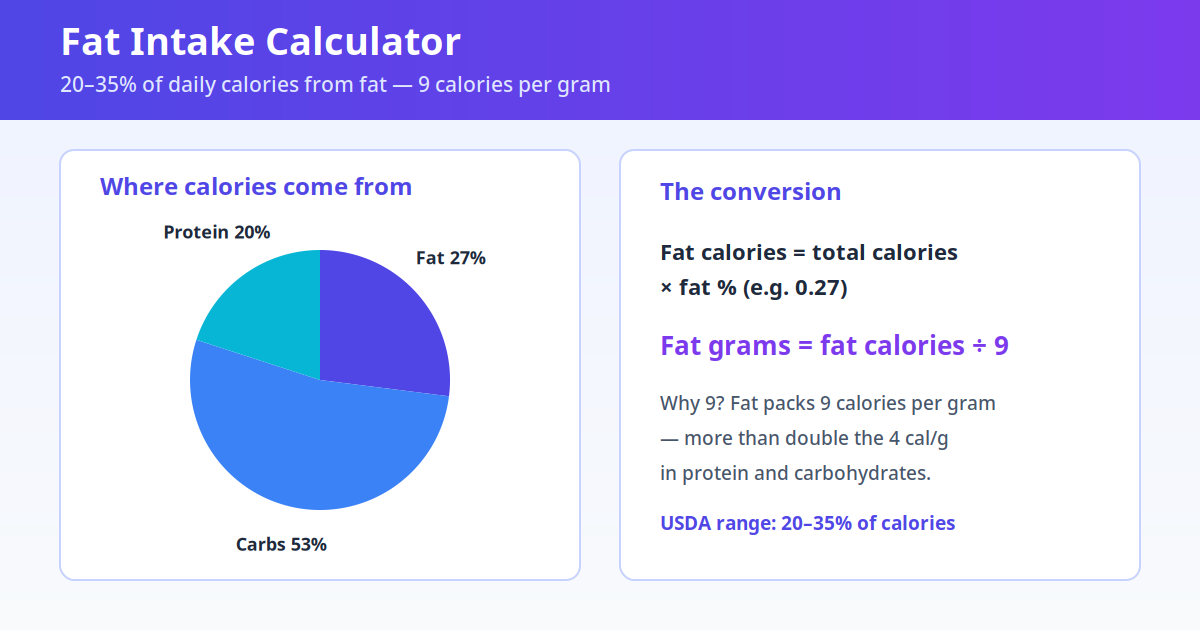
The calculation behind this tool follows the framework used by the Dietary Guidelines for Americans and major nutrition authorities. These guidelines recommend that 20 to 35 percent of your daily calories come from fat for most adults. This range is wide on purpose: it accommodates different eating patterns, activity levels, and health conditions while ensuring you get enough essential fatty acids without overdoing energy-dense fat calories.
Within that range, the specific percentage depends on your diet type and goal. A balanced diet typically lands around 30 percent, which is the default most nutritionists recommend. The Mediterranean diet, consistently ranked among the healthiest eating patterns, runs slightly higher at about 35 percent because of its emphasis on olive oil, nuts, and fish. Therapeutic low-fat diets may go down to 20 percent, while ketogenic diets deliberately push fat to 65-75 percent of calories to maintain ketosis. The calculator maps each diet choice to its appropriate percentage, then adjusts slightly for your goal.
A second calculation concerns saturated fat. The American Heart Association recommends keeping it below 10 percent of calories. Saturated fat, found in butter, fatty meats, and cheese, raises LDL cholesterol more than other types, so the calculator reports a separate saturated-fat ceiling.
Finally, the tool converts percentages into grams, because nobody eats “percentages.” Since fat provides 9 calories per gram (compared to 4 for protein and carbohydrates), the math is straightforward division. The result is a practical daily gram target you can measure against food labels and portion sizes.
Formula Breakdown
Daily fat grams = (Daily calories x Fat percentage) / 9
Maximum saturated fat grams = (Daily calories x 0.10) / 9
Variables Explained
- Daily calories: Your total energy target per day. This is the foundation of the entire calculation, so an accurate number matters more than anything else. Underestimate it and your fat target will be too low; overestimate and it will be too high.
- Fat percentage: The share of calories assigned to fat, set by your diet type: Low-Fat 20%, Balanced 30%, Mediterranean 35%, Keto 70%. Goal selection nudges these slightly (for example, a small reduction during aggressive weight loss).
- 9 calories per gram: The energy density of dietary fat, a fixed biochemical constant. This is why fat is the most calorie-dense macronutrient.
- 0.10 saturated cap: The 10% saturated-fat ceiling from heart-health guidelines, converted to grams the same way.
Limitations
This calculator provides a well-grounded estimate, not medical advice. It does not account for individual factors like genetics, existing cholesterol levels, diabetes, or gallbladder issues, all of which can change how much and what type of fat is appropriate for you. It also treats all fat within the total as equal, while in reality the quality of fat (olive oil versus processed trans fats, for example) matters enormously for health outcomes. If you have a medical condition or take cholesterol medication, discuss your fat intake with your doctor or a registered dietitian.
Worked Example: Daily Fat Intake in Practice
Let us walk through a complete example. Meet Sara, who eats about 2,000 calories per day to maintain her weight and follows a balanced diet. She wants to know her daily fat target in grams.
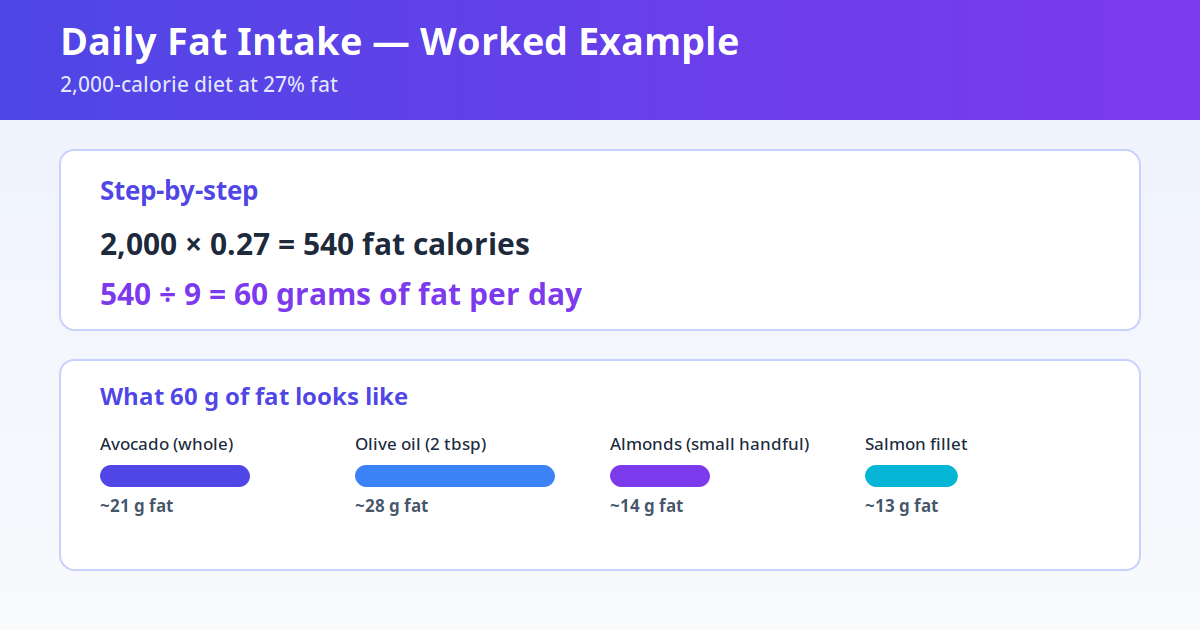
First, the calculator takes 30 percent of 2,000 calories, which is 600 calories from fat. Dividing by 9 calories per gram gives 66.7 grams of fat per day (rounded to about 67 grams). For saturated fat, the ceiling is 10 percent of 2,000 calories, or 200 calories, which divides down to 22.2 grams of saturated fat per day maximum.
In practical terms, 67 grams of total fat might look like this across a day: a tablespoon of olive oil on a salad (14g), a small handful of almonds (14g), half an avocado (15g), a piece of salmon (13g), and the naturally occurring fat in grains, vegetables, and dairy making up the rest (about 11g). Notice how quickly it adds up, which is why measuring for a few days is so eye-opening.
Sample Inputs and Outputs
| Daily Calories | Diet Type | Total Fat (g) | Max Saturated Fat (g) |
|---|---|---|---|
| 1,600 | Balanced (30%) | 53 | 18 |
| 2,000 | Balanced (30%) | 67 | 22 |
| 2,000 | Low-Fat (20%) | 44 | 22 |
| 2,000 | Mediterranean (35%) | 78 | 22 |
| 2,000 | Keto (70%) | 156 | 22 |
| 2,500 | Balanced (30%) | 83 | 28 |
| 3,000 | Balanced (30%) | 100 | 33 |
Notice that the saturated fat ceiling does not change with diet type in this table, because the 10% heart-health guideline applies regardless of eating pattern. Even on keto, keeping saturated fat in check while favoring unsaturated sources like olive oil, nuts, and fatty fish is the smarter approach.
Fat Grams at a Glance: Common Calorie Levels
Reading the grid is quicker than calculating for common calorie targets. Each cell is the daily fat grams at that percentage of calories (calories × percentage ÷ 9):
| Daily calories | 20% fat | 25% fat | 30% fat | 35% fat | Saturated fat ceiling (10%) |
|---|---|---|---|---|---|
| 1,800 kcal | 40 g | 50 g | 60 g | 70 g | 20 g |
| 2,000 kcal | 44 g | 56 g | 67 g | 78 g | 22 g |
| 2,500 kcal | 56 g | 69 g | 83 g | 97 g | 28 g |
| 3,000 kcal | 67 g | 83 g | 100 g | 117 g | 33 g |
The calculator gives you this table for any percentage and calorie level — including diet presets such as keto, where fat goes far above 35% — so use the grid as a starting point and the calculator for your exact target.
Frequently Asked Questions
How much fat should I eat per day?
For most adults, 20 to 35 percent of daily calories should come from fat, which works out to roughly 44 to 78 grams per day on a 2,000-calorie diet..
Is eating fat bad for weight loss?
No. Fat itself does not make you gain weight; excess calories do. In fact, including moderate amounts of healthy fat in meals helps you feel full longer, which can make it easier to stick to a calorie deficit. Very low-fat diets often backfire because meals become less satisfying.
What is the difference between saturated and unsaturated fat?
Saturated fats (butter, fatty meat, cheese, coconut oil) are solid at room temperature and tend to raise LDL cholesterol. Unsaturated fats (olive oil, nuts, avocados, fatty fish) are liquid at room temperature and support heart health.
Can I eat too little fat?
Yes. Diets below about 20% of calories from fat can lead to deficiencies in fat-soluble vitamins (A, D, E, K), hormonal disruptions, dry skin, and constant hunger. Essential fatty acids like omega-3s must come from food because your body cannot make them.
How does a keto diet change my fat intake?
On a ketogenic diet, fat becomes the primary fuel source, typically 65-75% of calories. For a 2,000-calorie keto diet, that means roughly 145-165 grams of fat per day. The calculator’s keto setting uses 70% as a standard midpoint.
Should athletes or very active people eat more fat?
Active people mainly need more total calories, which automatically raises their fat gram target even at the same percentage. Endurance athletes sometimes benefit from the higher end of the range (30-35%) since fat is an important fuel for long, moderate-intensity exercise.
Do I need to track fat forever, or is this a temporary tool?
Most people do not need to track forever. Use the calculator to learn what your target looks like in real food for two to four weeks. Revisit the calculator whenever your weight, activity level, or goals change significantly.
Does this calculator replace advice from my doctor?
No. This tool provides general nutrition estimates based on public health guidelines. With conditions like high cholesterol or diabetes, your ideal intake may differ. Always consult your doctor or a registered dietitian for personalized medical nutrition advice.
How much fat per day should I eat on a 2,000-calorie diet?
Guidelines recommend 20–35% of calories from fat, which works out to roughly 44–78 grams per day on a 2,000-calorie diet. Your exact number depends on your goals and diet type, so enter your own calorie target in the fat intake calculator for a personal figure. Most people do best starting near the middle of that range and adjusting based on energy and satiety.
What counts as a healthy fat intake per day?
A healthy fat intake is about both amount and type: stay within 20–35% of daily calories while favouring unsaturated fats from olive oil, nuts, seeds, and fish. Try to keep saturated fat under 10% of calories and avoid trans fats. The calculator’s diet-type presets (balanced, Mediterranean, low-fat, keto) automatically apply these proportions.
How do I use a fat grams per day calculator?
Enter your daily calorie goal and choose your diet type or fat percentage; the calculator multiplies your calories by the fat share and divides by 9 (calories per gram of fat) to give your daily grams. Then use that number as a ceiling when reading nutrition labels. If your goal is weight loss, use your target calorie level rather than your current intake.
How many grams of saturated fat per day can I have?
The general guideline is less than 10% of total calories from saturated fat: about 22 grams per day on a 2,000-calorie diet (200 calories ÷ 9). The American Heart Association suggests an even lower target — around 6% of calories, roughly 13 grams — for people who need to lower LDL cholesterol.
How should my fat intake be split between saturated and unsaturated fats?
Build most of the total from unsaturated fats: monounsaturated fats (olive oil, avocados, nuts) and polyunsaturated fats (fatty fish, seeds, vegetable oils). Include omega-3 sources such as oily fish, which dietary guidance commonly puts at around 500 mg of combined EPA and DHA per day. Keep saturated fat under 10% of calories and avoid industrial trans fats entirely — they have no recommended safe level.
Related Calculators
Try our BMI Calculator, Calorie Calculator, and BMR Calculator.
Related: Electricity Calculator.