Calculate molarity, moles, volume, or mass for chemistry solutions.
What Is a Molarity Calculator?
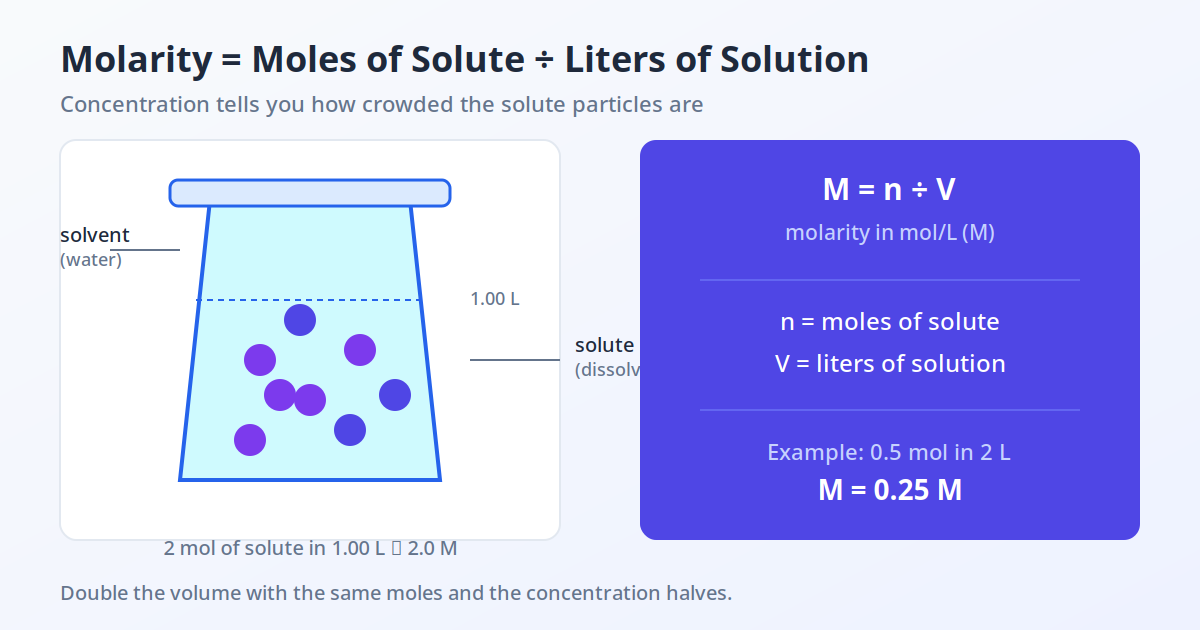
Molarity is the chemist’s standard unit of concentration: the number of moles of solute dissolved in each liter of solution, written as mol/L or M. A 1 M solution of table salt contains one mole (58.44 grams) of NaCl per liter. Whether you are preparing reagents for a titration, diluting a stock solution, or checking a homework problem, converting between mass, moles, volume, and molarity is routine and error-prone by hand. A molarity calculator performs these conversions instantly and consistently.
This molarity calculator solves the core relationship M = n/V for whichever variable you need. Give it any two of molarity, moles, and volume and it finds the third; give it a mass and a molar mass and it converts to moles first. It also handles dilutions via M1V1 = M2V2, the equation every lab student meets when preparing working solutions from concentrated stocks.
Common Workflows
Most lab work falls into three patterns. Preparing a solution from solid reagent uses mass mode: weigh, dissolve, dilute to volume. Preparing from a concentrated stock uses dilution mode: pipette the computed stock volume, then bring to final volume. Verifying an unknown concentration works backwards: titrate to find moles, divide by the sample volume. The calculator supports all three, so match the mode to your bench workflow before entering numbers.
How to Use This Molarity Calculator
Choose the quantity you want to find, then enter what you know:
- Select the calculation mode. Find molarity, moles, volume, or mass, or use dilution mode to prepare a weaker solution from a stock.
- Enter the known values. For molarity mode, enter moles of solute and solution volume in liters; milliliters are converted automatically.
- For mass mode, enter the molar mass. Look it up on the periodic table: NaCl is 58.44 g/mol, glucose 180.16 g/mol. Enter the mass in grams.
- For dilutions, enter stock and target values. Provide the stock concentration (M1), the desired concentration (M2), and the final volume (V2).
- Click Calculate. Results appear with the defining equation and unit-consistent values.
- Check significant figures. The calculator shows full precision; round your lab notebook entry to match your least precise measurement.
How Molarity Is Calculated
Molarity (M) is defined as moles of solute (n) divided by liters of solution (V): M = n / V. Rearranged, the same relationship yields moles (n = M x V) and volume (V = n / M): one equation, three uses. The subtlety most students miss is that V is the volume of the solution, not the solvent. You dissolve the solute and then bring the total volume up to the mark in a volumetric flask, because the solute itself occupies volume.
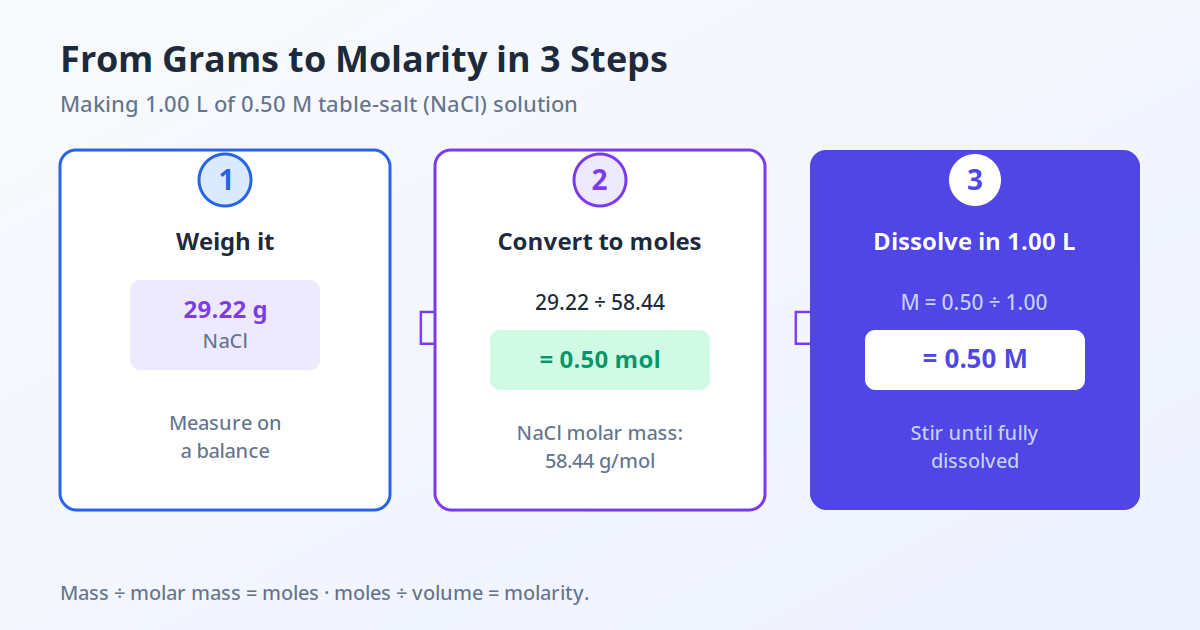
When you start from a weighed mass rather than moles, an extra conversion comes first: n = mass (g) / molar mass (g/mol). The molar mass is the sum of the atomic weights in the compound’s formula; for calcium chloride, CaCl2, that is 40.08 + 2(35.45) = 110.98 g/mol. Combined with the molarity equation, the full chain from grams to molarity is M = (mass / molar mass) / V.
Dilutions obey conservation of solute: the moles taken from the stock equal the moles in the final solution, so M1V1 = M2V2. To prepare 1 L of 0.1 M HCl from 12 M concentrated stock: V1 = (0.1 x 1) / 12 = 8.33 mL. Measure 8.33 mL of the concentrate into a flask and dilute to 1 L. Always add acid to water, never the reverse.
Variables Explained
- M (molarity): moles per liter of solution.
- n (moles): amount of solute; one mole equals 6.022 x 10^23 particles.
- V (volume): total solution volume in liters.
- Molar mass: grams per mole of the solute.
Converting From Percent Concentration
Reagent bottles often list percent rather than molarity. For weight/volume percent, % w/v means grams per 100 mL, so a 5% w/v NaCl solution contains 50 g/L, which is 50 / 58.44 = 0.856 M. For weight/weight percent you need the solution density: a 37% w/w HCl solution with density 1.19 g/mL contains 0.37 x 1190 = 440 g of HCl per liter, or 440 / 36.46 = 12.1 M, the familiar concentrated stock. Volume/volume percent applies to liquid solutes like ethanol.
Limitations
Molarity describes concentration, not chemical behavior. It does not account for incomplete dissociation of weak acids, activity effects in concentrated solutions, or temperature dependence: a solution prepared at 20 C has a slightly different molarity at 40 C because the volume expands. For temperature-independent work, chemists use molality (moles per kilogram of solvent) instead. Also verify the solute is fully dissolved; molarity is meaningless for a suspension.
Worked Example: Preparing 500 mL of 0.5 M NaCl
You need half a liter of 0.5-molar salt solution. First find the moles required: n = M x V = 0.5 mol/L x 0.500 L = 0.25 mol. Convert to mass with the molar mass of NaCl (58.44 g/mol): mass = 0.25 x 58.44 = 14.61 g.
| Input | Value |
|---|---|
| Target molarity | 0.5 M |
| Target volume | 500 mL (0.500 L) |
| Solute | NaCl (58.44 g/mol) |
| Mass to weigh | 14.61 g |
Weigh 14.61 g of NaCl, dissolve it in about 400 mL of distilled water, transfer to a 500 mL volumetric flask, and add water to the calibration mark. The result is 0.5 M NaCl: 0.25 moles in exactly half a liter.
Practical Lab Tips
Always use a volumetric flask for the final volume step; beakers and graduated cylinders are too imprecise for quantitative work, with errors of several percent. Dissolve the solid in roughly two-thirds of the final water volume first, since some salts dissolve slowly or release heat, then cool to room temperature before topping up: warm solutions contract as they cool and your concentration would drift. Rinse the weighing paper or boat into the flask so no solute is lost in transfer.
For dilutions, choose a pipette sized near your computed stock volume rather than a micropipette at its extreme; mid-range deliveries are more accurate. And label everything immediately with solute, molarity, date, and your initials. An unlabeled flask is a wasted preparation at best and a safety incident at worst.
Second Example: Diluting a Stock Solution
You need 250 mL of 0.020 M KMnO4 for a titration, and the shelf holds 0.10 M stock. Using M1V1 = M2V2: V1 = (0.020 x 0.250) / 0.10 = 0.050 L, or 50 mL. Pipette 50.0 mL of the stock into a 250 mL volumetric flask and dilute to the mark with distilled water. Because the stock itself was standardized, this two-step preparation is more accurate than weighing the few milligrams of solid that 0.005 moles would require, and it demonstrates why analytical labs keep concentrated stocks of common reagents.
Smaller Concentration Units: Millimolar and Micromolar
Many real solutions are far more dilute than 1 M, so chemists scale the unit down: 1 M = 1,000 millimolar (mM) = 1,000,000 micromolar (µM). A 0.001 M solution is 1 mM, and a 0.000001 M solution is 1 µM. To convert, multiply molarity by 1,000 to get millimolar (0.25 M = 250 mM) or by 1,000,000 to get micromolar.
Biochemists and clinicians live in these units: normal fasting blood glucose is around 5 mM, hormones are measured in nanomolar or picomolar ranges, and drug doses in cell cultures are usually quoted in µM. The calculator works in moles per liter, so convert first — enter 5 mM as 0.005 M.
Frequently Asked Questions
What is the difference between molarity and molality?
Molarity is moles per liter of solution; molality is moles per kilogram of solvent. Molarity is convenient for lab prep but shifts with temperature because liquids expand; molality is temperature-independent and preferred for colligative-property calculations like freezing-point depression.
How do I find the molar mass?
Add the atomic masses of every atom in the formula, from the periodic table. H2SO4: 2(1.008) + 32.06 + 4(16.00) = 98.08 g/mol. For hydrates, include the waters of crystallization: CuSO4.5H2O is 249.68 g/mol, not 159.61.
Why must volume be the solution volume, not the solvent?
Because molarity is defined per liter of final solution. Adding 1 L of water to 1 mole of solute gives slightly more than 1 L of solution, since the solute takes up space, so the true molarity would read slightly under 1 M. Volumetric flasks exist precisely to hit the total volume exactly.
Can I use this for dilutions?
Yes. Dilution mode applies M1V1 = M2V2. Enter your stock concentration, target concentration, and final volume to get the stock volume to pipette. Remember the lab safety rule: when diluting concentrated acids, always add acid to water.
What are common molarity mistakes?
Forgetting to convert mL to L (a factor-of-1000 error), using solvent volume instead of solution volume, using the wrong hydrate form’s molar mass, and confusing molarity (M) with moles (mol). Writing out the units at each step, dimensional analysis, catches nearly all of these.
How precise should my answer be?
Match the significant figures of your least precise input. If you weighed 14.6 g (3 s.f.) and measured 500 mL (3 s.f.), report 0.500 M, not 0.50000 M. The calculator shows full precision so you can round appropriately.
Does molarity work for gases or solids?
Molarity is defined for solutions. For gases, chemists use partial pressures or mol/L via the ideal gas law; for solids, mass percent or mole fraction. Dissolving a gas in a liquid, like CO2 in water, does create a solution with a meaningful molarity, though.
How do I convert between molarity and percent concentration?
For % w/v (grams per 100 mL), multiply by 10 to get g/L, then divide by the molar mass. A 5% w/v NaCl solution is 50 g/L / 58.44 = 0.856 M. For % w/w you also need the solution density to convert mass of solution to volume. For % v/v liquid solutes, convert the solute volume to mass via its density first, then proceed as w/v.
How do you calculate molarity?
To calculate molarity, divide the number of moles of solute by the volume of the solution in liters: M = n / V. For example, dissolving 1 mole of table salt in 1 liter of water gives a 1 M solution. If you start with grams instead of moles, first convert mass to moles using the substance’s molar mass.
What is the molarity formula in chemistry?
The molarity formula in chemistry is M = n/V, where M is molarity in moles per liter (mol/L), n is the amount of solute in moles, and V is the total solution volume in liters. A common mistake is using the volume of solvent instead of the final solution volume — always measure after the solute is fully dissolved and the solution is brought to its final volume.
How do you use M1V1 = M2V2 for dilutions?
The dilution equation M1V1 = M2V2 relates a concentrated stock solution to a diluted one: multiply the stock molarity (M1) by the stock volume used (V1) to get the final molarity (M2) times the final volume (V2). For instance, to make 500 mL of 0.1 M solution from a 1 M stock, you need 50 mL of stock topped up to 500 mL. The calculator above handles these dilution problems automatically.
What does mM mean in chemistry?
mM means millimolar: one thousandth of a mole per liter, or 0.001 M. It is used when concentrations are too small to write comfortably in molar units — for example, blood glucose around 5 mM and many buffer components in the 10–100 mM range. To use this calculator, convert mM to M first by dividing by 1,000.
How do I calculate molarity from mass and volume?
First convert the mass to moles by dividing by the molar mass, then divide by the volume in liters. Example: 5.85 g of NaCl (molar mass 58.44 g/mol) is 5.85 ÷ 58.44 = 0.100 mol. Dissolved and made up to 500 mL (0.500 L), the molarity is 0.100 ÷ 0.500 = 0.200 M. The calculator automates both steps.
Related Calculators
Try our Unit Converter, Cooking Measurement Converter, and Fuel Cost Calculator.
Related: Exponent Calculator, Hex Calculator.