A period calculator is a simple online tool that predicts your upcoming menstrual periods based on the dates of your past cycles. Also known as a menstrual cycle calculator, it takes the first day of your last period and your average cycle length, then estimates when your next period will begin, when you are likely to ovulate, and which days form your fertile window.
Millions of people use a period calculator every month to plan around their cycles — whether that means scheduling a vacation, preparing for PMS symptoms, or understanding fertility. While no calculator can predict your body with absolute certainty, a well-designed tool gives you a reliable estimate that gets more accurate the more consistently you track.
This free period calculator goes a step further than a basic date counter. Alongside your next period date, it estimates your ovulation day, maps your fertile window, tells you which cycle day you are on today, and projects your next three periods so you can plan months ahead.
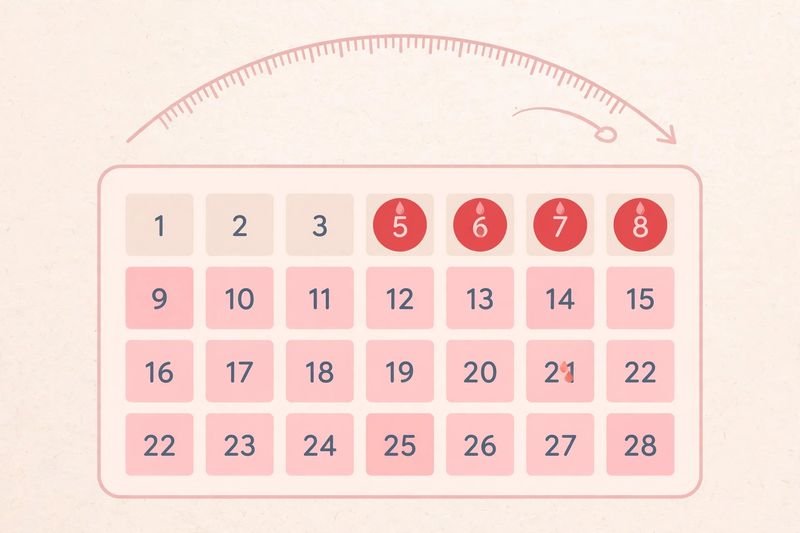
How to Use the Period Calculator
Using the calculator takes less than a minute. Here is what each field means:
- First day of your last period: Pick the date your most recent period started — not when it ended, but the very first day of bleeding. This is "Cycle Day 1." Getting this date right is the single most important input.
- Average cycle length (days): This is the number of days from the first day of one period to the first day of the next. The default is 28 days, which is the textbook average, but healthy cycles range from 21 to 35 days. If you have tracked a few cycles, enter your own average for better accuracy.
- Period duration (days): How many days your bleeding typically lasts. The default is 5 days. This helps the calculator describe your expected bleeding window.
Click "Calculate My Cycle" and you will instantly see your predicted results. You can re-run the calculation any time your cycle changes — for example, after a particularly short or long cycle.
How the Calculation Works
The period calculator uses three straightforward calendar formulas that mirror how healthcare providers estimate cycle events:
1. Next period date
Next period = first day of last period + average cycle length
If your last period started on September 20 and your average cycle is 28 days, your next period is estimated for October 18. The calculator simply adds your cycle length to your last start date, then repeats this to project the following three periods.
2. Ovulation date
Ovulation ≈ next period date − 14 days
In most cycles, ovulation happens about 14 days before the next period begins. This relationship is more consistent than counting forward from the last period, because the second half of the cycle (the luteal phase) varies less between people than the first half. So the calculator first finds your next period, then subtracts 14 days to estimate ovulation.
3. Fertile window
Fertile window = 5 days before ovulation through ovulation day
Conception is possible during roughly six days per cycle: the five days leading up to ovulation plus ovulation day itself. This is because sperm can survive in the reproductive tract for up to five days, while an egg survives only about 12 to 24 hours after release. The calculator marks this full six-day span.
4. Current cycle day
Current cycle day = today's date − last period start date + 1
If your last period started 10 days ago, you are on Cycle Day 11. This number helps you locate yourself within the four phases of the cycle described below.
Worked Example
Let us walk through a complete example so you can see exactly how the numbers work.
Inputs:
- Last period started: Sunday, September 20, 2026
- Average cycle length: 28 days
- Period duration: 5 days
Step 1 — Next period: September 20 + 28 days = Sunday, October 18, 2026. Bleeding is expected to last about 5 days, through October 22.
Step 2 — Ovulation: October 18 − 14 days = Sunday, October 4, 2026.
Step 3 — Fertile window: October 4 − 5 days = September 29, so the fertile window runs Tuesday, September 29 through Sunday, October 4, 2026.
Step 4 — Next three periods: October 18, then November 15 (October 18 + 28), then December 13 (November 15 + 28).
Step 5 — Current cycle day: If today is September 30, that is 10 days after September 20, so you are on Cycle Day 11 — right in the follicular phase, a few days before the fertile window begins.
Understanding the Four Phases of Your Cycle
Your menstrual cycle is divided into four phases. Knowing which phase you are in helps you interpret symptoms like cramps, mood changes, or shifts in energy:
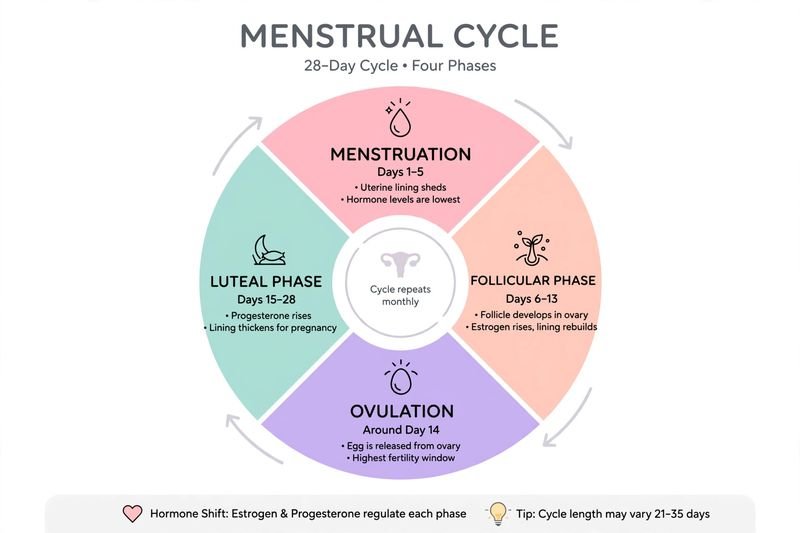
- Menstrual phase (Days 1–5): Bleeding occurs as the uterine lining sheds. This is "Cycle Day 1" — the day your period starts.
- Follicular phase (Days 1–13): Overlapping with menstruation, the ovaries prepare follicles and estrogen rises, rebuilding the uterine lining.
- Ovulation (around Day 14): A mature egg is released from the ovary. This is the most fertile day of the cycle.
- Luteal phase (Days 15–28): Progesterone rises to prepare the uterus for a possible pregnancy. If no pregnancy occurs, hormone levels fall and the next period begins.
These day ranges assume a 28-day cycle. In longer or shorter cycles, the follicular phase stretches or shrinks while the luteal phase stays close to 14 days — which is exactly why the calculator counts backward from your next period to find ovulation.
For a dedicated deep dive into your most fertile days, try our ovulation calculator, which focuses specifically on pinpointing ovulation and the fertile window.
How to Get a More Accurate Prediction
The best single improvement: average your last three to six cycles instead of one cycle or the 28-day default. Add the recent cycle lengths together and divide by how many there are. Averaging also smooths out one-offs — a stressful 34-day month barely moves an average built from several cycles.
And 28 days is a convention, not a rule. In a study of more than 600,000 cycles (Bull et al., 2019), the average length was 29.3 days. The period date predicts more reliably, since most variation sits in the follicular phase while the luteal phase stays near 14 days. When logging a start date, count the first day of full flow, not spotting.
What Can Make Your Cycle Longer or Shorter
A few days off prediction usually has an ordinary explanation:
- Stress: can delay the hormonal signals that trigger ovulation, pushing the whole cycle later.
- Illness: a fever or significant illness around ovulation can postpone it — and with it, your period.
- Travel: crossing time zones and disrupted sleep disturb the body clock that times hormone release.
- Weight change and intense exercise: rapid weight loss or a sudden jump in training can lengthen or pause cycles.
- Life stage: cycles run longer and less regularly after periods begin, and again before menopause.
- Hormonal conditions: PCOS and thyroid disorders can keep cycles longer, shorter, or irregular — see the limitations below.
Practical Uses of a Period Calculator
- Planning ahead: Know whether your period will coincide with a wedding, vacation, exam, or athletic event, and prepare accordingly.
- Tracking regularity: Comparing predicted dates with actual dates over several months reveals whether your cycle is regular or drifting — useful information to share with your doctor.
- Managing PMS: If you notice symptoms like cramps, headaches, or mood changes in the days before your period, predictions help you anticipate and manage them.
- Family planning: The fertile window estimate helps couples trying to conceive identify the best days, and helps others understand when pregnancy is most likely.
- Medication timing: Some people schedule pain relief or hormonal treatments around expected period dates.
- Health monitoring: A sudden change — a missed period, or a cycle that shortens or lengthens dramatically — can be an early signal worth discussing with a healthcare provider.
Limitations and Medical Disclaimer
A period calculator is an estimation tool, not a medical device. Please keep these limitations in mind:
- Cycles vary naturally. Stress, illness, travel, intense exercise, weight changes, and hormonal shifts can all move your period by several days. Predictions are averages, not guarantees.
- Ovulation timing is approximate. The "14 days before next period" rule holds for many people but not everyone. Those with irregular cycles may ovulate earlier or later, or occasionally not at all in a given cycle.
- Not a contraceptive method. Calendar-based estimates alone are not reliable birth control. The fertile window shown here is an approximation; pregnancy can occur outside it.
- Irregular cycles reduce accuracy. If your cycle length swings widely month to month, predictions based on an average will be less precise. Tracking for three or more months improves the average.
- Certain conditions affect cycles. PCOS, thyroid disorders, perimenopause, breastfeeding, and some medications can make cycles unpredictable.
Medical disclaimer: The results on this page are estimates for informational purposes only and are not medical advice, diagnosis, or treatment. Always consult a qualified healthcare provider about menstrual health concerns, irregular bleeding, severe pain, or family planning decisions. If you miss a period and pregnancy is possible, take a pregnancy test and speak with your doctor rather than relying on a calculator.
Frequently Asked Questions
How accurate is a period calculator?
For people with regular cycles, period calculators typically predict the next period within a day or two. Accuracy drops with irregular cycles, since the tool relies on your average cycle length. Tracking your actual start dates for three or more months and updating the average gives the best results.
What is the difference between a period calculator and an ovulation calculator?
A period calculator focuses on predicting when your next menstrual bleeding will start, while an ovulation calculator focuses on identifying your most fertile days. This tool does both: it predicts your next period and estimates ovulation and the fertile window from the same inputs. For a fertility-focused view, see our ovulation calculator.
Can I use a period calculator if my cycle is irregular?
Yes, but treat the results as rough estimates. Enter the average of your last three to six cycle lengths for the best approximation, and expect a wider margin of error — your period could arrive several days early or late. If irregularity is new or persistent, discuss it with a healthcare provider.
Why is ovulation estimated as 14 days before the next period?
The luteal phase — the second half of the cycle, after ovulation — is the most consistent part, lasting about 14 days in most people. The first half (follicular phase) varies more. Counting backward 14 days from the predicted next period is therefore more reliable than counting forward 14 days from the last period.
Can a period calculator tell me if I am pregnant?
No. A calculator cannot detect pregnancy. If your period is more than a week late and pregnancy is possible, take a home pregnancy test and consult your healthcare provider. A missed period has many possible causes, including stress, illness, and hormonal changes.
Should I track anything besides the start date?
Recording your actual start dates each month is the most valuable habit — it refines your average cycle length over time. Many people also note flow heaviness, cramps, mood, and spotting, which can reveal patterns and provide useful detail for medical appointments.
Should I average my last few cycles instead of using 28 days?
Yes — averaging your last three to six cycles beats the 28-day default. Cycles of 26, 29, 28, and 31 days average 28.5, so enter 28 or 29.
Is it normal for my cycle to be shorter than 21 days or longer than 35 days?
For adults, 21 to 35 days is typical; teenagers can range up to about 45 days. Cycles regularly shorter than 21 or longer than 35 days, bleeding lasting over a week, or periods stopping are worth raising with a healthcare provider, who can check for causes like thyroid problems or PCOS.
Related Calculators
- Ovulation Calculator — pinpoint your fertile window and ovulation day in detail.
- BMI Calculator — check your body mass index, another useful health baseline.