Estimates only. For code compliance and safety, consult a licensed electrician.
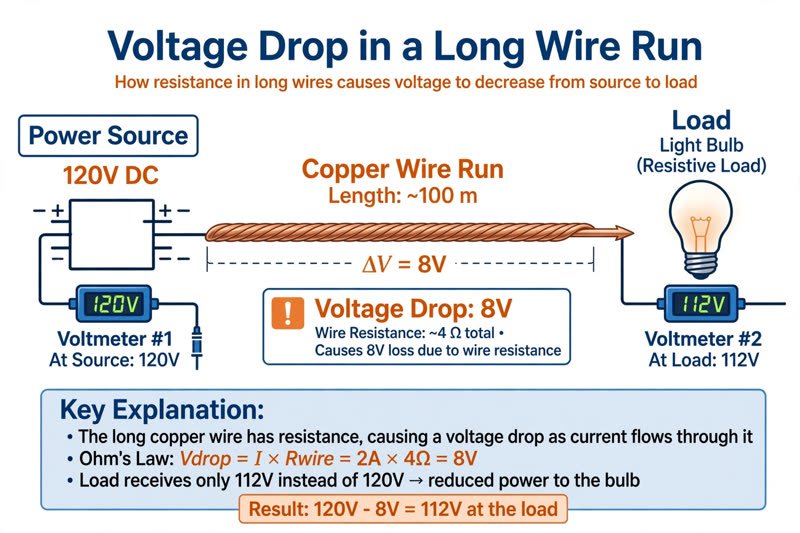
When electricity travels through a wire, some voltage is always lost along the way. A voltage drop calculator tells you exactly how much voltage your circuit loses between the power source and the load, so you can pick the right wire size before you buy cable or fail an inspection. Whether you are an electrician sizing a long branch circuit, a DIYer wiring a workshop, or an RV owner running power to a distant outlet, knowing your voltage drop keeps equipment running safely and efficiently.
How to Use the Voltage Drop Calculator
- Select the wire material — copper or aluminum. Copper has lower resistance (K = 12.9) than aluminum (K = 21.2), so it drops less voltage for the same size.
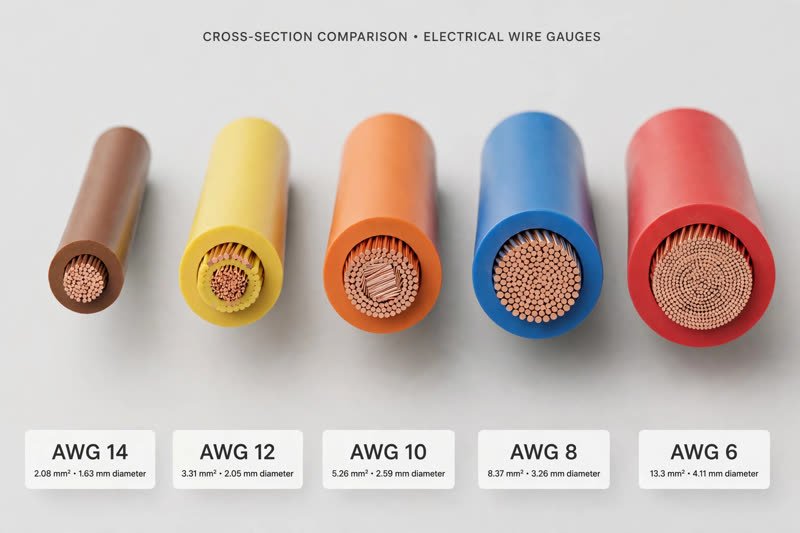
- Choose the wire size (AWG) — from 14 AWG up to 4/0 AWG. Smaller AWG numbers mean thicker wire and less drop.
- Enter the one-way circuit length in feet — the distance from the panel to the load, not the round trip. The calculator doubles it internally.
- Enter the load current in amps — the current the equipment actually draws.
- Pick the system voltage (120 V, 240 V, 208 V, 480 V, 12 V, or 24 V) and the phase (single-phase or three-phase).
- Click Calculate Voltage Drop to see the drop in volts, the drop as a percentage, and the actual voltage arriving at the load.
The Voltage Drop Formula
Voltage drop follows directly from Ohm's law. Every wire has resistance, and resistance converts some electrical energy into heat. The standard formula used by electricians is:
Single-phase: VD = 2 × K × I × L ÷ CM
Three-phase: VD = 1.732 × K × I × L ÷ CM
Where:
- VD = voltage drop in volts
- K = resistivity constant — 12.9 for copper, 21.2 for aluminum
- I = current in amps
- L = one-way length in feet
- CM = wire cross-section in circular mils (from the AWG table)
- 2 = accounts for the round trip (out and back) in single-phase circuits; 1.732 (the square root of 3) is the three-phase equivalent
The percentage drop is simply (VD ÷ system voltage) × 100. The voltage at the load is the system voltage minus VD.
Worked Examples
Example 1: Workshop circuit, 12 AWG copper
A 120 V, 20 A workshop circuit runs 100 feet (one way) on 12 AWG copper (6,530 circular mils).
VD = 2 × 12.9 × 20 × 100 ÷ 6,530 = 51,600 ÷ 6,530 ≈ 7.90 V
Drop % = 7.90 ÷ 120 × 100 ≈ 6.58%
Voltage at load ≈ 112.1 V
This exceeds the 3% guideline — stepping up to 10 AWG would cut the drop roughly in half.
Example 2: Long aluminum feeder, 240 V
A 240 V, 30 A subpanel feeder runs 200 feet on 10 AWG aluminum (10,380 circular mils, K = 21.2).
VD = 2 × 21.2 × 30 × 200 ÷ 10,380 = 254,400 ÷ 10,380 ≈ 24.51 V
Drop % = 24.51 ÷ 240 × 100 ≈ 10.21%
Far too high — this run needs much larger wire, such as 4 AWG or 2 AWG aluminum.
Example 3: Three-phase motor, 480 V
A 480 V three-phase motor draws 50 A through 150 feet of 4 AWG copper (41,740 circular mils).
VD = 1.732 × 12.9 × 50 × 150 ÷ 41,740 = 167,571 ÷ 41,740 ≈ 4.01 V
Drop % = 4.01 ÷ 480 × 100 ≈ 0.84%
Well within limits — higher system voltages are far more forgiving of long runs.
Example 4: A 12 V DC run to an RV water pump
Inputs: 12 V DC, 10 amps, 25 ft one-way run, 10 AWG copper.
Calculation: VD = 2 × 12.9 × 10 × 25 ÷ 10,380 (circular mils for 10 AWG) = 6,450 ÷ 10,380 ≈ 0.62 V.
Result: 0.62 V is about 5.2% of 12 V, leaving roughly 11.38 V at the pump. The same wire at 120 V would lose under 1%, which is why short-looking low-voltage runs still need generous wire sizes — on a 12 V system, every tenth of a volt is a real percentage.
NEC Voltage Drop Guidance: The 3% and 5% Rules
The National Electrical Code recommends (as informational notes, not hard requirements) that branch circuits be sized for a maximum 3% voltage drop, and that the combined drop of feeder plus branch circuit stay under 5% for reasonable efficiency. These appear in NEC 210.19(A)(1) Informational Note No. 4 and 215.2(A)(1) Informational Note No. 2. Staying within these limits keeps motors starting reliably, prevents lights from dimming, and avoids overheating wire.
Voltage Drop Is Not Ampacity
Two separate checks decide whether a wire size is right, and passing one does not guarantee the other. Ampacity is about heat: can the conductor carry the current continuously without its insulation overheating? That limit barely changes with length. Voltage drop is about performance: how much voltage is left when the current reaches the load — and it grows with every extra foot. A wire can be perfectly legal on ampacity for a short run yet leave a distant motor starved on a long one, which is why electricians run both checks and let the stricter result set the final size.
Practical Uses
- Electricians sizing branch circuits and feeders for homes, shops, and outbuildings.
- DIYers running power to a garage, shed, well pump, or landscape lighting.
- RV and marine owners checking 12 V DC runs, where even small drops matter enormously.
- Solar installers sizing DC conductors between panels, charge controllers, and batteries.
- Inspectors and students verifying designs against NEC guidance.
Tips for Reducing Voltage Drop
- Upsize the wire — going from 12 AWG to 10 AWG cuts resistance by about 37%.
- Shorten the run — route cable directly instead of around the building.
- Use copper instead of aluminum where the budget allows.
- Raise the voltage — a 240 V circuit drops half the percentage of a 120 V circuit for the same watts.
- Split the load — two smaller circuits drop less than one heavily loaded circuit.
AWG to Circular Mils Reference
The calculator uses circular mils (CM) — the cross-sectional area of the wire — from this standard table. If you ever calculate voltage drop by hand, look up your wire size here:
| Wire Size | Circular Mils | Typical Use |
|---|---|---|
| 14 AWG | 4,110 | Lighting circuits (15 A) |
| 12 AWG | 6,530 | Receptacle circuits (20 A) |
| 10 AWG | 10,380 | Water heaters, AC units (30 A) |
| 8 AWG | 16,510 | Ranges, large tools (40–50 A) |
| 6 AWG | 26,240 | Subpanels (55–65 A) |
| 4 AWG | 41,740 | Feeders (70–85 A) |
| 2 AWG and larger | 66,360+ | Service entrances, large feeders |
Safety Note
This calculator provides planning estimates, not code-compliant designs. Electrical work must follow the NEC and local codes. If you are not a licensed electrician, have your work reviewed or performed by one — incorrect wire sizing can cause fires.
Related Calculators
- Ohm's Law Calculator — solve for voltage, current, resistance, or power.
- Electricity Calculator — estimate energy usage and cost.
Frequently Asked Questions
What is an acceptable voltage drop?
For branch circuits, aim for 3% or less. The NEC suggests a 5% maximum for the combined feeder and branch circuit. Sensitive electronics and motors perform best with the lowest drop you can practically achieve.
Does wire size affect voltage drop?
Yes — directly. Thicker wire (lower AWG number) has more circular mils of conductor, lower resistance, and therefore less voltage drop. Doubling the wire's cross-section roughly halves the drop.
Why is voltage drop worse on 12V systems?
Because the drop is a fixed number of volts but the percentage is relative to system voltage. A 1 V drop on a 120 V circuit is under 1%, but the same 1 V drop on a 12 V circuit is over 8% — which is why low-voltage runs need oversized wire.
Do I enter one-way or round-trip length?
Enter the one-way distance from the power source to the load. The formula already multiplies by 2 (single-phase) to account for the return conductor.
Is aluminum wire worse for voltage drop?
Aluminum has about 64% higher resistivity than copper (K = 21.2 vs 12.9), so the same AWG size drops more voltage. Electricians compensate by using aluminum two sizes larger than the copper equivalent.
Can voltage drop damage equipment?
Yes. Motors draw higher current at low voltage, which overheats windings. Electronics may malfunction or shut down. Chronic undervoltage shortens equipment life, which is why proper wire sizing matters.
Can I use this calculator for DC circuits like solar or RV wiring?
Yes. The same formula applies to DC — use the one-way length of the run, the load current, and the 12 V or 24 V option for the system voltage. Low-voltage DC is actually where drop bites hardest: the 12 V example above loses about 5.2% over just 25 ft, so solar, RV, and marine runs deserve the same check as any AC circuit.