How much water does your fish tank hold? Will that sofa fit through the doorway — or even in the moving truck? How many cubic feet of concrete do you need for a patio slab? Every one of these questions comes down to a single measurement: volume, the amount of three-dimensional space an object occupies. A volume calculator takes the tedious arithmetic out of the process, turning length, width, and height measurements into an exact capacity in seconds.
Whether you are a student working through geometry homework, a contractor estimating materials, or a home cook scaling a recipe, knowing how to find volume quickly is a genuinely useful skill. This guide explains the volume formulas for the seven most common shapes, walks through worked examples, and shows you how to convert between cubic units like cm³, m³, in³, and ft³. You will also learn the difference between volume and capacity, the mistakes that trip most people up, and handy kitchen conversions you can use every day.
How to Use the Volume Calculator
Using the calculator above is straightforward:
- Select your shape from the dropdown — cube, rectangular prism, sphere, cylinder, cone, square pyramid, or triangular prism.
- Enter the dimensions shown for that shape (for example, radius and height for a cylinder).
- Choose your input unit — centimeters, meters, inches, or feet.
- Click "Calculate Volume" to see the result in your chosen cubic unit, plus automatic conversions to the other three units and the formula used.
All inputs must be positive numbers. The calculator updates the input fields automatically when you switch shapes, so you always see exactly which measurements each formula needs.
Volume Formulas for Common Shapes
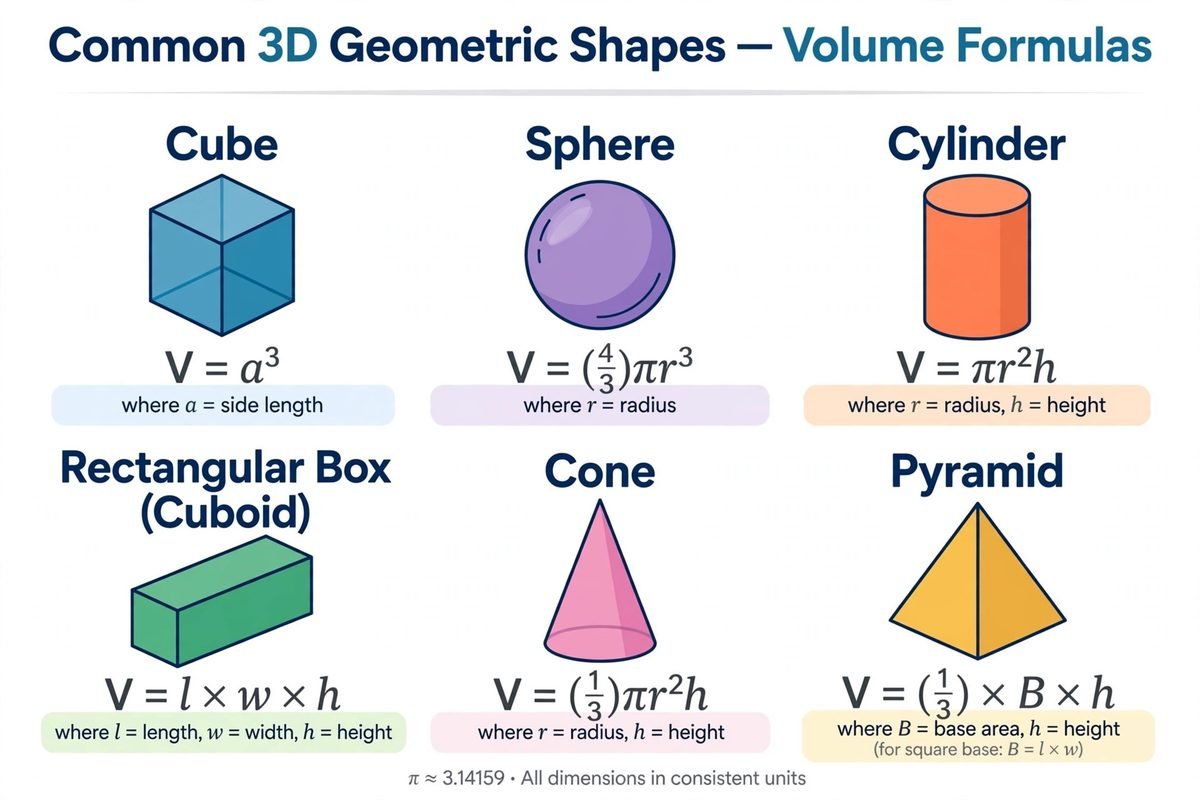
Volume is always measured in cubic units — the unit you measure length in, raised to the third power. Here are the formulas the calculator uses:
Cube
A cube has six identical square faces. If s is the side length:
V = s³
Rectangular Prism (Box)
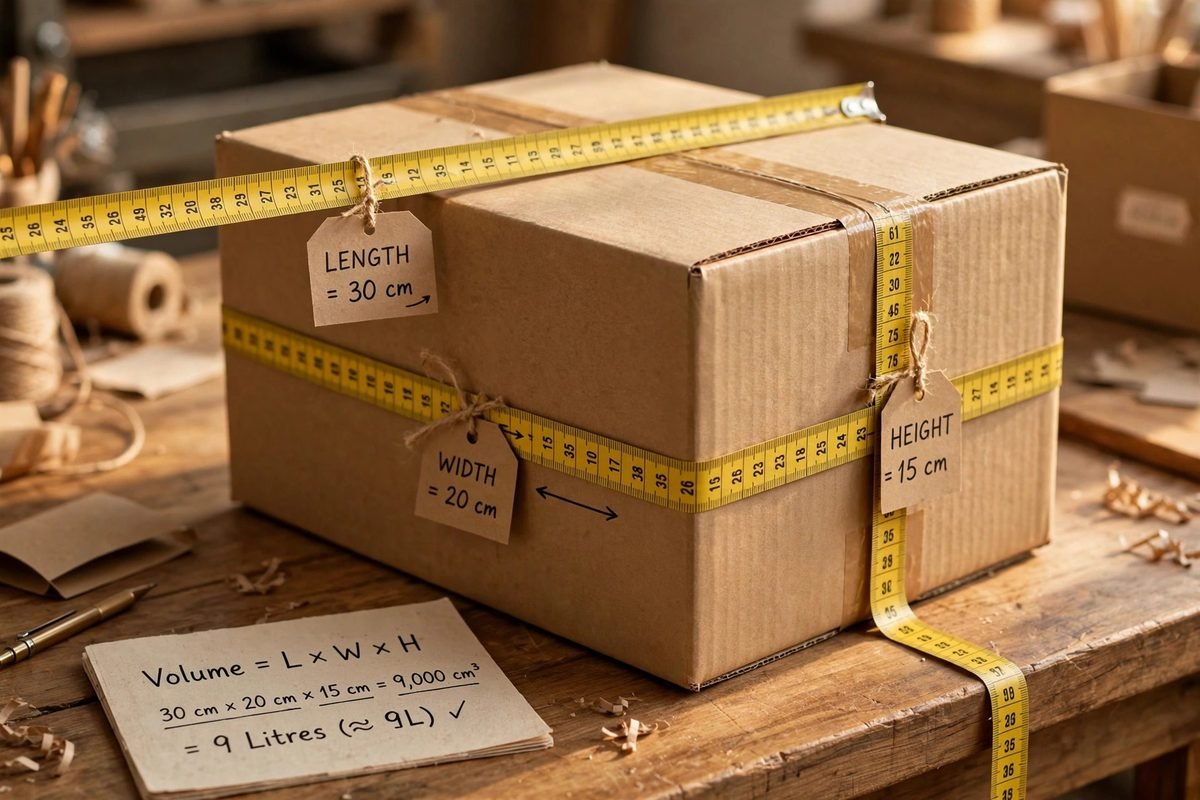
The classic box shape — shipping cartons, rooms, aquariums. With length l, width w, and height h:
V = l × w × h
Sphere
Balls, globes, and bubbles. With radius r:
V = (4/3) × π × r³
Cylinder
Cans, pipes, tanks, and silos. With radius r and height h:
V = π × r² × h
Cone
Traffic cones, funnels, and party hats. With radius r and height h:
V = (1/3) × π × r² × h
Notice a cone holds exactly one-third the volume of a cylinder with the same base and height.
Square Pyramid
With base side b and vertical height h:
V = (1/3) × b² × h
Triangular Prism
Think of a tent or a Toblerone bar. With triangle base b, triangle height h, and prism length l:
V = (1/2) × b × h × l
More Volume Formulas: Hemisphere, Frustum, Capsule and Ellipsoid
Four more have no widget button — work these by hand:
Hemisphere
Half of a sphere:
V = (2/3) × π × r³
Radius 3 cm: ≈ 56.55 cm³ — half of Example 2's sphere.
Conical Frustum
A cone with its tip cut off. Bottom radius R, top radius r, height h:
V = (1/3) × π × h × (R² + R×r + r²)
R = 4, r = 2, h = 6: ≈ 175.93 cubic units.
Capsule
A cylinder with a hemisphere at each end — the caps form one sphere. Radius r, straight-section length h:
V = π × r² × h + (4/3) × π × r³
r = 2, h = 5: ≈ 96.34 cubic units.
Ellipsoid
A sphere stretched along three axes; semi-axes a, b, c:
V = (4/3) × π × a × b × c
Semi-axes 4, 3, 2: ≈ 100.53 cubic units (a sphere is a = b = c).
Worked Examples
Example 1: How many cubic feet of water does a rectangular fish tank hold?
A tank measures 48 inches long, 18 inches wide, and 24 inches tall. First convert to feet (divide by 12): 4 ft × 1.5 ft × 2 ft. Then:
V = 4 × 1.5 × 2 = 12 cubic feet
Since one cubic foot holds about 7.48 gallons, this tank holds roughly 90 gallons.
Example 2: What is the volume of a sphere with a 3 cm radius?
Using V = (4/3) × π × r³:
V = (4/3) × 3.14159 × 27 = 113.10 cm³
Example 3: A cylindrical water tank has a 2-meter radius and is 5 meters tall. What is its volume?
Using V = π × r² × h:
V = 3.14159 × 4 × 5 = 62.83 m³
One cubic meter equals 1,000 liters, so this tank holds about 62,830 liters.
Working Backward: Find a Missing Dimension From Volume
Know the capacity but not a dimension? Rearrange first:
- Cylinder height: h = V ÷ (π × r²)
- Cube side: s = ∛V
- Sphere radius: r = ∛(3V ÷ 4π)
- Box height: h = V ÷ (l × w)
Example: 1,000 cm³, radius 5 cm: h = 1,000 ÷ (π × 25) ≈ 12.73 cm.
Understanding Cubic Units and Conversions
Because volume is three-dimensional, converting units means cubing the linear conversion factor. Some handy equivalents:
- 1 cubic meter (m³) = 1,000,000 cm³ = 1,000 liters = 35.31 ft³
- 1 cubic foot (ft³) = 1,728 in³ ≈ 28.32 liters ≈ 7.48 US gallons
- 1 cubic inch (in³) = 16.387 cm³
- 1 US gallon = 231 in³ ≈ 3.785 liters
The calculator above handles these conversions automatically — enter dimensions in any unit and see the result expressed in all four cubic units.
Practical Uses of a Volume Calculator
- Moving and shipping: Estimate truck or container space; carriers often charge by dimensional weight, which is derived from volume.
- Construction: Calculate cubic yards of concrete, cubic feet of gravel, or insulation needed for an attic.
- Cooking: Scale recipes between container sizes — a 9-inch round pan and an 8-inch square pan hold surprisingly different volumes.
- Aquariums and pools: Determine water capacity for treatment dosing and heater sizing.
- Gardening: Figure out how many bags of soil or mulch a raised bed needs.
- Science and school: Check geometry homework and lab measurements quickly.
Tips for Accurate Results
- Measure consistently: Use the same unit for every dimension before calculating — mixing inches and feet is the most common mistake.
- Radius vs. diameter: Sphere, cylinder, and cone formulas need the radius (half the diameter). If you measured across the full width, divide by two first.
- Inside vs. outside: For containers, measure the interior dimensions if you want usable capacity; wall thickness can make a real difference.
- Round at the end: Keep full precision through intermediate steps and round only the final answer to avoid compounding errors.
Volume vs. Capacity: Is There a Difference?
In everyday language, volume and capacity are often used interchangeably, but there is a subtle distinction. Volume refers to the total three-dimensional space an object occupies — including its walls. Capacity refers to how much that object can hold. A thick-walled cooler might have an exterior volume of 50 liters but a capacity of only 40 liters, because the insulation takes up space.
For most calculator purposes this distinction rarely matters, but it becomes important when you are buying storage containers, sizing a water heater, or calculating shipping costs. When in doubt, measure the interior dimensions for capacity and the exterior dimensions for total volume.
Common Volume Mistakes to Avoid
- Forgetting to cube the unit: If you measure in inches, your answer is in cubic inches — not inches. Labeling units correctly prevents costly ordering errors.
- Using diameter instead of radius: This is the single most common geometry error. The sphere, cylinder, and cone formulas all require the radius. Double-check which one you measured.
- Ignoring the pyramid/ cone one-third rule: A cone is not "a bit smaller" than a cylinder — it is exactly one-third the volume. The same applies to pyramids versus prisms.
- Mixing units mid-calculation: If length is in feet but height is in inches, convert everything to one unit first. The calculator's unit selector exists precisely to prevent this.
Volume in the Kitchen: A Quick Reference
Cooking is one of the most frequent everyday uses of volume math. These conversions save time:
- 1 cup = 16 tablespoons = 48 teaspoons ≈ 237 ml
- 1 pint = 2 cups; 1 quart = 2 pints; 1 gallon = 4 quarts
- A standard 9×13-inch baking pan holds about 14 cups (3.3 liters)
- To halve a recipe in a cylindrical pot, you do not halve the diameter — area (and thus volume) scales with the square of the diameter
Frequently Asked Questions
What is the difference between volume and surface area?
Volume measures the space inside an object (cubic units), while surface area measures the area of its outer skin (square units). A balloon's volume tells you how much air it holds; its surface area tells you how much rubber was used to make it. Try our surface area calculator for the latter.
How do I calculate volume in cubic feet?
Measure length, width, and height in feet, then multiply them: V = l × w × h. If your measurements are in inches, divide each by 12 first (or divide the cubic-inch result by 1,728).
What is the volume of a cylinder in liters?
Calculate the volume in cubic centimeters (V = π × r² × h), then divide by 1,000 — there are 1,000 cm³ in a liter. The calculator above shows metric conversions automatically.
How do you find the volume of an irregular object?
Use water displacement: submerge the object in a graduated container and measure how much the water level rises. The rise in volume equals the object's volume — the same principle Archimedes famously used.
Why is volume always in cubic units?
Because volume spans three dimensions. Multiplying length × width × height multiplies the unit by itself three times (e.g., cm × cm × cm = cm³). This is why area uses square units (two dimensions) and volume uses cubic units (three).
Can this calculator handle hollow objects like pipes?
For a hollow cylinder, calculate the outer cylinder's volume and subtract the inner cylinder's volume (using the inner radius). The difference is the volume of the material itself — useful for estimating weight from density.
What is the volume of a hemisphere?
Half a sphere: V = (2/3) × π × r³; at 3 cm radius, ≈ 56.55 cm³.
How do I find a missing dimension if I only know the volume?
Rearrange so the unknown stands alone: for a cylinder, h = V ÷ (π × r²), giving ≈ 12.73 cm for a 1,000 cm³ tank of 5 cm radius.