Enter the market values and costs of equity and debt below to compute the weighted average cost of capital.
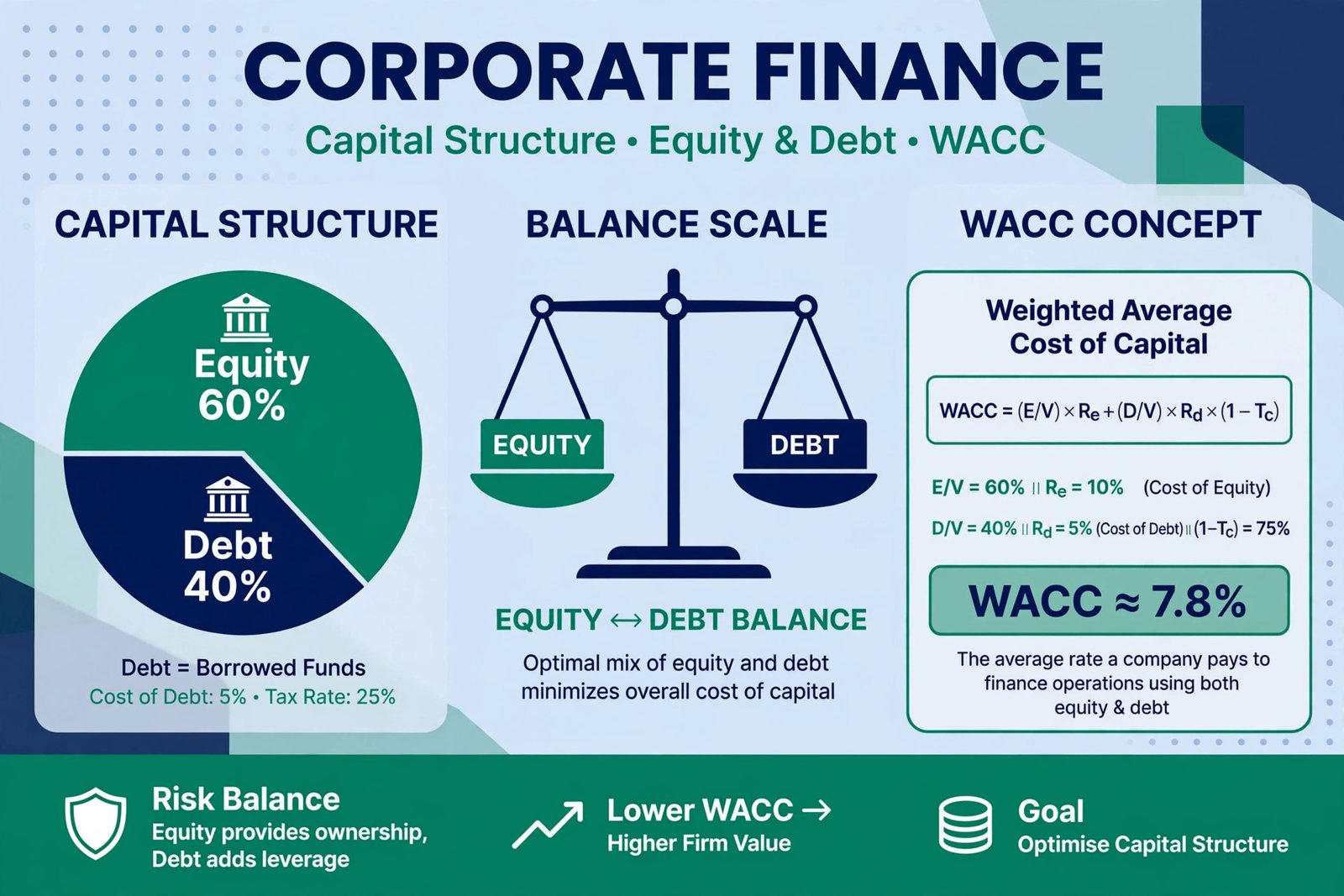
What Is a WACC Calculator?
A WACC calculator computes the weighted average cost of capital — the average rate a company must pay to finance its assets, weighted by how much of its funding comes from equity versus debt. Every business raises money from two broad sources: shareholders who expect a return on their equity, and lenders who charge interest on debt. These two sources do not cost the same, and a company rarely uses them in equal proportions, so a simple average would be misleading. WACC blends the cost of equity and the after-tax cost of debt in proportion to their market values, producing a single percentage that represents the blended price of the company's capital.
This single number is one of the most widely used figures in corporate finance. It serves as a hurdle rate for new projects, a discount rate for valuing future cash flows, and a benchmark for judging whether a business is creating or destroying shareholder value. If a project is expected to earn less than the company's WACC, it will not cover the cost of the money funding it. If it earns more, it creates value. Because of this central role, students, analysts, investors, and small business owners all need a fast, reliable way to compute it, and that is exactly what the WACC calculator on this page does.
One important detail is that the weights must be based on market values, not accounting book values. The market value of equity is the company's market capitalization — share price multiplied by shares outstanding — while the market value of debt is what the company's borrowings would be worth if sold today. Market values reflect what investors actually demand right now, which is why finance professionals insist on them. Using stale book values from the balance sheet can distort the weights and produce a WACC that does not reflect current reality.
How to Use the WACC Calculator
Using the calculator takes less than a minute. Enter the cost of equity as a percentage, for example 10 for ten percent. This is the return shareholders require, often estimated with the capital asset pricing model. Next, enter the cost of debt as a percentage, for example 6, which is the interest rate the company pays on its borrowings before tax. Then enter the corporate tax rate as a percentage, for example 25, because interest payments are usually tax-deductible and therefore reduce the true cost of debt.
Finally, enter the market value of equity and the market value of debt in the same currency. These two figures determine the weights. Click the Calculate WACC button and the tool instantly shows your WACC to two decimal places, along with a full breakdown: the weight of equity, the weight of debt, the after-tax cost of debt, and the final equation with your numbers plugged in so you can see exactly how the result was reached. If any input is missing, negative, or outside the allowed range, the calculator shows a clear message telling you what to fix instead of producing a wrong answer.
The WACC Formula Explained
The standard WACC formula is: WACC = (E/V) x Ce + (D/V) x Cd x (1 - T). Here E is the market value of equity, D is the market value of debt, and V is the total market value of the firm's financing, which equals E plus D. Ce is the cost of equity and Cd is the cost of debt, while T is the corporate tax rate expressed as a decimal. The formula simply says: take the fraction of financing that comes from equity and multiply it by the cost of equity, then take the fraction that comes from debt and multiply it by the after-tax cost of debt, and add the two together.
Why Debt Is Taken After Tax
Notice that the cost of debt is multiplied by (1 - T). This is the tax shield on interest. In most countries, interest paid on debt is a deductible business expense, which means every dollar of interest reduces taxable profit and therefore saves the company tax. If the interest rate is 6 percent and the tax rate is 25 percent, the government effectively subsidizes one quarter of the interest, so the true cost of debt is only 6 x (1 - 0.25) = 4.5 percent. Equity dividends, by contrast, are paid from after-tax profits and receive no such shield, which is why debt financing usually looks cheaper than equity in the WACC calculation. This does not mean companies should borrow without limit — more debt raises the risk of financial distress — but it explains why the formula treats the two sources differently.
How the Weights Work
The weights E/V and D/V always add up to one. A company funded 80 percent by equity and 20 percent by debt will have a WACC much closer to its cost of equity, while a heavily indebted company will have a WACC pulled toward its cheaper after-tax cost of debt. The weights also shift over time as share prices move, which is another reason market values matter: a rising stock price automatically increases the equity weight and usually pushes WACC upward, since equity is the more expensive source of capital.
Estimating the Cost of Equity with CAPM
The cost of debt is observable — it is the interest rate the company actually pays. The cost of equity is not, so analysts estimate it with the capital asset pricing model: Re = Rf + β × (Rm − Rf). Here Rf is the risk-free rate, usually the yield on long-term government bonds; β (beta) measures how strongly the stock moves with the overall market; and (Rm − Rf) is the equity risk premium investors demand for holding shares instead of safe bonds. For example, with Rf = 4%, β = 1.1 and an expected market return of 9.5%, the premium is 5.5% and the cost of equity is 4 + 1.1 × 5.5 = 10.05%. A beta above 1 means the stock amplifies market swings, which is why growth shares usually carry a higher cost of equity than utilities.
Worked Example: Calculating WACC Step by Step
Suppose a company has a market value of equity of 800,000 and a market value of debt of 200,000. Its cost of equity is 10 percent, its cost of debt is 6 percent, and the corporate tax rate is 25 percent. Step one is to find total value: V = 800,000 + 200,000 = 1,000,000. Step two is to compute the weights: the weight of equity is 800,000 / 1,000,000 = 0.80, and the weight of debt is 200,000 / 1,000,000 = 0.20.
Step three is the after-tax cost of debt: 6% x (1 - 0.25) = 4.50%. Step four plugs everything into the formula: WACC = 0.80 x 10% + 0.20 x 4.50% = 8.00% + 0.90% = 8.90%. The company's weighted average cost of capital is therefore 8.90 percent. Any new project this company considers should be expected to earn at least 8.90 percent per year; anything less fails to compensate the investors and lenders supplying its capital. Try these exact numbers in the calculator above and you will get the same result, confirming each intermediate step.
Practical Uses of WACC
The most common use of WACC is as a hurdle rate for capital budgeting. When managers compare competing projects — opening a new factory, launching a product line, or buying equipment — they estimate each project's expected return and accept only those that clear the WACC hurdle. This discipline prevents the company from spending shareholder money on ventures that cannot pay for their own financing.
WACC is equally central to valuation. In a discounted cash flow analysis, an analyst forecasts a company's future free cash flows and discounts them back to the present using WACC as the discount rate. A lower WACC produces a higher valuation because future cash is discounted less aggressively, which is why technology companies with low perceived risk can command high valuations while risky, debt-laden firms are valued more conservatively. Investors also compare a company's return on invested capital against its WACC: consistently earning above WACC means the business is creating value, while earning below it means it is destroying value, no matter how profitable it looks in absolute terms.
In mergers and acquisitions, buyers use the target's WACC — or a combined pro-forma WACC — to value the deal and to decide the maximum price they can pay while still earning their required return. Banks and credit analysts watch WACC too, because a rising WACC signals that investors see the company as riskier, which can foreshadow tighter credit terms. Even personal finance has an analogy: your own blended cost of borrowing across a mortgage, car loan, and credit cards works the same way, with each debt weighted by its balance.
What Counts as a Normal WACC?
No universal good or bad WACC exists, but broad patterns help you sanity-check a result. Mature, regulated businesses such as utilities often land around 5–8%, because their cash flows are stable and lenders charge them little. Most established operating companies fall somewhere in the 8–10% region. High-growth technology firms, which rely mostly on expensive equity, commonly run at 10–14% or more. These ranges drift with interest rates — when central-bank rates rise, debt costs and required equity returns rise with them — so judge a WACC against companies in the same industry at the same time, not against a fixed rule of thumb.
Tips for Accurate Results and Limitations
For the most accurate WACC, always use current market values rather than book values, and refresh the calculation when markets move significantly. Estimate the cost of equity carefully — it is the hardest input to pin down, and small changes move the result noticeably when equity dominates the capital structure. Remember that the tax shield only applies where interest is actually deductible; if a company has no taxable profit, the shield has no immediate value and the effective cost of debt is higher.
Be aware of the formula's limitations. WACC assumes the company's capital structure, tax rate, and risk profile stay roughly constant over the period being analyzed, which is reasonable for stable firms but shaky for startups or companies in distress. It also assumes a single cost of capital applies to every project, when in reality a risky new venture deserves a higher hurdle than a safe expansion of the core business — analysts often adjust WACC upward or downward for project-specific risk. Finally, WACC is a forward-looking concept built on estimates: the cost of equity is unobservable and must be modeled, so treat the result as a well-grounded estimate rather than an exact measurement, and run the calculation with a range of inputs to see how sensitive your decision is to the assumptions.
WACC in a spreadsheet: with inputs entered as decimals, the one-cell formula is =(E/(E+D))*Re + (D/(E+D))*Rd*(1−Tc), formatted as a percentage.
Frequently Asked Questions
What is WACC in simple terms?
WACC stands for weighted average cost of capital. It is the average interest-like rate a company pays for all its financing, blended from the cost of equity and the after-tax cost of debt according to how much of each it uses. Think of it as the minimum return the business must earn on its investments to satisfy both shareholders and lenders.
Why is the cost of debt taken after tax in the WACC formula?
Interest on debt is usually tax-deductible, so the government effectively subsidizes part of the interest bill. If a company pays 6 percent interest and faces a 25 percent tax rate, the real cost is only 4.5 percent because the interest reduces taxable profit. The formula captures this with the (1 - T) factor. Dividends on equity get no such deduction, which is why only debt is adjusted.
Should I use market values or book values for the weights?
Always use market values. The market value of equity is the share price times shares outstanding, and the market value of debt is what the borrowings are worth today. These reflect what investors currently demand. Book values from the balance sheet are historical accounting figures that can be badly out of date, and using them distorts the weights and the resulting WACC.
What is a good WACC?
There is no universal good number because WACC depends on interest rates, the company's risk, and its mix of debt and equity. A stable utility might have a WACC near 6 percent, while a risky startup's could exceed 15 percent. What matters is comparison: a company creates value when its return on invested capital consistently exceeds its own WACC, regardless of the absolute level.
How does WACC relate to the discount rate in a DCF valuation?
In a discounted cash flow valuation, WACC is the standard discount rate applied to projected free cash flows. Future cash is worth less today, and WACC measures exactly how much less, based on the blended cost of the capital funding those cash flows. A lower WACC means future cash is discounted less heavily, which produces a higher present valuation for the company.
Can WACC change over time?
Yes, WACC moves constantly. Rising share prices increase the equity weight, interest rate changes alter the cost of debt, tax reforms change the value of the interest tax shield, and shifts in perceived risk move the cost of equity. That is why analysts recalculate WACC regularly rather than treating it as a fixed constant, especially before major investment or acquisition decisions.
How do I estimate the cost of equity?
Most analysts use the capital asset pricing model: Re = Rf + β × (Rm − Rf), where Rf is the risk-free rate (typically a long-term government bond yield), β is the stock's beta and (Rm − Rf) is the equity risk premium. With Rf = 4%, β = 1.1 and a 5.5% premium, the cost of equity is 4 + 1.1 × 5.5 = 10.05%.
Why is debt cheaper than equity?
Two reasons. Lenders are paid before shareholders if a company fails, so they accept a lower return for their lower risk. And interest payments are usually tax-deductible while dividends are not, which cuts the effective cost of debt further through the tax shield described above.