Blood Type Calculator
What Is a Blood Type Calculator?
A blood type calculator is a simple educational tool that predicts which blood types are genetically possible for a child based on the blood types of the two biological parents. Also known as a child blood type predictor, it applies the well-established rules of ABO and Rh inheritance to work out every combination a baby could inherit. You enter each parent's blood group (O, A, B, or AB, with a positive or negative Rh factor), and the calculator lists the possible blood types for the child.
People use a blood type calculator out of curiosity, to settle a family debate, to understand how their own type was inherited, or to double-check a parent blood type chart they found online. It lists genetic possibilities, not certainties, and it is never a substitute for a laboratory blood test or medical advice.
The ABO Blood Group System Explained
The ABO system is the most important blood group system for transfusions. It was discovered by Karl Landsteiner in 1901 — a discovery that made safe blood transfusion possible. The system has four main groups: O, A, B, and AB.
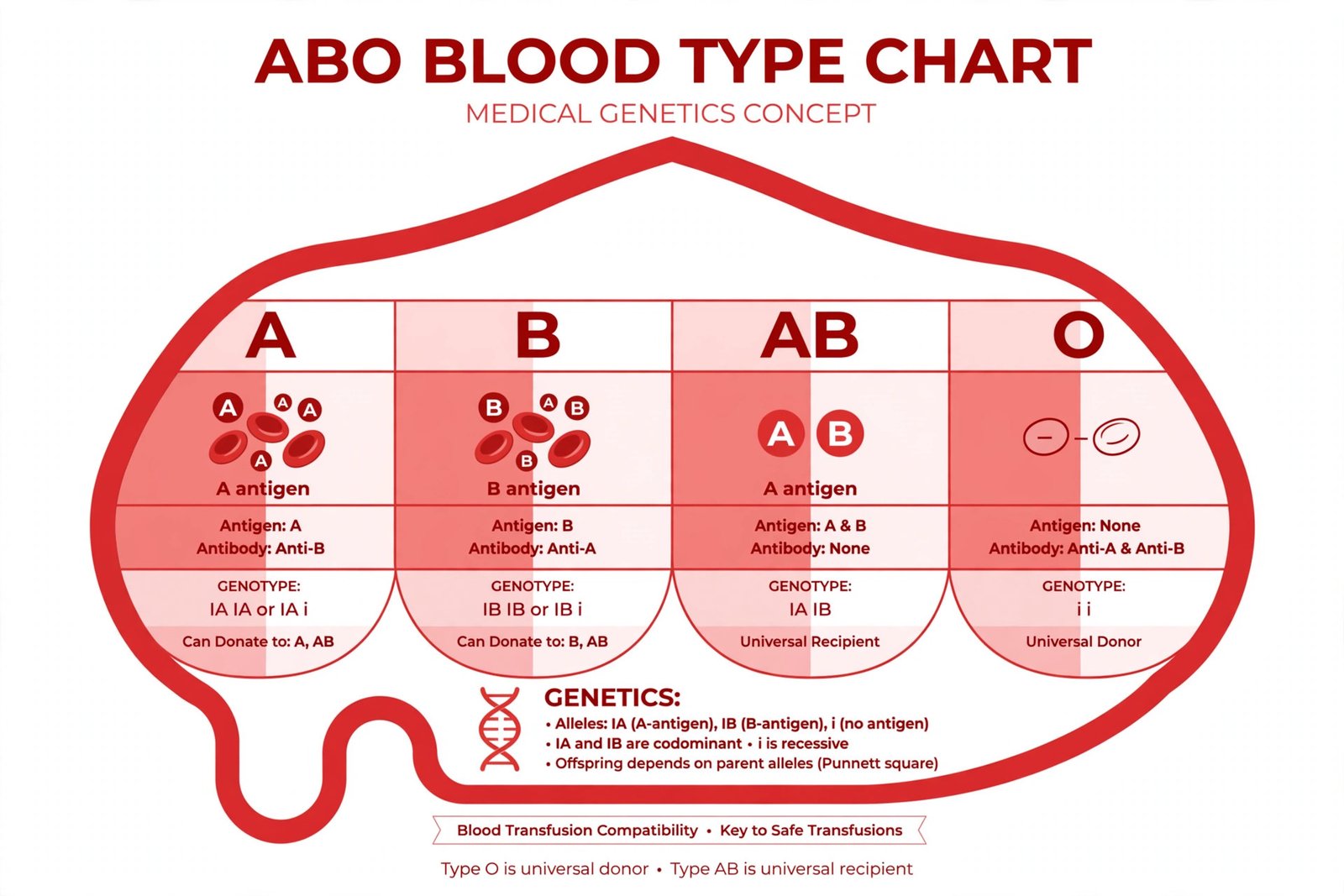
What distinguishes them are antigens — structures on the surface of red blood cells. Type A blood carries the A antigen, type B carries the B antigen, type AB carries both, and type O carries neither. Your immune system also produces antibodies against the ABO antigens you lack: type A blood has anti-B antibodies, type B has anti-A antibodies, type O has both, and type AB has neither. This is why blood must be matched before transfusion: mismatched blood triggers an immune attack on the donor cells. In most Western populations, O positive is the most common type (roughly 35–40 percent of people) and AB negative the rarest (under 1 percent).
The Rh Factor Explained
The "+" or "-" attached to a blood type refers to the Rh factor, named after the Rhesus monkeys in whose blood a related antigen was first studied. The key antigen is called the D antigen. If your red blood cells carry it, you are Rh positive (written +); if they do not, you are Rh negative (written -).
Rh status matters most in two situations. The first is transfusion: Rh-negative recipients should receive Rh-negative blood to avoid forming anti-D antibodies. The second is pregnancy. If an Rh-negative mother carries an Rh-positive baby, the mother's immune system can develop antibodies against the baby's blood — a condition called Rh incompatibility. This is routinely prevented with an injection (anti-D immunoglobulin), which is why expectant mothers get their blood type tested early. A blood type calculator cannot assess pregnancy risk — only a doctor and a lab test can.
How Blood Type Inheritance Works
Each person inherits two copies of every gene — one from each parent. For blood type, two separate genes matter: the ABO gene and the Rh (RHD) gene.
Alleles: the gene variants behind ABO
The ABO gene comes in three variants, called alleles: IA, IB, and i. Each person carries two of them, and the combination — the genotype — determines the visible blood type:
- O means ii; A means IAIA or IAi;
- B means IBIB or IBi; AB means IAIB.
The IA and IB alleles are dominant over i, and they are co-dominant with each other — when both are present, both antigens appear, producing type AB. This is why a blood type alone does not reveal the full genotype: a type A parent could be IAIA or IAi.
Dominant and recessive: the Rh gene
Rh inheritance is simpler. The D allele (Rh positive) is dominant; the d allele (Rh negative) is recessive. Rh-positive people can be DD or Dd, while Rh-negative people are always dd. A child receives one allele from each parent: if either allele is D, the child is Rh positive; only a dd combination produces an Rh-negative child.
The Punnett square method
Geneticists map these combinations with a Punnett square: one parent's possible alleles along one axis, the other's along the other axis, each cell showing the child's resulting genotype. Our calculator automates this. Because one blood type can hide several genotypes (type A can be IAIA or IAi), it runs the Punnett square for every possible parental genotype combination and merges the results into one complete list of possible child blood types.
How to Use the Blood Type Calculator
- Select Parent 1's blood type from the eight options (O+, O-, A+, A-, B+, B-, AB+, AB-).
- Select Parent 2's blood type the same way, making sure the Rh sign is correct.
- Click "Predict Child Blood Type." The calculator runs the ABO and Rh inheritance logic and lists every possible child blood type, for example "A+, A-, O+, O-".
- Read the note. The result is a list of possibilities — the child will have exactly one of them. The calculator cannot say which one or with what odds, because the parents' hidden genotypes are unknown.
Tip: if you only know one parent's type, try all eight options for the unknown parent to see the full range of possibilities.
Worked Examples
Example 1: A+ father and O- mother
The father's ABO genotype could be IAIA or IAi; the mother is ii. Every child receives an i from the mother and either IA or i from the father, so the children can be type A or type O. For Rh, the mother is dd and the father is DD or Dd, so each child gets a d from the mother and D or d from the father — Rh positive or Rh negative are both possible. Possible child blood types: A+, A-, O+, O-.
Example 2: AB+ father and O+ mother
The father is IAIB and always passes either IA or IB; the O mother always passes i. The children can therefore be type A or type B — never O, never AB. Both parents are Rh positive, but either could carry a hidden d allele, so a small chance of an Rh-negative child remains. Possible child blood types: A+, A-, B+, B-.
Example 3: Two O- parents
Both parents are ii and dd, so every allele they can pass is i and d. Their biological child can only be O-. This answers one of the most-asked questions: no, two type O parents cannot have a non-O child (barring extremely rare mutations).
Parent Blood Type Chart: Common Combinations
The table below summarizes the possible child blood types for common parental pairings. Use it as a quick reference, or enter the pair into the calculator above for the full Rh breakdown.
| Parent 1 | Parent 2 | Possible child ABO types | Possible child Rh |
|---|---|---|---|
| O | O | O | + or - (depends on parents' Rh) |
| O | A | O, A | + or - |
| O | B | O, B | + or - |
| O | AB | A, B | + or - |
| A | A | O, A | + or - |
| A | B | O, A, B, AB | + or - |
| A | AB | A, B, AB | + or - |
| B | B | O, B | + or - |
| B | AB | A, B, AB | + or - |
| AB | AB | A, B, AB | + or - |
Note on Rh: if both parents are Rh negative (-), the child must be Rh negative. If at least one parent is Rh positive (+), both + and - remain possible unless laboratory genotype testing proves otherwise.
Why Predictions Are Possibilities, Not Certainties
A child blood type predictor lists every outcome the genetics allow, but it cannot tell you which one will happen or how likely each is. The reason is the hidden genotype problem: a type A parent might be IAIA (every child gets an IA allele) or IAi (each child has a 50 percent chance of getting i instead). A blood type alone cannot distinguish the two — only extended family patterns or DNA testing can narrow it down. Rare exceptions such as the Bombay phenotype or new mutations can also produce results that look impossible on a standard chart.
Real-World Uses of a Blood Type Calculator
Beyond curiosity, people reach for a blood type calculator in several practical situations. Expectant parents often want to know what to expect before the baby's first blood test. Students use it to check their genetics homework. Families sometimes explore whether a surprising blood type "runs in the family" — and occasionally to ask paternity questions.
That last use deserves a clear warning: a blood type calculator cannot prove or disprove paternity. Blood types can only rule out impossible combinations in narrow cases (for instance, two O parents cannot have an AB child). Real paternity questions require a proper DNA paternity test from an accredited laboratory. The calculator also cannot be used to plan a transfusion or make any medical decision — hospitals always type and crossmatch blood directly.
Blood Donation and Transfusion Compatibility
Blood type inheritance is only half of the picture — blood types also determine who can donate to whom. Red blood cells carry antigens, and a recipient's immune system attacks unfamiliar ones, so a transfusion must match donor antigens to recipient antibodies:
| Donor blood type | Can donate red cells to | Can receive red cells from |
|---|---|---|
| O− | O−, O+, A−, A+, B−, B+, AB−, AB+ | O− |
| O+ | O+, A+, B+, AB+ | O−, O+ |
| A− | A−, A+, AB−, AB+ | O−, A− |
| A+ | A+, AB+ | O−, O+, A−, A+ |
| B− | B−, B+, AB−, AB+ | O−, B− |
| B+ | B+, AB+ | O−, O+, B−, B+ |
| AB− | AB−, AB+ | O−, A−, B−, AB− |
| AB+ | AB+ | Everyone (all 8 types) |
O− is the universal red-cell donor because its cells carry no A, B, or D antigens, so they can be given to anyone in an emergency. AB+ is the universal red-cell recipient because its plasma contains no anti-A, anti-B, or anti-D antibodies, so it accepts all types. In planned transfusions, hospitals still prefer an exact match; the chart matters most in emergencies. Actual donation eligibility also depends on factors like hemoglobin levels, health history, and local rules.
Limitations and Medical Disclaimer
This tool is strictly educational. It models the standard ABO and Rh inheritance rules and assumes the entered blood types are correct. It does not account for the dozens of other blood group systems (Kell, Duffy, Kidd, and others) that matter in specialized transfusion medicine, and it cannot detect rare variants such as the Bombay phenotype.
Medical disclaimer: nothing on this page or produced by the calculator is medical advice. Do not use it to make decisions about transfusions, pregnancy care, or family relationships. Only a laboratory blood test ordered by a qualified healthcare professional can determine anyone's actual blood type. If you have questions about your blood type, Rh status during pregnancy, or compatibility for donation, speak with your doctor or a licensed medical provider.
Frequently Asked Questions
How accurate is a blood type calculator?
For listing genetically possible child blood types, it is fully accurate — it applies the standard ABO and Rh inheritance rules. Its limit is that it lists possibilities, not the single correct answer: it cannot tell you which of the possible types your child will actually have, or the odds of each, because the parents' hidden genotypes are unknown.
Can two O blood type parents have a non-O child?
No. Two type O parents both have the genotype ii, so every allele they can pass to a child is i. Their biological child must be type O. The Rh factor can still vary: two O positive parents, for example, can have an O negative child if both carry a hidden d allele.
What is the rarest blood type?
AB negative is the rarest of the eight main blood types, found in under 1 percent of most populations. AB positive is also uncommon. O positive is the most common type in most populations, at roughly 35 to 40 percent.
Can a blood type calculator replace a blood test or be used for paternity testing?
No. Only a laboratory blood test ordered by a qualified professional can confirm anyone's actual blood type. For paternity questions, blood types can only rule out a few impossible combinations — a proper DNA paternity test from an accredited laboratory is required. The calculator is an educational tool, not medical evidence.
How is the Rh factor inherited?
The Rh positive allele (D) is dominant and the Rh negative allele (d) is recessive. Rh negative people are always dd, while Rh positive people can be DD or Dd. A child who receives D from either parent is Rh positive; only a child who receives d from both parents is Rh negative. Two Rh negative parents will always have Rh negative children.
How does this blood type calculator work?
It uses the Punnett square method from genetics. For each parent's blood type it considers every compatible genotype (for example, type A can be IAIA or IAi), combines one allele from each parent in every possible way, and converts the results into blood types. It does this for both the ABO gene and the Rh gene, then lists every possible child blood type.
What is a universal blood donor?
People with O− (O negative) blood are called universal red-cell donors: their red blood cells carry no A, B, or D antigens, so they can be transfused to patients of any ABO and Rh type. Conversely, AB+ people are universal red-cell recipients. Hospitals still prefer exact matches whenever time allows.
Why does the Rh factor matter during pregnancy?
If an Rh-negative mother carries an Rh-positive baby, her immune system can become sensitized to the Rh (D) antigen, usually during delivery. In a later pregnancy with an Rh-positive baby, her antibodies can cross the placenta and attack the baby's red blood cells — a condition called hemolytic disease of the fetus and newborn (HDFN). It is preventable with Rh immunoglobulin treatment during pregnancy and after birth. If this situation applies to you, discuss testing and timing with your obstetrician; this tool cannot replace medical advice.